
Earthing and Lightning Protection for Rooftop Solar: What Has to Be in Place?
Published by Quinn Lai | By InverPower Technical Team
Published 22 August 2026 · Last updated 22 August 2026
DIRECT ANSWER
Three separate requirements apply. Every exposed metal part of the array is bonded together and connected to the installation's earth; the building's lightning protection system, where one exists, has to take the array into account; and surge protection devices are fitted on the DC and AC sides of the inverter. Malaysia's storm frequency makes the third one routine rather than optional.
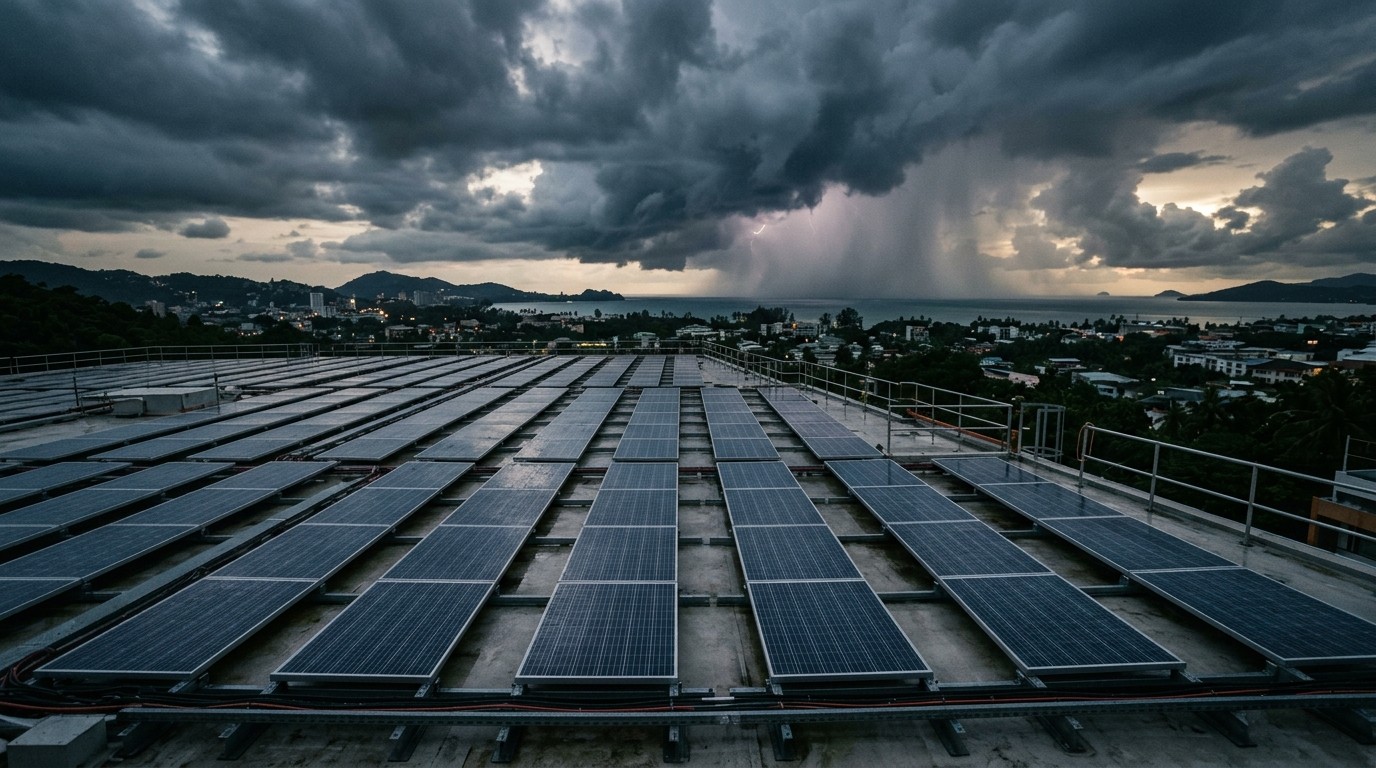
Malaysia sits in one of the most lightning-active regions on earth, with thunderstorm activity on the majority of days in the year. A rooftop array raises metal above a building for twenty-five years in that climate. The protection question is therefore not whether it is worth doing, but which of three related jobs each part of the design is actually doing.
Earthing, bonding and lightning protection are not the same thing
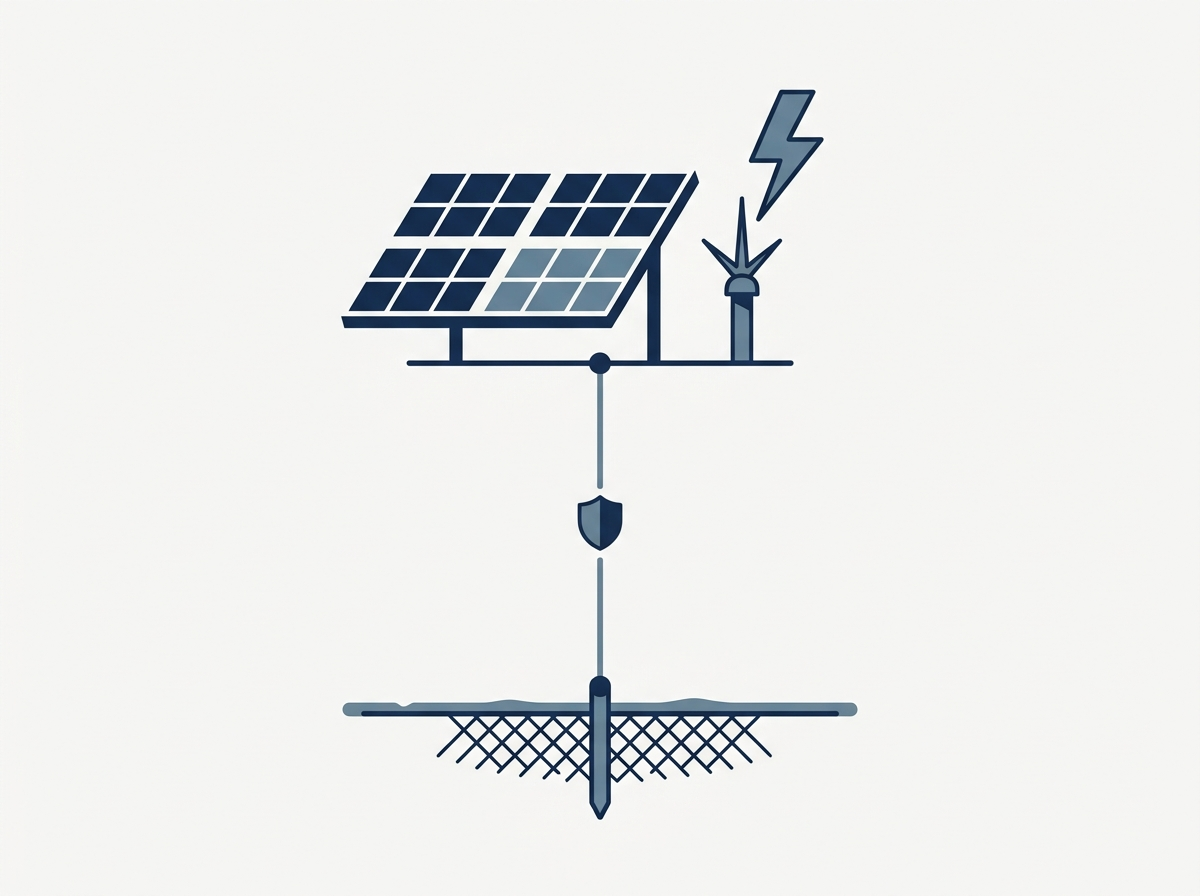
Earthing connects the installation to the general mass of earth, giving fault current a defined path and the system a voltage reference. Bonding connects exposed metal parts to one another so they sit at the same potential, which is what stops a difference in voltage appearing across two things a person can touch at once. Lightning protection is a separate system — air terminations, down conductors and an earth termination — designed to intercept a strike and take it to ground away from the building's contents.
They interact, which is why they get confused. A well-bonded array is safer in a strike, but bonding is not lightning protection. A lightning protection system does not remove the need to bond module frames. And neither of them protects the inverter's electronics from the surge that travels in on the cabling, which is the job of surge protection devices.
Bonding the array properly
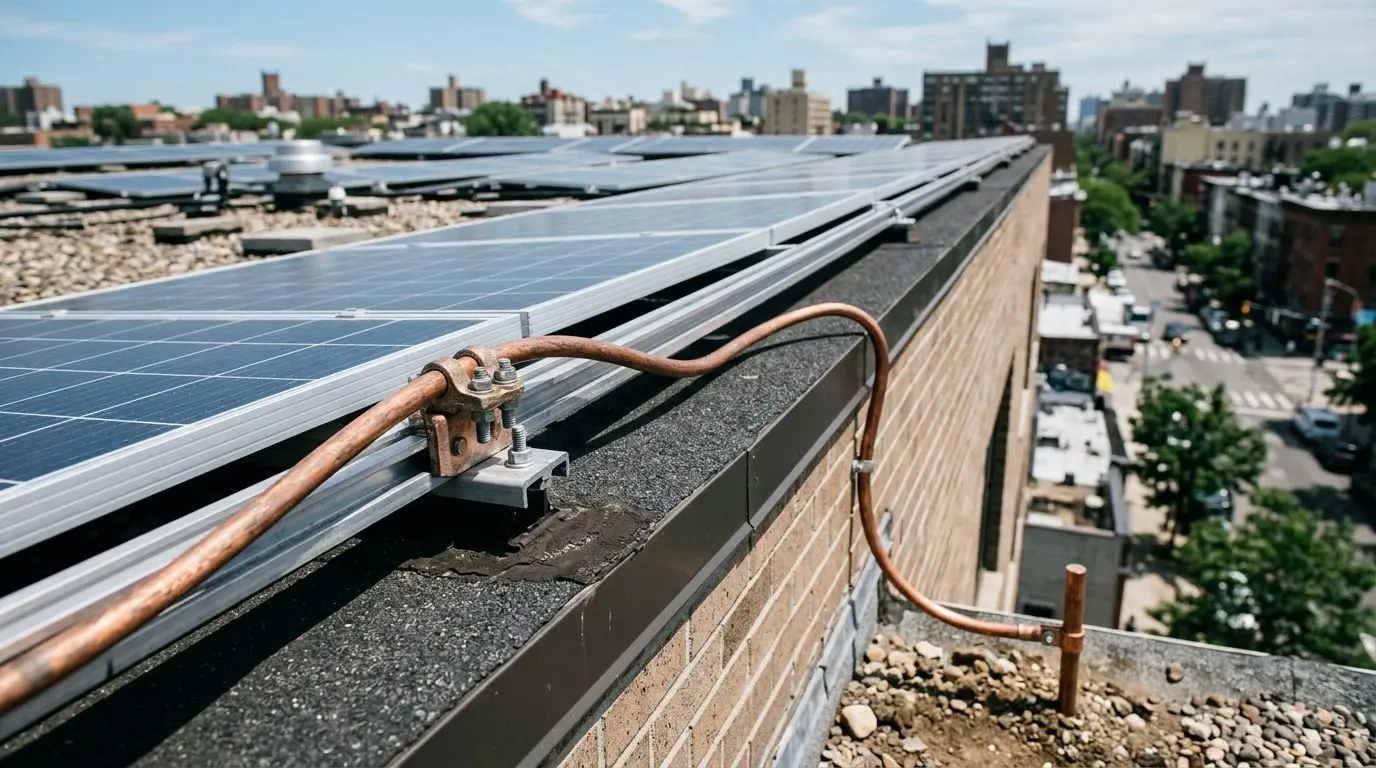
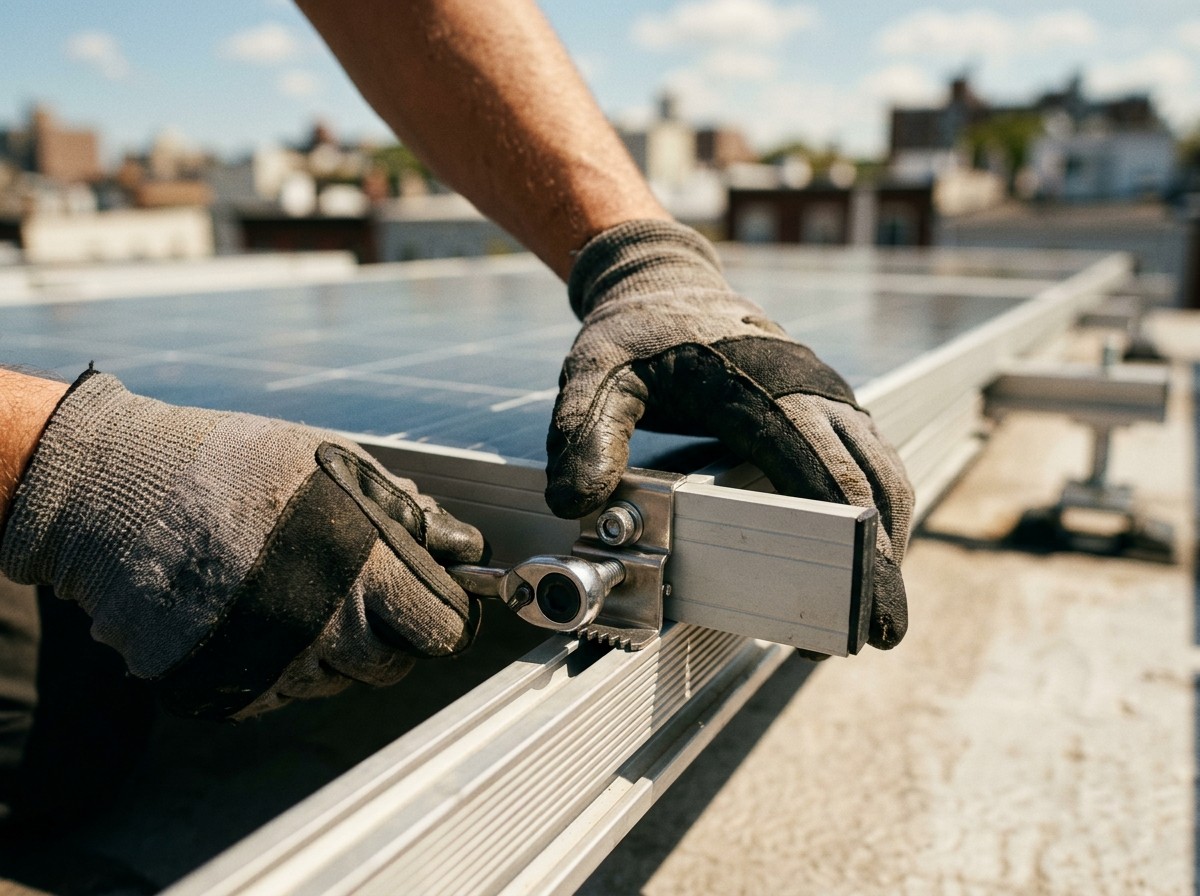
Every rail, frame and metal enclosure in the array needs a continuous, low-resistance path back to the main earthing terminal. The obstacle is that aluminium rails and module frames are anodised, and anodising is an insulator. Continuity that appears to exist because two aluminium parts are bolted together often does not, which is why listed bonding components — clips, star washers, lugs designed for the job — are specified rather than assumed.
The second obstacle is corrosion. Copper against aluminium in a humid coastal atmosphere corrodes at the joint until the connection it was making is gone, so bimetallic joints need the right transition hardware and the right fixings. And a bonding conductor should not depend on a single clamp for the whole array: if one connection is disturbed during maintenance, the rest of the array should still be bonded.
Surge protection is the part that gets left out
Most lightning damage to a solar system is not a direct strike. It is the surge induced in the DC cabling by a strike nearby, arriving at the inverter as a voltage transient measured in kilovolts. Surge protection devices are fitted to divert it: on the DC side close to the inverter input, on the AC side at the connection point, and selected by type according to whether the building has a lightning protection system and whether the array sits inside its protected zone.
Two installation details decide whether they work. The connecting leads have to be short, because the length of the lead adds voltage that the protected equipment still sees. And the device has to be replaceable and visibly monitored — most carry a status indicator, and a device that has already absorbed a surge is doing nothing until it is changed. On a Malaysian site that means the indicator goes on the maintenance checklist, not just on the commissioning sheet.
The checks before sign-off
| Item | What good looks like | Common failure |
|---|---|---|
| Bonding continuity | Measured and recorded rail to earth terminal | Assumed through bolted anodised joints |
| Bonding components | Listed clips, washers and lugs for the material | General-purpose hardware biting through coating |
| Bimetallic joints | Correct transition hardware and fixings | Copper direct to aluminium in coastal air |
| Earth electrode | Resistance measured and recorded | Never measured after installation |
| Lightning protection interface | Array inside the protected zone or separated as designed | Array added later, system never reassessed |
| DC surge protection | Fitted at the inverter with short leads | Omitted, or long looping leads |
| AC surge protection | Fitted at the connection point | Assumed to be the building's problem |
| Records | Test results and device types in the handover pack | Verbal assurance only |
Retrofitting onto a protected building
Most rooftop arrays in Malaysia go onto buildings that already have a lightning protection system, and that system was designed before the array existed. Adding metal above the roof changes the geometry the design was based on. The array either sits within the zone the existing air terminations protect, in which case the interaction has to be checked and bonded or separated as the standard requires, or it does not, in which case the protection design needs revisiting.
This is a design decision, not an installation one, and it belongs in the proposal rather than in a conversation on the roof. It is also the point where a competent EPCC visibly differs from a cheap one, because it is the part a customer cannot see and will only learn about after a storm.
Specifying the parts
Bonding hardware, earth conductors, surge protection and the enclosures they sit in are all part of the bill of materials, and they are all cheaper than the call-out that follows a missed one. InverPower supplies protection components, mounting systems and inverters together, held in Malaysia — send the array layout and the building's existing protection arrangement, and we will tell you what the bill of materials is missing.
Frequently Asked Questions
Does a rooftop array need its own lightning rod?
Not automatically. Whether air terminations are needed, and where, follows from a risk assessment under the lightning protection standard and from what the building already has. What is not optional is bonding the array and fitting surge protection, both of which apply whether or not air terminations are installed.
What surge protection device type is used on a solar system?
It depends on the exposure. Where the building has a lightning protection system and the array may carry part of a strike current, a device rated for that duty is required; where the risk is induced surges only, a lower-duty device is appropriate. Select against IEC 61643-32 and the site's arrangement rather than fitting a default part.
Is bonding really necessary if the frames are bolted together?
Yes. Module frames and rails are anodised, and anodising does not conduct reliably. A bolted joint may measure as continuous on the day and fail after a year of thermal cycling and corrosion, which is why listed bonding components and a measured continuity test are the standard, not a visual check.
How often should surge protection devices be checked?
At every scheduled maintenance visit, and after any nearby strike. Most devices carry a status window that shows when a module has been used up. A device that has done its job once and has not been replaced leaves the inverter unprotected while looking installed.
Sources
- IEC — IEC 62305 series, Protection against lightning, including risk management and physical damage to structures — https://webstore.iec.ch
- IEC — IEC 61643-31 and IEC 61643-32, Surge protective devices for photovoltaic installations: requirements and selection — https://webstore.iec.ch
- IEC — IEC 62548, Photovoltaic (PV) arrays: design requirements, including earthing and bonding — https://webstore.iec.ch
- Department of Standards Malaysia — MS 1837:2018, Installation of grid-connected photovoltaic (PV) system — https://www.jsm.gov.my
- Malaysian Meteorological Department — thunderstorm frequency and climate data for Malaysia — https://www.met.gov.my
About InverPower
InverPower is Malaysia's A–Z solar component distributor — Sungrow Preferred Distributor and Sunkean Sole Distributor — supplying EPCCs, installers, and government projects nationwide.
Explore the InverPower resource hub at inverpower.com.my
Related InverPower posts:
- DC Isolators and Disconnect Switches: What Does Malaysian Code Require?
- TNB Grid Code for Solar: What Must EPCCs Do Before Energization?
- Cable Fire Ratings Decoded: Why Isn't 'Eca' the Standard to Specify?