
TNB Grid Code for Solar: What EPCCs Must Comply With Before Energization?
Published by Quinn Lai | By InverPower Technical Team
Published · Last updated
DIRECT ANSWER
Before TNB will energize a grid-connected or NEM solar system in Malaysia, an EPCC must clear a defined set of technical gates. The design and single-line diagram (SLD) must be prepared and endorsed by a competent person — and, for systems above 72kW, by a Professional Engineer (Electrical) registered with the Board of Engineers Malaysia (BEM). The inverter must meet the grid-interface rules in the TNB Technical Guidebook: anti-islanding that ceases to energize the grid within 2 seconds and only reconnects after voltage and frequency are stable for about 5 minutes, voltage and frequency trip windows, and total harmonic current distortion below 5%. Metering must be to TNB specification and procured from TNB, protection settings must be declared, and the system must pass a testing-and-commissioning process witnessed and accepted by TNB before the NEM contract commences and the system goes live.
Who signs off the design — and when do you need a PE?
Every grid-connected system’s design and single-line diagram must be endorsed by a competent person. The threshold that changes the game is 72kW. At or below 72kW, a registered competent person can certify the work and no distribution-licensee study is required. Above 72kW, two things kick in: a TNB technical assessment (NEMAS) becomes mandatory, and the design and SLD must be endorsed by a Professional Engineer (Electrical) registered with BEM. The installing firm must also be a SEDA Registered PV Service Provider. Getting the right signature on the SLD is the first gate — an SLD endorsed by the wrong person is a common reason a submission bounces.
What are the core technical requirements the system must meet?
These come from the TNB Technical Guidebook on Grid-interconnection of PV and the SEDA NEM guidelines. The essentials an EPCC designs to are summarised below.
| Requirement | What TNB expects |
|---|---|
| Anti-islanding | Cease energizing the grid at the connection point within 2 seconds of an island; no reconnection until voltage & frequency are stable for ~5 minutes |
| Voltage protection | Operate within the nominal band (LV ~85–110%); trip outside it within the specified times (per IEC 61727) |
| Frequency protection | Trip when frequency drifts outside the allowed window around 50 Hz within the specified time |
| Power quality | Total harmonic current distortion < 5% at rated output; power factor > 0.9 |
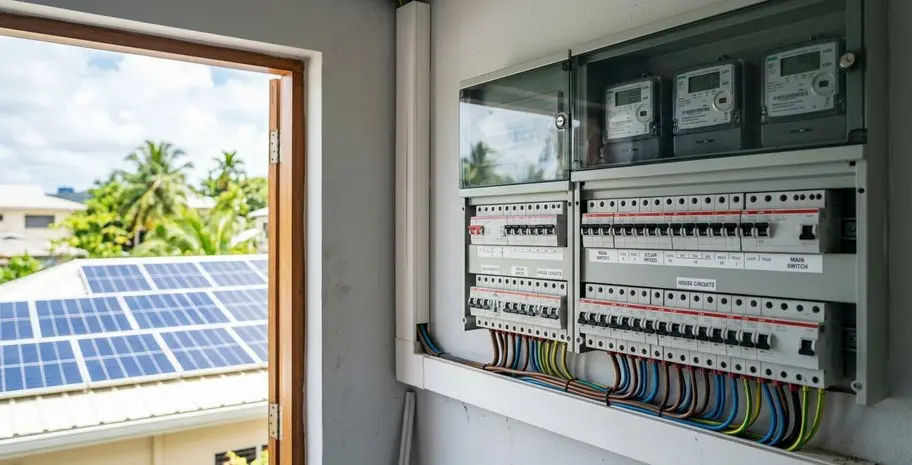
| Metering | Bi-directional / export meter to TNB specification, procured from TNB and installed by TNB |
| Protection settings | Developer declares the protection scheme & settings; larger/MV connections add relays (e.g. reverse power) |
| Earthing | Equipment earthing to MS IEC 60364 / 60364-7-712 |
What’s the sequence from application to energization?
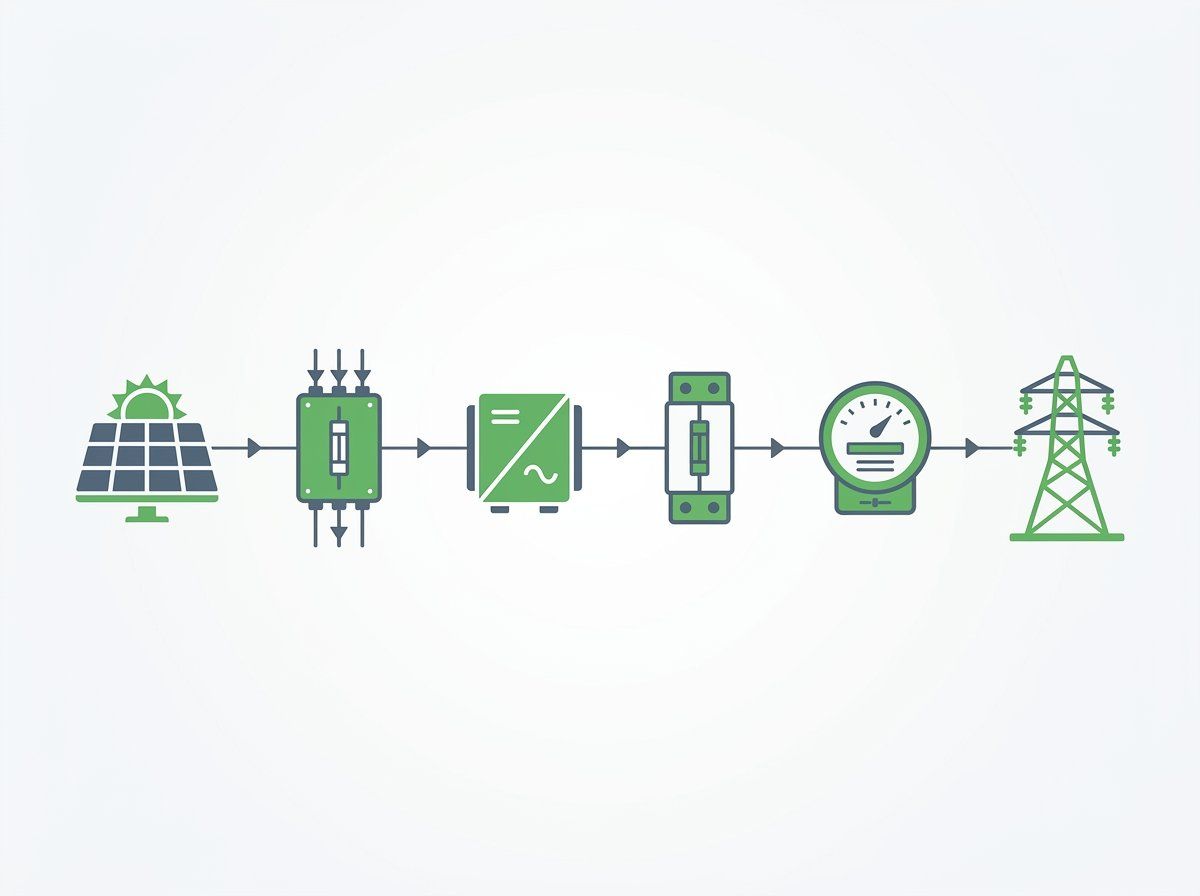
Knowing the order avoids costly rework. For a NEM project it runs roughly like this: appoint a Registered PV Service Provider and prepare the PE-endorsed design and SLD; for systems above 72kW, complete the TNB technical assessment (NEMAS); submit the NEM application through SEDA’s eNEM portal; on quota approval, begin installation within three months or the approval is cancelled; finish the installation; apply for the meter change so TNB installs the bi-directional meter; complete testing and commissioning, certified by the competent person and witnessed by TNB; sign the NEM contract; and energize once TNB accepts the testing-and-commissioning report. The NEM contract is deemed to commence on that acceptance — which is the moment the system legally goes live.
Where do requirements step up with system size?
Beyond the 72kW line (which triggers the NEMAS study and PE endorsement), larger systems bring more obligations: additional protection relays and export-limiting where the connection requires it, low-voltage penetration limits per feeder that may push a project onto a power-systems study, and at the largest scale, SCADA/RTU monitoring. A generating licence from the Energy Commission (Suruhanjaya Tenaga) is also required above the relevant single- and three-phase thresholds. The practical takeaway for an EPCC: identify which size band a project falls into early, because it determines who must sign, what studies are needed, and how long approval takes.
Why do energizations get delayed or rejected?
- Incomplete submission — TNB and SEDA only process complete applications and can reject incomplete ones outright.
- SLD not approved or wrongly endorsed — missing the PE endorsement for systems above 72kW.
- Non-compliant protection settings — declared anti-islanding, voltage/frequency or reverse-power settings not meeting the guidebook.
- Equipment not accepted — meters not from TNB, or inverters that can’t demonstrate the required certifications.
- Failed witness test — anti-islanding or power-quality results out of limits, or results from uncalibrated test equipment.
- Lapsed timelines — installation not started within three months of approval, or an expired technical-assessment validity.
The bottom line for EPCCs
Energization is won or lost on paperwork and settings as much as on hardware. Get the PE-endorsed SLD right, declare compliant protection settings, use TNB-specified metering, and book a clean, calibrated, witnessed commissioning test — and the connection goes live on schedule. Compliant equipment that can prove its certifications, sourced from an accountable supplier, is what keeps the technical assessment moving rather than stalling.
InverPower supplies EPCCs with genuine, certification-backed inverters, protection and cabling — the compliant equipment that clears TNB’s technical assessment without surprises.
Frequently Asked Questions
Do I need a Professional Engineer to sign off my solar design?
For systems above 72kW, yes — the design and SLD must be endorsed by a BEM-registered Professional Engineer (Electrical). At or below 72kW, a registered competent person can certify the work.
When is a TNB technical study (NEMAS) required?
For systems above 72kW. At or below 72kW there is no distribution-licensee study requirement; above it, the NEMAS assessment is mandatory before energization.
What anti-islanding behaviour must my inverter have?
It must cease energizing the grid at the connection point within 2 seconds of an island forming, and must not reconnect until grid voltage and frequency have been stable for about 5 minutes.
Can I buy and install my own NEM meter?
No — the export/bi-directional meter must follow TNB specifications and be procured from TNB, which installs it as part of the meter-change step.
What are the most common reasons energization is delayed?
Incomplete applications, an SLD without the correct PE endorsement, non-compliant protection settings, equipment TNB won’t accept, a failed or uncalibrated witness test, or missing the three-month installation window after approval.
Sources
- TNB Technical Guidebook on Grid-interconnection of PV (SEDA) — https://www.seda.gov.my/pdfdownload/tnb-technical-guidebook-on-grid-interconnection-of-photovoltaic-power-generation/
- SEDA — NEM 3.0 portal — https://www.seda.gov.my/reportal/nem/
- SEDA — Guideline for Solar PV under NEM Rakyat & GoMEn (2024) — https://www.seda.gov.my/reportal/wp-content/uploads/2024/12/NEM-2024_Rakyat_2211.pdf
- TNB — Technical Guideline for Interconnection of Distributed Generator (2018) — https://www.mytnb.com.my/-/media/Project/TNB/myTNBportal/Documents/Guides-and-Booklets/Technical-Guideline-for-Interconnection-of-Distributed-Generator-to-Distribution-System-2018.pdf
- Board of Engineers Malaysia (BEM) — https://www.bem.org.my/
- Suruhanjaya Tenaga (Energy Commission) — Solar PV installation guidelines — https://www.st.gov.my/
About InverPower
InverPower is Malaysia's A–Z solar component distributor — Sungrow Preferred Distributor and Sunkean Sole Distributor — supplying EPCCs, installers, and government projects nationwide.
Explore the InverPower resource hub at inverpower.com.my
Related InverPower posts:
- Which Solar Inverters Are SEDA-Registered in Malaysia (2026)?
- Where to Source Solar PV Components in Malaysia: An EPCC's Supply Checklist
- Solar DC Cables in Malaysia: What Specs and Certs Do EPCCs Need?