
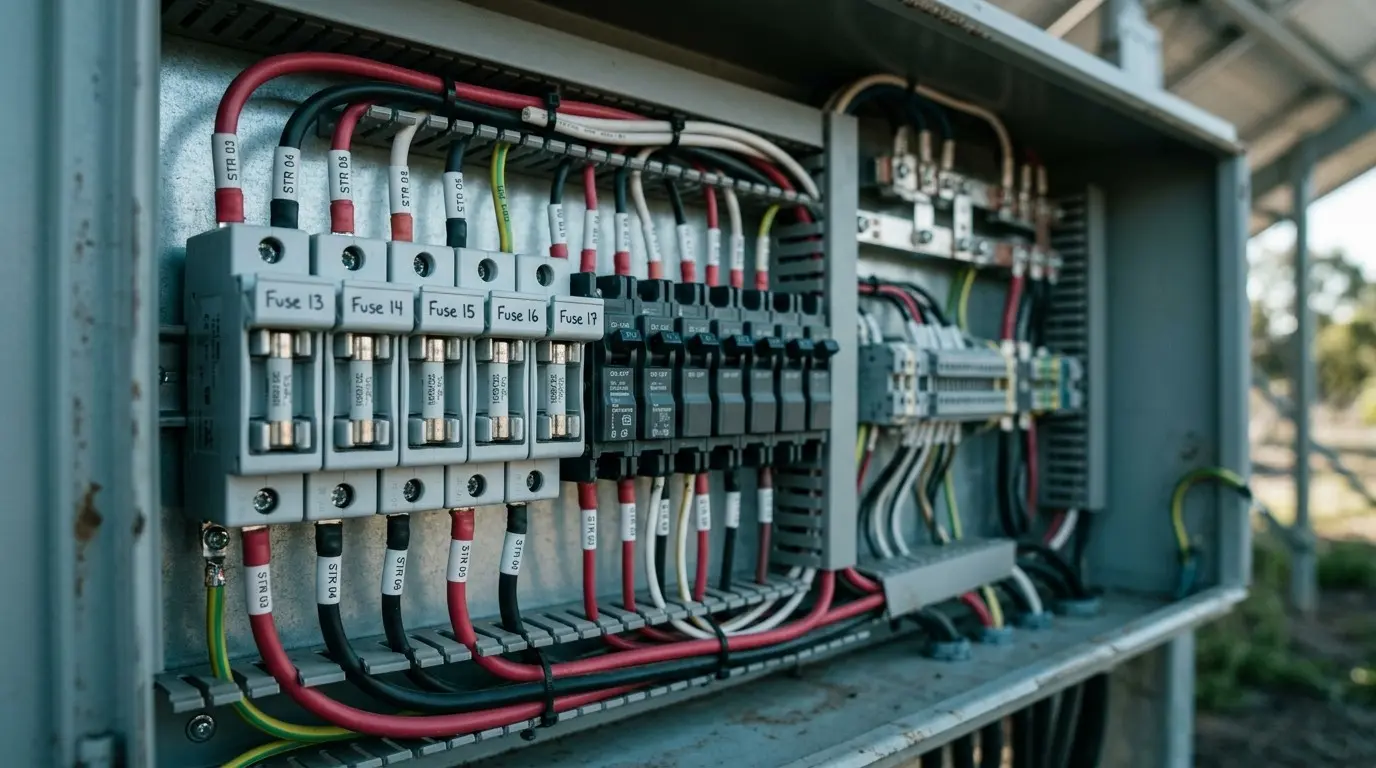
Solar Fuse and DC Breaker Ratings: How Do You Size Them Correctly?
Published by Quinn Lai | By InverPower Technical Team
Published 22 August 2026 · Last updated 22 August 2026
DIRECT ANSWER
String protection is sized from the module's short-circuit current and capped by the module's maximum series fuse rating, using devices rated for direct current at the array's full voltage. An AC-rated part is not a substitute at any rating, and the current rating has to be derated for the temperature inside the enclosure it sits in.
Protection on the DC side is a short calculation with a long tail of consequences. Get it wrong upwards and a fault current runs where it should have been cleared; get it wrong downwards and the system nuisance-trips on a bright afternoon. Both come back to the same three inputs on the module datasheet.
An AC-rated part is not a substitute
The physics is the same argument as for isolators. Alternating current passes through zero a hundred times a second and an arc has a natural moment to extinguish. Direct current does not, so a device interrupting it has to stretch and cool the arc entirely by its own construction — longer arc chambers, different filler, different contact geometry. That is why a photovoltaic fuse is a specific product to IEC 60269-6, not a general-purpose fuse used on a DC circuit.
A DC device also has a polarity and a voltage rating that depends on how it is installed: many DC breakers achieve their full rating only with poles connected in series in the pattern shown in the manufacturer's literature. Fitting one pole and assuming the printed voltage still applies is a common and invisible error.
Sizing from short-circuit current
Two numbers on the module datasheet bracket the answer. The fuse has to carry more than the string will ever deliver in normal operation, so its rating starts above the module's short-circuit current with the margin the standard applies. And it must not exceed the module's maximum series fuse rating, which is the manufacturer's statement of how much reverse current the module can survive. Between those two figures, take the standard rating that sits closest to the lower bound.
The voltage rating is separate and absolute. It has to cover the array's maximum voltage — open-circuit voltage at the lowest ambient the site will see — and it is not a place for interpolation. A fuse rated below the array voltage may clear the current and then continue to arc across its own body.
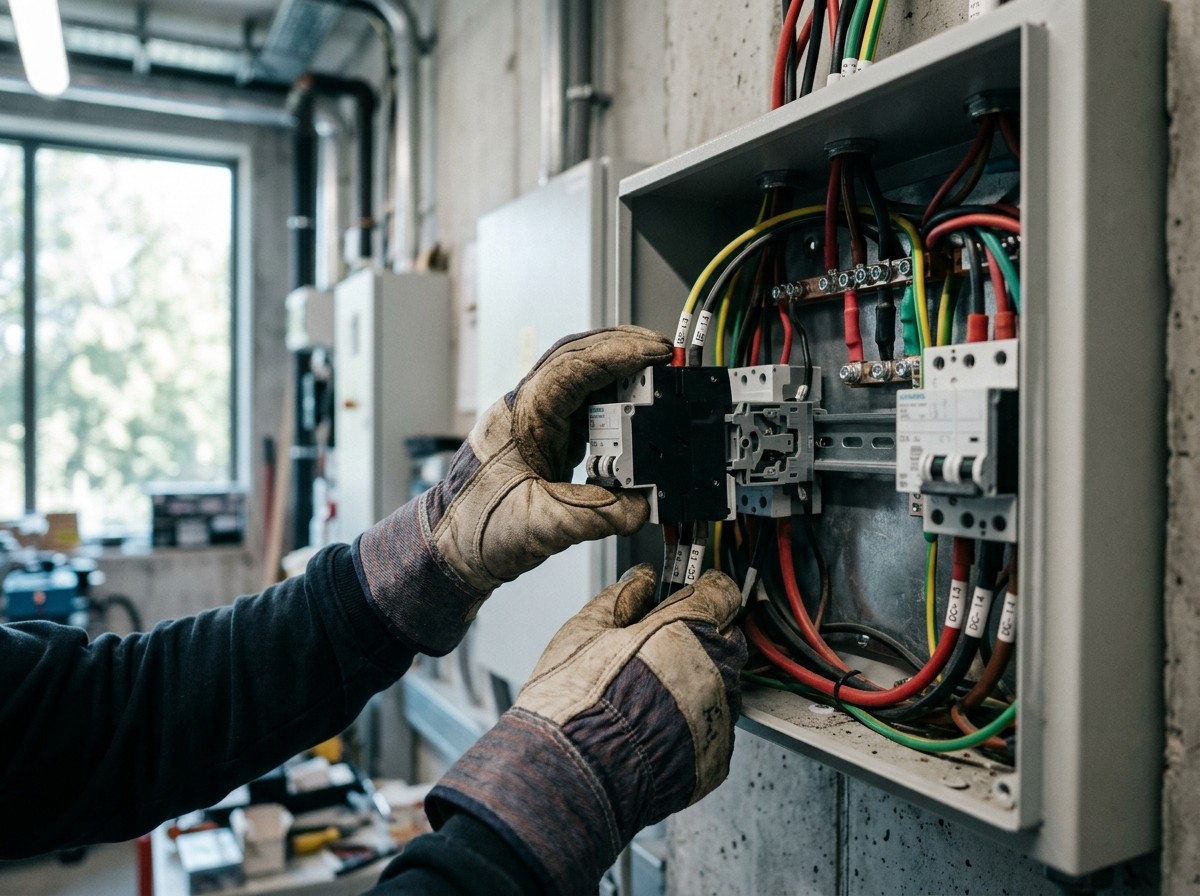
The point at which strings need fusing
A string does not need a fuse because it is a string; it needs one when the rest of the array can push more current back into it than it can withstand. With one or two strings in parallel there is no other string to supply that current in any meaningful quantity, and fusing is generally unnecessary. Add a third and the fault current available to any one string rises with the number of parallel strings, which is the point at which the module's reverse current rating comes into play.
Where fusing is required, it goes in both polarities on an array with no earthed conductor, because a single fault can otherwise leave part of the circuit live through the remaining pole. The combiner also has to be arranged so a fuse can be changed with the circuit isolated — which is the practical reason the DC isolator and the combiner tend to live next to each other.
The numbers to work from
| Input | Where it comes from | What it sets |
|---|---|---|
| Short-circuit current | Module datasheet, standard test conditions | Lower bound on fuse rating |
| Maximum series fuse rating | Module datasheet | Upper bound on fuse rating |
| Open-circuit voltage at lowest ambient | Module datasheet and site conditions | Device voltage rating |
| Number of parallel strings | Array design | Whether string fusing is required at all |
| Enclosure temperature | Position, ventilation, sun exposure | Derating applied to the current rating |
| Conductor rating | Cable specification | Whether the fuse protects the cable it sits on |
| Device standard | IEC 60269-6 for PV fuses, DC-rated breakers | Whether the part is fit for DC at all |
Derating inside a hot enclosure
This is the step most often skipped, and Malaysia is where it bites. A fuse's current rating is stated at a reference temperature, and manufacturers publish a derating curve for the temperature inside the enclosure. A combiner box on an unshaded roof here runs far above ambient by mid-morning, and a bank of fuse holders in a sealed enclosure adds its own heat on top of that.
The result is a fuse that opens at a current well below its printed rating — read as nuisance tripping by whoever is called out, and usually replaced with a larger fuse rather than a cooler enclosure. Apply the derating curve at design stage, ventilate or shade the enclosure, and keep the fuse rating inside the module's limit. Where the arithmetic leaves no room, the answer is a different enclosure position, not a bigger fuse.
Specifying the parts
Take the module datasheet, the string layout and the intended enclosure position, and size in that order: voltage rating from the array, current rating from short-circuit current inside the module's limit, then derate for temperature. Record what was fitted on the single-line so the next person to open the combiner replaces like with like. InverPower supplies DC protection, combiner components, connectors and cable alongside the inverters, held in Malaysia — send the string design and we will tell you what is on the shelf.
Frequently Asked Questions
Can an AC breaker be used on a DC solar circuit?
No. A device rated only for alternating current has no verified ability to interrupt direct current, where the arc does not self-extinguish. Some devices carry both ratings, and in that case only the DC rating and the manufacturer's pole-connection instructions apply to a PV circuit.
How is the fuse rating worked out from short-circuit current?
The rating sits above the module's short-circuit current with the margin the standard applies, and no higher than the maximum series fuse rating printed on the module datasheet. Choose the standard rating closest to the lower bound, then check it still holds after temperature derating.
Do two-string arrays need string fuses?
Generally not. With only two strings in parallel, there is not enough current available from the healthy string to exceed the module's reverse current rating. From three strings upward, string protection becomes the normal requirement — check the design against IEC 62548 rather than a rule of thumb.
Why does a fuse trip below its rated current?
Because the rating is stated at a reference temperature and the enclosure is hotter than that. On an unshaded Malaysian roof the derating is substantial. The fix is a cooler or better ventilated enclosure, not a larger fuse — a larger fuse may exceed the module's maximum series fuse rating.
Sources
- IEC — IEC 60269-6, Low-voltage fuses: supplementary requirements for fuse-links for the protection of solar photovoltaic energy systems — https://webstore.iec.ch
- IEC — IEC 62548, Photovoltaic (PV) arrays: design requirements, including string overcurrent protection — https://webstore.iec.ch
- IEC — IEC 60364-7-712, Requirements for special installations: photovoltaic power supply systems — https://webstore.iec.ch
- Department of Standards Malaysia — MS 1837:2018, Installation of grid-connected photovoltaic (PV) system — https://www.jsm.gov.my
- Module manufacturers' datasheets — short-circuit current and maximum series fuse rating (Trinasolar and others) — https://www.trinasolar.com
About InverPower
InverPower is Malaysia's A–Z solar component distributor — Sungrow Preferred Distributor and Sunkean Sole Distributor — supplying EPCCs, installers, and government projects nationwide.
Explore the InverPower resource hub at inverpower.com.my
Related InverPower posts:
- DC Isolators and Disconnect Switches: What Does Malaysian Code Require?
- Solar DC Cables in Malaysia: What Specs & Certs Do EPCCs Need?
- Solar Cable Sizing: Why Ampacity Alone Isn't Enough