
Published by Quinn Lai | By InverPower Technical Team
Published 22 August 2026 · Last updated 27 October 2026
DIRECT ANSWER
A BESS for a C&I solar project in Malaysia is sized from the site’s half-hourly load profile, not from the size of the array. The power rating in kW has to cover the height of the maximum demand peaks to be cut, and the usable energy in kWh has to hold out for as long as those peaks last. TNB measures maximum demand over 30-minute intervals, so 12 months of half-hourly meter data is the input.
Nameplate capacity is then worked back from usable capacity through depth of discharge, round-trip efficiency and temperature derating, and checked against the battery’s C-rate and the inverter’s battery window. Dividing usable capacity evenly across the peak tariff window oversizes the battery, because a factory’s peaks sit in a few hours.
The quickest way to lose money on a storage job is to size the battery off the solar. An array is sized for a roof and a bill; a battery is sized for a load curve. They are different exercises, and a quote that quietly treats them as the same one usually arrives either too small to do what the customer expected, or too big to make sense.
Capacity and power are two different numbers
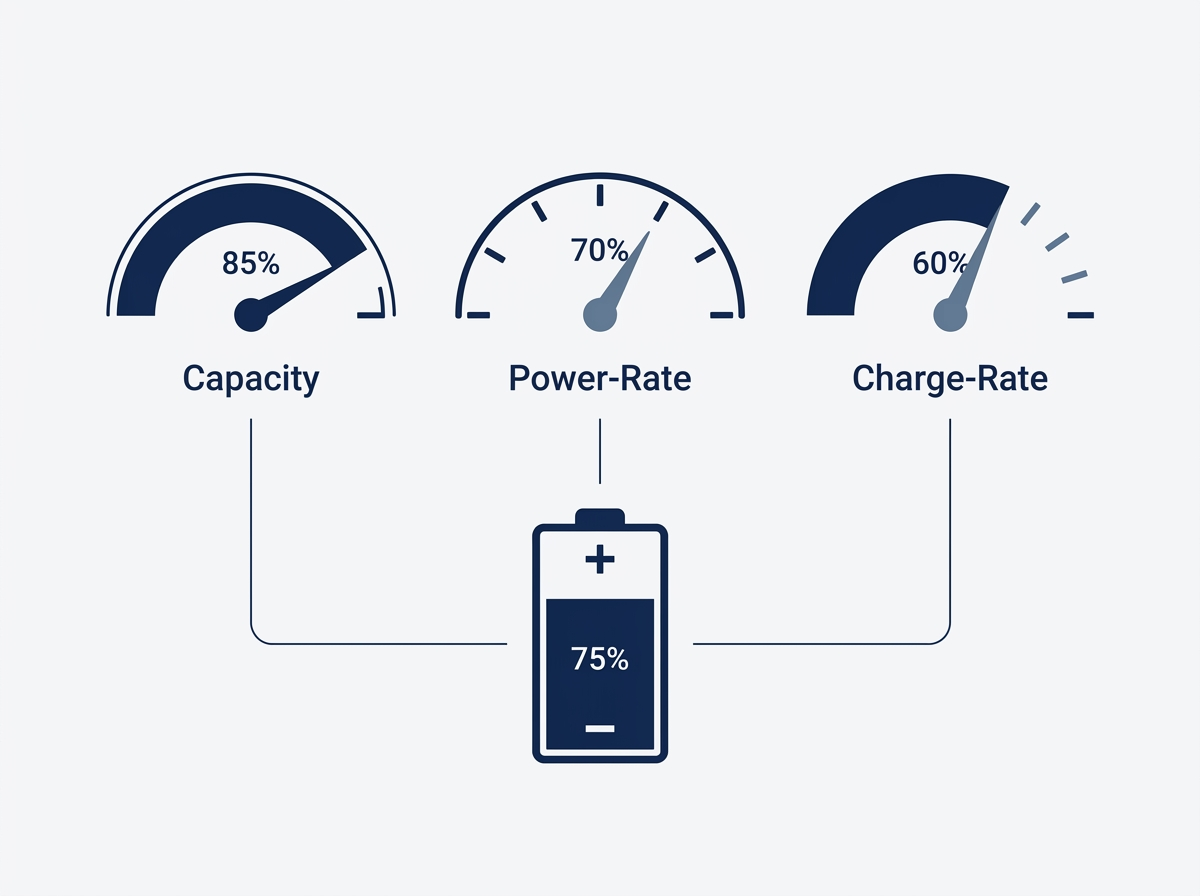
Capacity is kilowatt-hours: the energy in the battery, and therefore how long it can hold up a given load. Power is kilowatts: how much load it can carry at any instant. A battery with plenty of energy and a modest power rating will run a light load all night and trip on a compressor start. A battery with high power and little energy will carry that compressor and be flat in twenty minutes.
So the customer's question — how long will this last? — is really two questions. What has to stay on, and for how long. Get the list of loads first, in kilowatts, and the runtime second, in hours. The product of those two is the starting point for capacity, before anything is derated.
The C-rate sets a ceiling both ways
The C-rate is the ratio between the power rating and the capacity. A pack that can deliver its full capacity in one hour is 1C; one that takes two hours is 0.5C. It sets a ceiling in both directions — a 0.5C battery cannot discharge faster than half its capacity per hour, and it cannot be charged faster than that either, whatever the inverter in front of it is capable of.
That charge limit is the one that catches people out on solar-charged systems. If the array can deliver more than the battery is allowed to accept, the surplus does not disappear into the battery faster — it goes to the load, to export, or nowhere. Check the manufacturer's continuous charge current, not just the discharge headline, and check it against what the array actually produces in the middle of the day.
Usable capacity is smaller than nameplate capacity
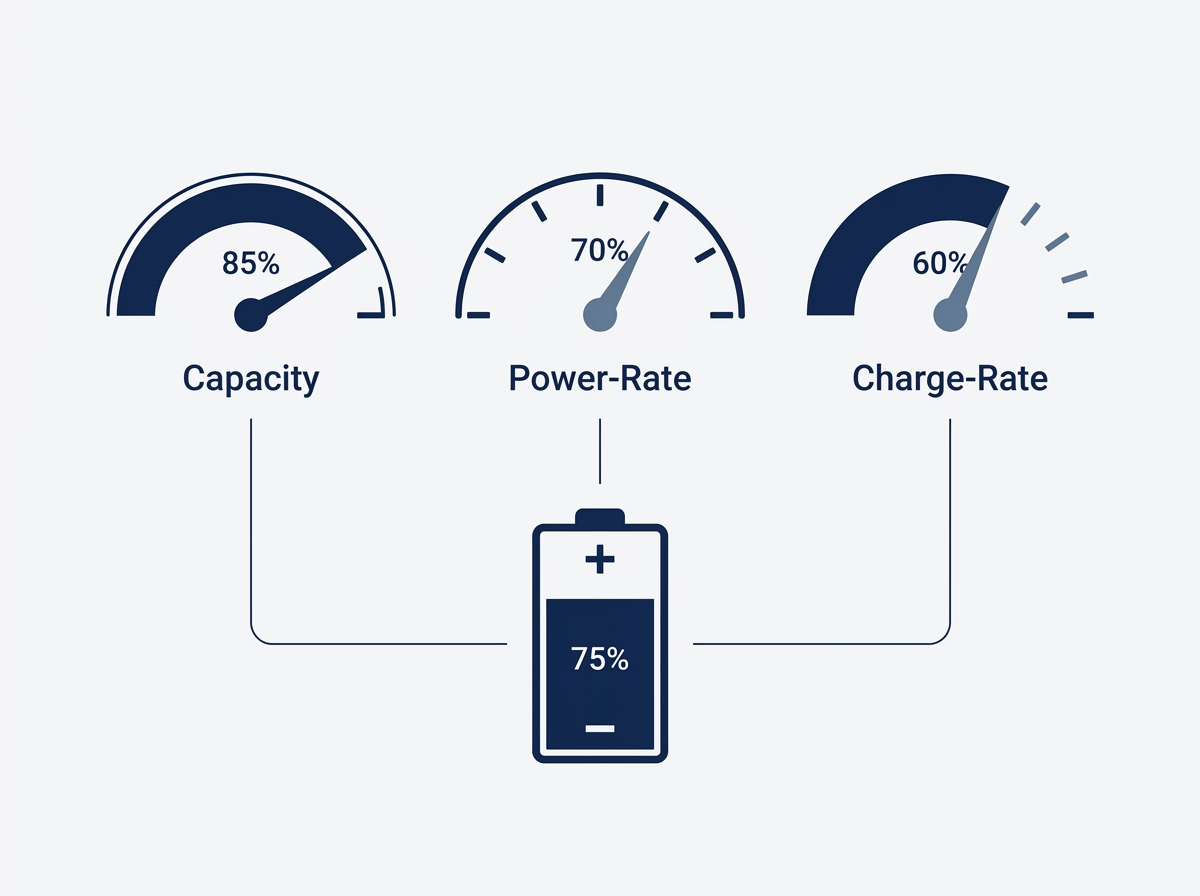
Nameplate capacity is the energy in the cells. Usable capacity is what the battery management system will let you take out, and the gap between them is depth of discharge. Lithium iron phosphate systems are generous here compared with older chemistries, but the figure is set by the manufacturer and it belongs in the sizing arithmetic, not in a footnote.
Two more deductions apply before the number is real. Round-trip efficiency takes a slice of everything that goes in and comes back out, and heat takes another: manufacturers derate continuous power above a stated ambient, which in a Malaysian plant room or an unshaded outdoor position is a working condition rather than an edge case. Size on the derated figure at the temperature the battery will actually see.
The numbers to pull before you quote
| Input | Where it comes from | What it decides |
|---|---|---|
| Interval load data | TNB meter data or a logger on the incomer | Everything else — get this first |
| Peak demand, kW | Highest half-hour average in the billing month | Inverter and battery power rating |
| Load to be backed up, kW | The customer's list of what must stay on | Minimum power rating |
| Runtime, hours | The customer's expectation, made explicit | Raw capacity requirement |
| Depth of discharge | Battery datasheet | Usable share of nameplate capacity |
| Continuous charge current | Battery datasheet, against the array's midday output | Whether solar can actually refill it |
| Ambient temperature | The proposed installation position | Derated continuous power |
Size from the load profile, not the roof
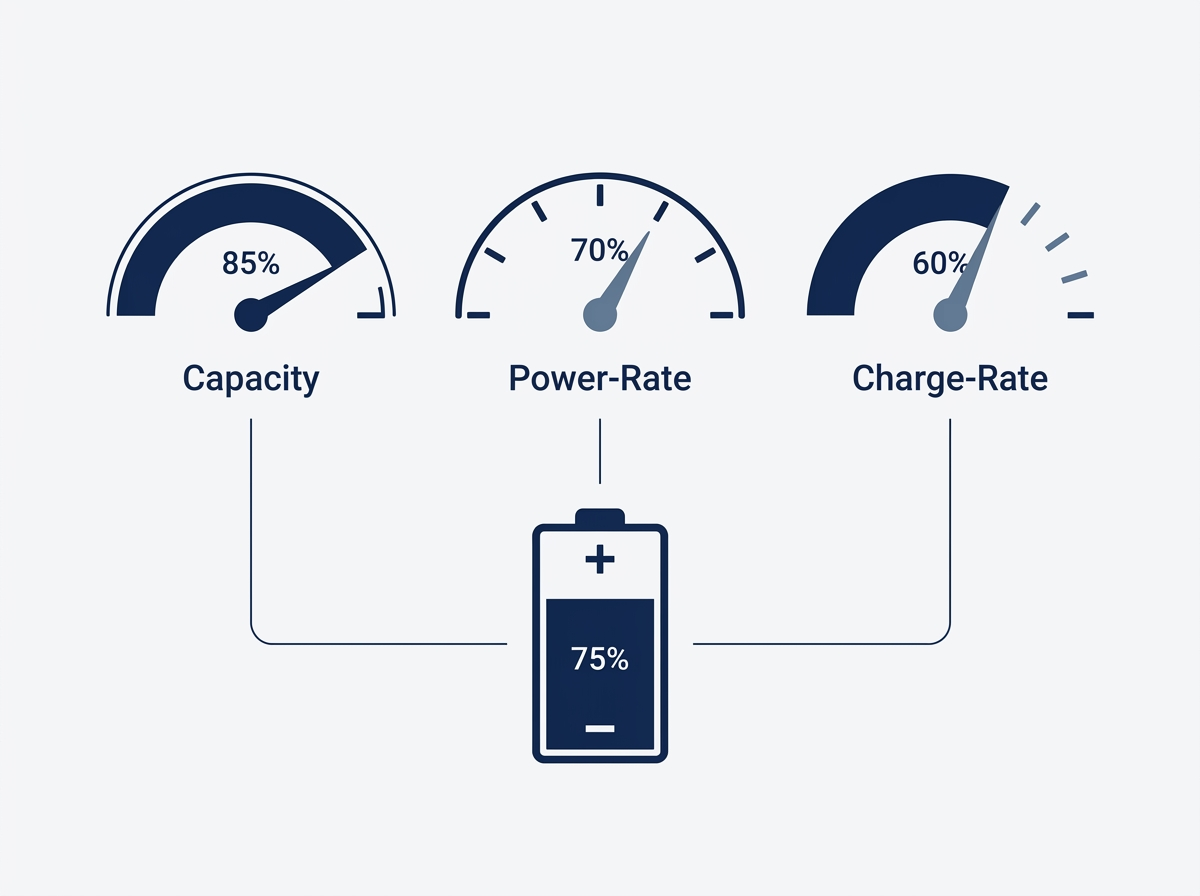
The load profile is the whole job. TNB measures maximum demand as twice the largest kilowatt-hours supplied in any consecutive thirty minutes in the month, so half-hour interval data is both what the tariff is built on and the right resolution for sizing. With a month of it you can see the peaks that set the demand charge, the shape of the working day, and how much of the customer's consumption sits outside solar hours.
Without interval data, sizing is guesswork dressed as arithmetic. If the meter data is not available, put a logger on the incomer for a fortnight that includes a normal production week. It is a small cost against the risk of a battery that is wrong in a direction you cannot fix after commissioning.
Then work backwards. Peak demand and the backup list set the power rating. Runtime sets raw capacity. Depth of discharge, efficiency and temperature derating turn that into nameplate capacity. Check the result against the C-rate and against the inverter's battery window, and if the arithmetic argues with the datasheet, the datasheet wins.
Specifying the hardware
Battery and inverter are specified together, because each constrains the other. On a hybrid system the inverter sets the battery voltage window and the charge current; on an AC-coupled system the battery inverter sets the usable power regardless of how much capacity is behind it. Both have to be equipment that is registered and certified for use here — the inverter on the SEDA register, the battery to IEC 62619 and IEC 63056, and the installation signed off by a competent person under the Electricity Supply Act 1990.
InverPower stocks Sungrow storage in Malaysia, from residential batteries to the SH125CX C&I hybrid inverter and the PowerStack ST255CS-2H (257 kWh) and ST510CS-4H (514 kWh) C&I cabinets. Send the load profile and the bill of materials, and we will tell you what pairs, what is in stock today, and what the lead time looks like on the rest.
Frequently Asked Questions
How do you size a battery without an interval load profile?
You log for one. Put a data logger on the incomer for at least two weeks covering a normal working pattern, or request the interval data behind the meter. A monthly kilowatt-hour total cannot show you the peaks that set the power rating, so sizing from a bill alone is guesswork.
What is a realistic depth of discharge for a lithium iron phosphate battery?
Take it from the manufacturer's datasheet rather than a rule of thumb — the battery management system enforces it, and the figure varies between ranges. What matters is that you size on usable capacity, and that the warranty terms are read against the way the system will actually be cycled.
Does the battery need to match the size of the solar array?
No. The array is sized to a roof and a consumption pattern; the battery is sized to the load it has to carry and for how long. The array only enters the sizing through charging — whether it can refill the battery within the manufacturer's charge current limit during solar hours.
Why is the battery derated for temperature?
Continuous power and charge current are specified up to a stated ambient, above which the manufacturer reduces them to protect the cells. An unshaded outdoor wall or an unventilated plant room in Malaysia will sit above that threshold for part of the day, so the derated figure is the real one.
Sources
- TNB — Maximum Demand definition and measurement (twice the largest kWh in any consecutive 30 minutes) — https://www.tnb.com.my/commercial-industrial/maximum-demand
- Sungrow — SBH high-voltage battery and PowerStack commercial storage datasheets (usable capacity, continuous charge current, temperature derating) — https://www.sungrowpower.com
- IEC — IEC 62619 and IEC 63056, safety requirements for secondary lithium cells and batteries in industrial and energy-storage applications — https://webstore.iec.ch
- Electricity Supply Act 1990 (Act 447) and the Electricity Regulations 1994 — competent person and registered electrical contractor requirements — https://lom.agc.gov.my
- SEDA Malaysia — register of approved solar PV inverters — https://www.seda.gov.my
About InverPower
InverPower is Malaysia's A–Z solar component distributor — Sungrow Preferred Distributor and Sunkean Sole Distributor — supplying EPCCs, installers, and government projects nationwide.
Explore the InverPower resource hub at inverpower.com.my
Related InverPower posts:
- Who Is the Sungrow Distributor in Malaysia?
- TNB Grid Code for Solar: What Must EPCCs Do Before Energization?
- String Inverters vs MLPE: How to Decide for Malaysian C&I?