
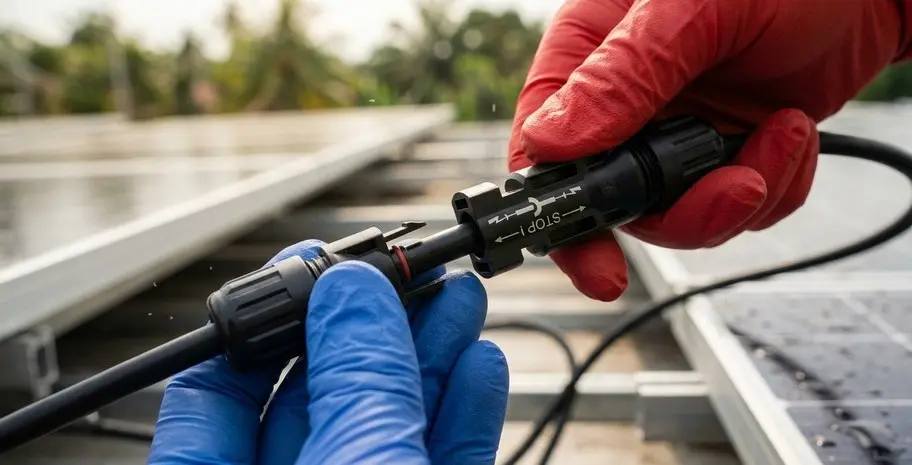
Stäubli MC4 Connectors in Malaysia: Where Do You Source the Original?
Published by Quinn Lai | By InverPower Technical Team
Published 20 August 2026 · Last updated 20 August 2026
DIRECT ANSWER
Stäubli Electrical Connectors — formerly Multi-Contact — invented the MC4 connector and still makes the Original. InverPower distributes genuine Stäubli MC4 and MC4-Evo 2 in Malaysia. Anything sold as "MC4-compatible" is a different manufacturer's part, and Stäubli certifies no cross-brand connection, so the working rule on site is one brand on both halves of every mated pair.
MC4 is the rare product name that got absorbed into the trade vocabulary so completely that most people using it no longer know it belongs to anyone. It does. Knowing whose it is turns out to be the practical part, because the moment a name becomes generic, the market fills with parts that answer to it without being it — and on a DC circuit that runs at full current every sunny hour for twenty-five years, that distinction has consequences.
Who actually makes the Original MC4?
The connector was developed by Multi-Contact AG of Allschwil, Switzerland. The name is a description rather than a model code: MC for Multi-Contact, 4 for the 4 mm diameter of the contact pin. Multi-Contact is now Stäubli Electrical Connectors, part of the Stäubli group, and the product line carried on under the new name — which is why a datasheet may say Stäubli while the housing in your hand says MC4.
What sits inside is the reason the design outlived its patents. Stäubli's MULTILAM contact system uses a louvred contact band rather than a simple friction fit, holding many parallel contact points at a defined spring force, and it is what keeps contact resistance low and stable over years of thermal cycling. Stäubli puts the installed base of the MC4-Evo 2 contact technology at several hundred million connections since 2004.
Everything else on the market is a different manufacturer's interpretation of the same shape, usually sold as "MC4-compatible". Stäubli's published position is that it recognises no third-party product as compatible with the Original MC4 and that there is no certification for a cross-connection. We have written separately about why mixing brands across a single mated pair is a fire risk; this post is the other half of that answer — where the genuine part comes from, and what it actually specifies.
What does the Original specify?
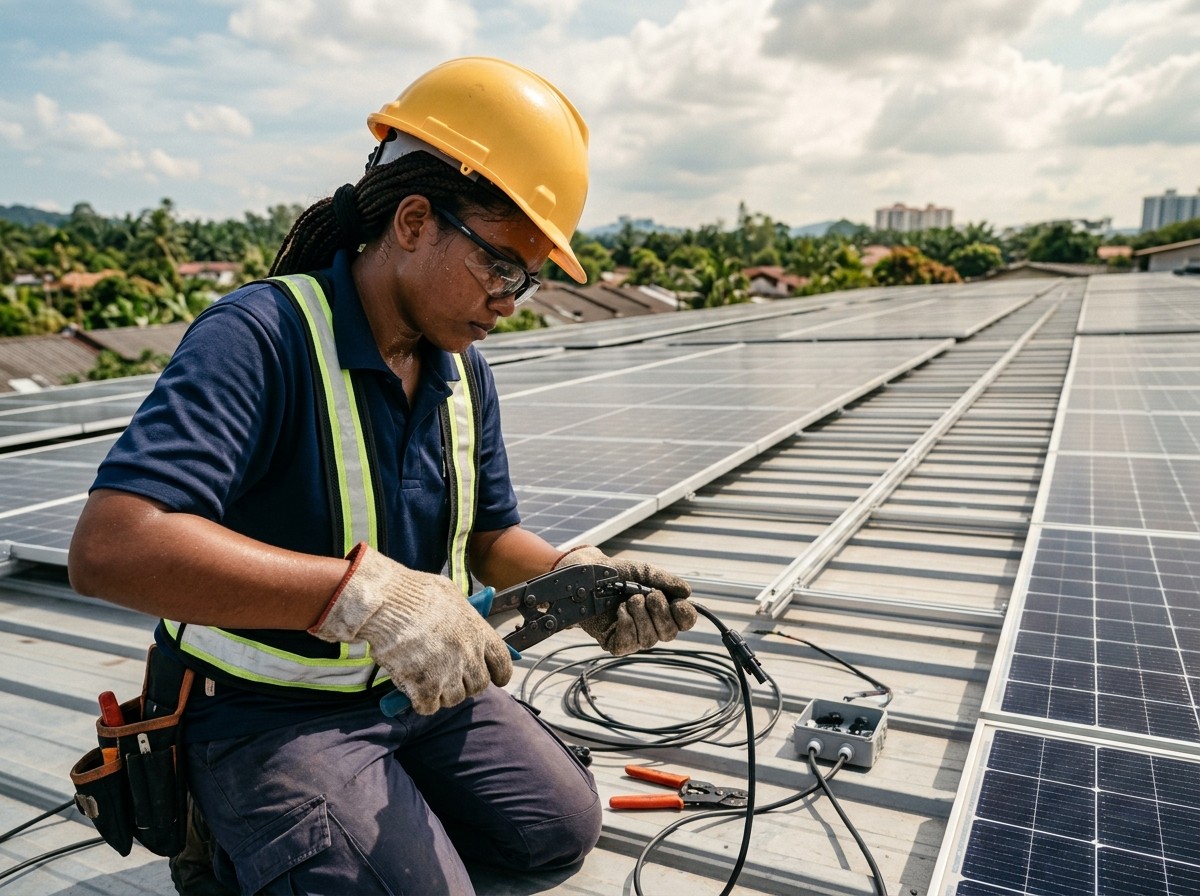
The two current families are the MC4 and the MC4-Evo 2. They mate with each other within the Stäubli range, and both are crimped, tin-plated copper contacts in a locking housing that needs a tool to open in accordance with NEC 2020. The MC4-Evo 2 is certified with IEC, UL, JET and cTÜVus and approved for DC 1500 V, with UL unrestricted access. The figures below are from the Stäubli photovoltaic main catalogue, and the last column is what each line actually decides on a Malaysian roof.
| Catalogue line | MC4 | MC4-Evo 2 | What it constrains |
|---|---|---|---|
| Max. contact resistance | 0.25 mΩ | 0.2 mΩ | Heat generated at the joint at full string current |
| Upper limiting temperature | 105 °C | 115 °C | Headroom above a black roof surface at midday |
| Ambient temperature range | −40…+85 °C | −40…+85 °C | The rated envelope, TÜV and UL |
| Degree of protection | IP68 (1 m, 1 h)/IP65 | IP68 (1 m, 1 h)/IP65 | Mated only — unmated is IP2X |
| Rated impulse voltage | 16 kV | 16 kV | Surge withstand on a lightning-heavy grid |
| Insulation material | PC/PA | PA | UV and weathering behaviour of the housing |
| Fire protection class | UL94 V-0 | UL94 V-0 | Flame behaviour of the housing material |
| Salt mist spray, severity 6 | Yes | Yes | Coastal and island sites |
| Ammonia resistance | Yes (DLG) | Yes (TÜV) | Agricultural and livestock rooftops |
| Certificate numbers | TÜV R 60127190 | TÜV R 60127169 | UL file E343181 for both — checkable |
Two rows deserve reading twice. The first is contact resistance, because it is the whole argument in one number: resistance at the joint turns current into heat, heat degrades the contact, and a degraded contact has more resistance still. A connector is one of the few components on a PV array whose failure mode is self-accelerating, which is why a fraction of a milliohm is worth specifying rather than assuming.
The second is the ingress rating, which is routinely misread. IP68 describes the connector mated and locked. An unmated connector is IP2X — finger-safe and nothing more. A string left half-terminated overnight on a Malaysian roof, in a climate that delivers rain most afternoons, is not protected by the rating printed on the datasheet, and sealing caps exist precisely for that gap.
How do you confirm what arrived on site is genuine?
Four checks, none of which need a laboratory. The housing carries a moulded type designation — PV-KST4 and PV-KBT4 for the male and female MC4 cable couplers, PV-KST4-EVO 2 and PV-KBT4-EVO 2 for the newer family — rather than a bare "MC4" marking. The assembly instruction referenced on the packaging is document MA231 for the MC4 and MA273 for the MC4-Evo 2. The certificate numbers in the table above can be checked against the TÜV Rheinland and UL databases directly. And the delivery paperwork should trace back to an appointed distribution channel, which is the only one of the four that has to be established before the goods arrive rather than after.
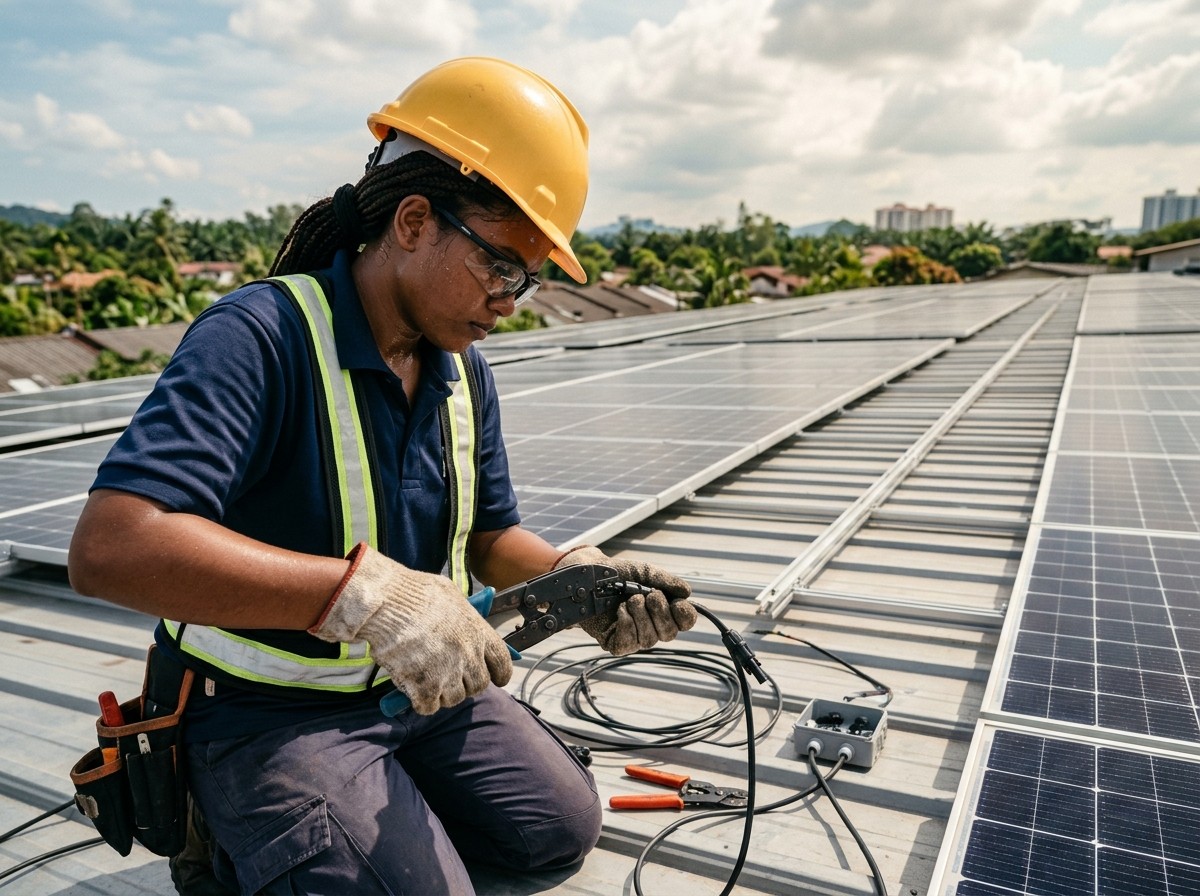
Then there is the half of the product that comes out of your own toolbox. A genuine connector crimped with the wrong die, or tightened by hand instead of to the specified torque, is a bad joint wearing a good name. Stäubli specifies crimping pliers, a torque tool and an open-end spanner per connector type, and IEC 62852 — the international standard for DC connectors in PV systems — governs the connector as an assembled system, not as a bag of parts. If a site crew is sharing one set of generic pliers across three connector brands, the specification stopped being real somewhere before commissioning.
Where does InverPower fit?
We distribute genuine Stäubli connectors in Malaysia and hold them alongside the solar cable, MLPE and inverters that terminate into them, so a BOM can be filled from one source with one connector brand on both ends of every pair — which is the condition the whole certification argument rests on. We stock the assembly tooling as well, because the tool is part of the specification. If a tender needs the type-test certificates or a specification point confirmed in writing, ask us at BOM stage; the design and the installation stay yours.
Frequently Asked Questions
Is an "MC4-compatible" connector the same as an MC4?
No. MC4 is Stäubli's product, and Stäubli recognises no third-party part as compatible with it. A "compatible" connector is another manufacturer's part in a similar housing, and no certification covers the two mated together.
What is MULTILAM, and why does it matter?
It is Stäubli's louvred contact band, which holds many contact points at a defined spring force instead of relying on a friction fit. It is the mechanism behind the low, stable contact resistance the catalogue quotes, and it is what a copied housing cannot copy.
Should a project specify MC4 or MC4-Evo 2?
The MC4-Evo 2 has lower rated contact resistance and a higher upper limiting temperature, so it is the stronger choice on hot rooftops and high-current strings. Both mate within the Stäubli family. Specify one type per project and keep it consistent through the BOM.
Do genuine connectors still need the manufacturer's tools?
Yes. Stäubli specifies crimping pliers, a torque tool and an unlocking spanner per connector type. A correct part assembled with the wrong die or without torque control produces exactly the high-resistance joint the specification was meant to prevent.
Sources
- Stäubli Electrical Connectors — Photovoltaic main catalogue, MC4 and MC4-Evo 2 technical data — https://www.staubli.com/electrical
- Stäubli — Avoid cross-mating, official position — https://www.staubli.com/global/en/electrical-connectors/industries/renewable-energy/cross-connection.html
- Stäubli — Cross-connection and product-liability statement (PDF) — https://www.staubli.com/content/dam/ecs/pictures/solar-photovoltaics/RE-Statement-PV-CrossConnection-ProductLiability-EN.pdf
- TÜV Rheinland — Check routine for connectors in PV systems, IEC 62852 (PDF) — https://www.tuv.com/content-media-files/master-content/services/products/0206-tuv-rheinland-photovoltaic-components/tuv-rheinland-check-routine-connectors-for-pv-systems-en.pdf
- IEC 62852 — Connectors for DC-application in photovoltaic systems — https://webstore.ansi.org/standards/iec/iec62852ed2014
About InverPower
InverPower is Malaysia's A–Z solar component distributor — Sungrow Preferred Distributor and Sunkean Sole Distributor — supplying EPCCs, installers, and government projects nationwide.
Explore the InverPower resource hub at inverpower.com.my
Related InverPower posts:
- MC4 vs "MC4-Compatible": Why Is Cross-Mating a Fire Risk?
- Solar DC Cables in Malaysia: What Specs & Certs Do EPCCs Need?
- Where Do EPCCs Source Solar PV Components in Malaysia?