
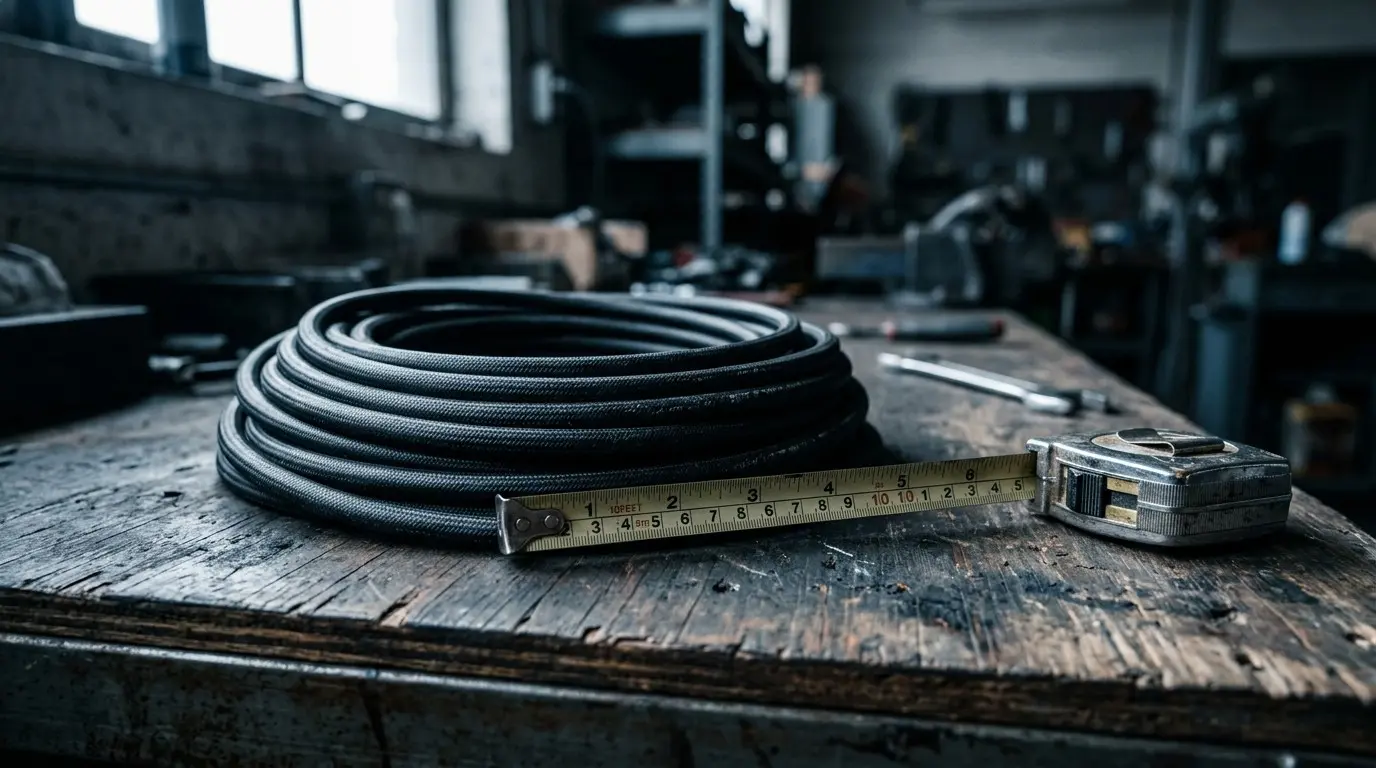
\
Solar Cable Sizing: Why Ampacity Alone Isn't Enough
Published by Quinn Lai | By InverPower Technical Team
Published 14 August 2026 · Last updated 14 August 2026
DIRECT ANSWER
Cable gauge has to satisfy two separate constraints: current-carrying capacity, and voltage drop over the length of the run. Ampacity is a safety limit and a cable that passes it can still be too small — because voltage lost along a long run is energy the system never delivers, every day, for the life of the asset.
Ampacity is the check everyone runs, because it is the one that fails loudly. Undersize a conductor against its current and it heats, and heat is a fire argument. Voltage drop fails quietly instead: the system works, nothing trips, nobody is unsafe, and the array simply delivers a little less than it should — permanently.
What are the two constraints doing?
Current-carrying capacity asks whether the conductor can carry the design current without exceeding its temperature rating. It is set by the cable's construction, its insulation rating and the conditions it is installed in — bunched in a tray on a hot roof is a very different derating case from a single cable in free air.
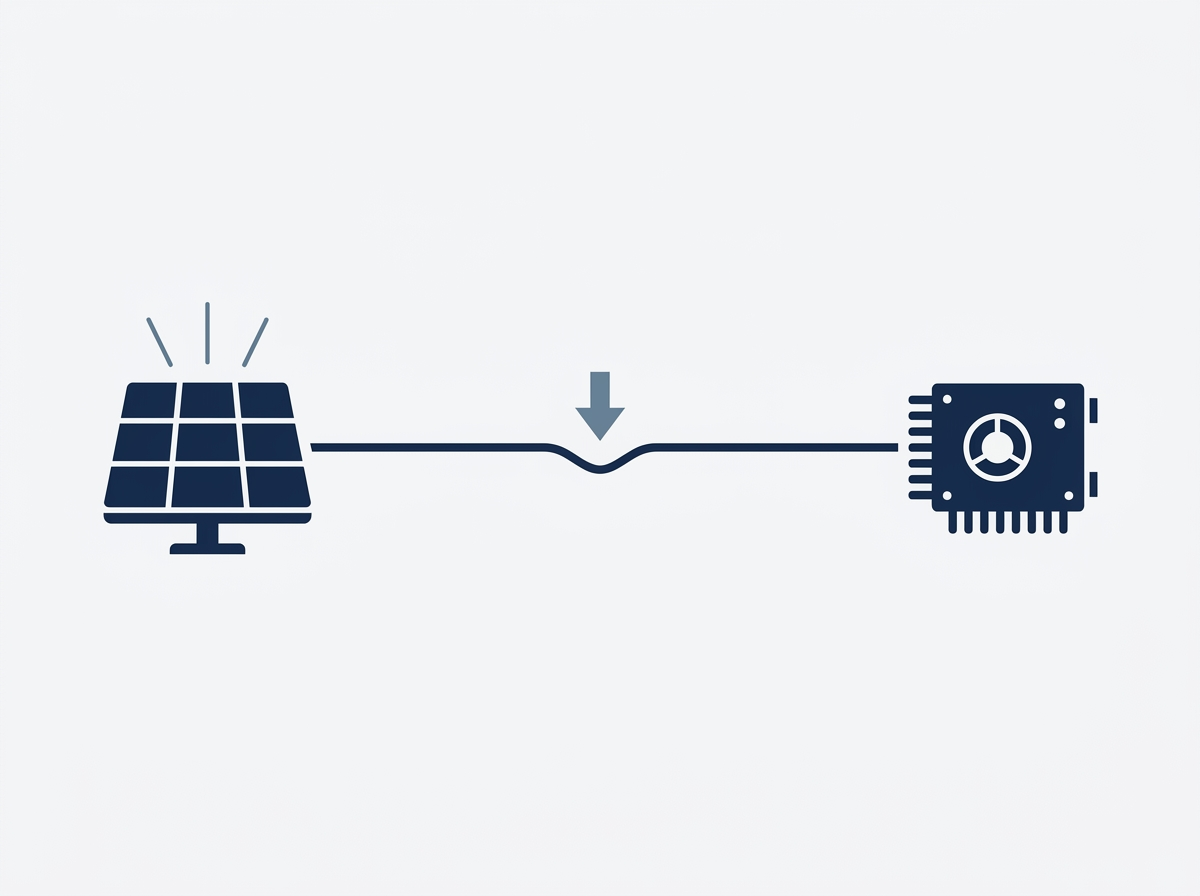
Voltage drop asks a different question entirely: how much of the array's voltage is consumed by the resistance of the conductor before it reaches the inverter. That loss scales with the length of the run and the current flowing, and it falls as cross-section increases. A short run at modest current can pass on the smallest gauge that clears ampacity. A long run cannot.
The two checks are independent, and the larger of the two answers wins. Sizing on ampacity alone is not a shortcut; it is answering only half the question.
Why does run length dominate on large roofs?
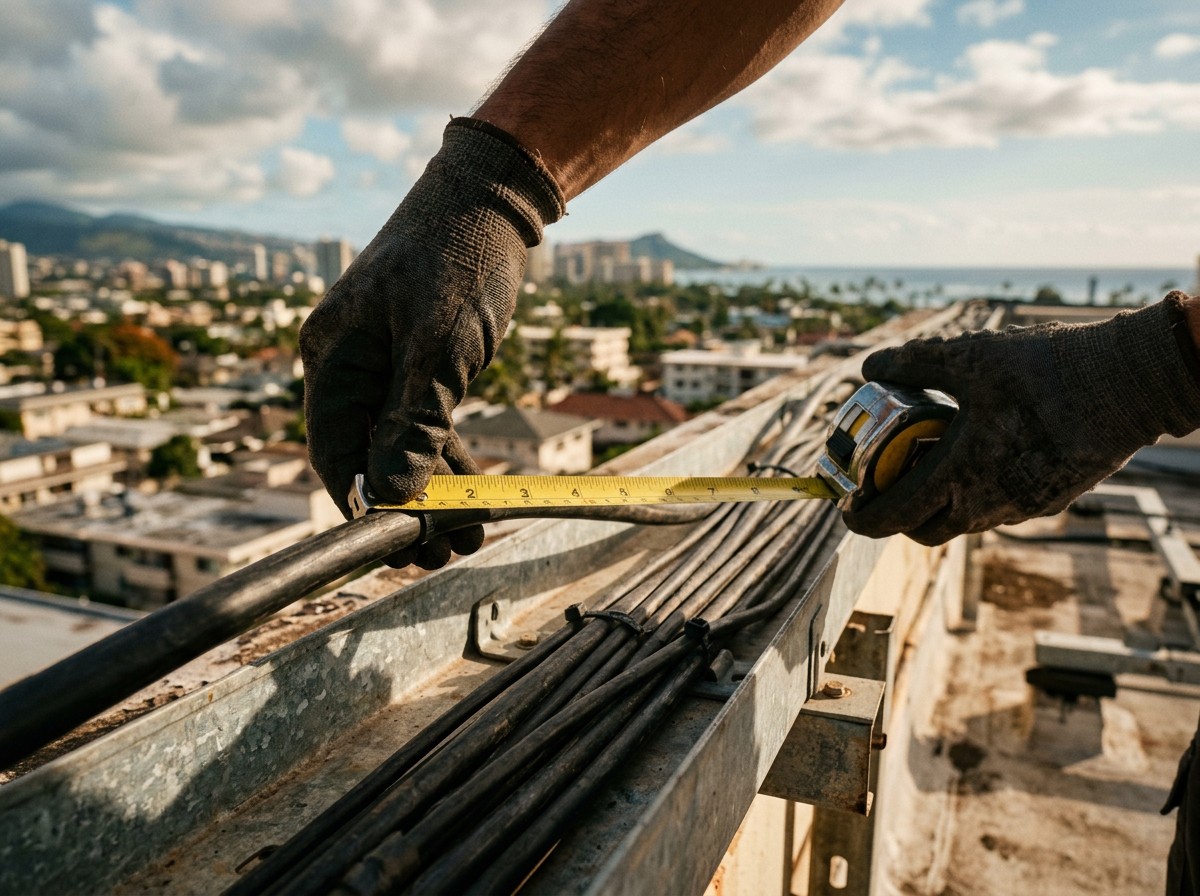
Because the distances are not what the drawing suggests. A cable route follows rails, drops down risers, crosses expansion joints and works around plant. The installed length is routinely well beyond the straight-line distance measured on a plan, and voltage drop responds to the route, not the plan.
On a large warehouse or a ground-mount, that difference compounds. The string furthest from the inverter can be several times the length of the nearest one, which means a single cable specification applied across the whole array is generous in one corner and inadequate in another. Sizing the whole site off the average run is how the far end quietly underperforms.
There is a second-order effect worth knowing. Voltage drop is not fixed — it rises and falls with the current flowing, so the loss is at its worst at peak generation, the middle of a clear day. The hours you lose the most to an undersized cable are the same hours the array is producing the most, which is why a small percentage on paper turns into a disproportionate share of the annual yield.
What actually drives the number?
You do not have to model this from first principles, because the cable maker publishes it. Sunkean's H1Z2Z2-K datasheet gives voltage drop directly, in millivolts per metre per amp, for the complete loop — and it gives two figures, one at 20 °C and one at 90 °C:
| Cross-section | Voltage drop at 20 °C | Voltage drop at 90 °C | Penalty when hot |
|---|---|---|---|
| 2.5 mm² | 16.42 mV/m·A | 20.94 mV/m·A | +28% |
| 4 mm² | 10.18 mV/m·A | 12.98 mV/m·A | +28% |
| 6 mm² | 6.78 mV/m·A | 8.65 mV/m·A | +28% |
| 10 mm² | 3.90 mV/m·A | 4.97 mV/m·A | +27% |
| 16 mm² | 2.48 mV/m·A | 3.16 mV/m·A | +27% |
| 25 mm² | 1.590 mV/m·A | 2.03 mV/m·A | +28% |
| 35 mm² | 1.13 mV/m·A | 1.44 mV/m·A | +27% |
Read the last column first. Every gauge loses roughly 27 to 28 percent more voltage at 90 °C than at 20 °C, because conductor resistance climbs with temperature. A cable bunched in a tray on a Malaysian roof is not operating at 20 °C, so the left-hand column is the one that flatters your calculation and the right-hand column is the one that describes your site.
Put real numbers through it. Take a 60 metre run at 10 amps on 6 mm² cable. At 90 °C that is 8.65 × 60 × 10 = 5,190 mV, or about 5.2 V lost. On an 800 V string that is roughly 0.65 percent — acceptable on most specifications. Run the same circuit on 2.5 mm² and it becomes 20.94 × 60 × 10 = 12,564 mV, about 12.6 V, or 1.6 percent. Same current, same distance, same compliance status on ampacity — two and a half times the loss, every hour of every day for twenty-five years.
The ampacity side derates the same way, and harder than people expect. Sunkean's conversion factors put a single cable at 1.00, six bunched cables at 0.57 and twenty at 0.38 — so a tightly bundled tray run carries barely a third of the current the headline figure suggests. The published ampacity table is also normalised to a 60 °C ambient, which is a realistic rooftop number rather than a conservative one.
How should you handle it on a real project?
- Set a voltage-drop budget at design stage and put it in the specification, rather than discovering the number during commissioning.
- Measure or estimate the installed route length, including vertical drops and detours, not the straight-line distance on the layout.
- Check the worst-case run — the furthest string — rather than the average, and size that run on its own merits.
- Apply the correct derating for how the cable is actually installed: bunched, in a tray, in conduit, in direct sun on a hot roof.
- Confirm the conductor is the material you specified, and that the cross-section on the drum matches the cross-section on the order.
- Re-check the calculation if the inverter location moves during construction, because the run length moves with it.
None of this is difficult. It is simply a second calculation that often gets skipped because the first one passed, and because the consequence of skipping it never announces itself.
How does InverPower support the cable spec?
As Sunkean's sole distributor in Malaysia we hold H1Z2Z2-K across the published range, 2.5 mm² to 35 mm², and we have the datasheet the figures above come from — voltage drop, ampacity and the full set of derating factors for bunching, ambient temperature and installation method. The calculation and the specification belong to the EPCC. What we can do is give you the manufacturer's numbers rather than a generic table, and confirm the conductor material on the paperwork before the drum ships.
Frequently Asked Questions
What voltage drop percentage is acceptable for a solar DC run?
There is no single mandated figure — it is a project specification decision and consultants differ. What you can do is calculate it exactly: Sunkean publishes voltage drop per metre per amp for each cross-section at both 20 °C and 90 °C, so multiply by your run length and design current and compare against whatever budget your specification sets.
Does cable temperature rating affect ampacity?
Yes, and it affects voltage drop too. Sunkean's own figures show roughly 28% more voltage drop at 90 °C than at 20 °C for the same cable. On ampacity, their derating factors take a single cable at 1.00 down to 0.57 for six bunched together and 0.38 for twenty.
Is voltage drop a compliance issue or a performance issue?
Mostly performance. Ampacity is the safety constraint; voltage drop is an energy-loss constraint. That is exactly why it gets skipped — nothing fails inspection, the array simply produces less than the model promised for twenty-five years.
Can I use one cable size across the whole array?
You can, but you will over-specify the near strings or under-specify the far ones. On a long roof the worst-case run should be sized on its own, and it is often cheaper to run two gauges than to take the largest everywhere.
Sources
- Department of Standards Malaysia — MS 1837:2018, Installation of grid-connected photovoltaic (PV) system — https://www.jsm.gov.my/
- SUNKEAN — 1.5 kV solar cable, EN 50618 H1Z2Z2-K / UL 4703 / IEC 62930 product specification — https://www.sunkean.com/pid18474354/1-5kV-Solar-Cable-EN-50618-H1Z2Z2-K-UL4703-IEC62930.htm
- Eland Cables — EN 50618 H1Z2Z2-K photovoltaic cable standard reference — https://www.elandcables.com/cables/photovoltaic-solar-h1z2z2-k-cable
About InverPower
InverPower is Malaysia's A–Z solar component distributor — Sungrow Preferred Distributor and Sunkean Sole Distributor — supplying EPCCs, installers, and government projects nationwide.
Explore the InverPower resource hub at inverpower.com.my
Related InverPower posts:
- Where Do You Source Sunkean Solar Cable in Malaysia?
- Solar DC Cables in Malaysia: What Specs & Certs Do EPCCs Need?
- Cable Fire Ratings Decoded: Why Isn’t ‘Eca’ the Standard to Specify?