
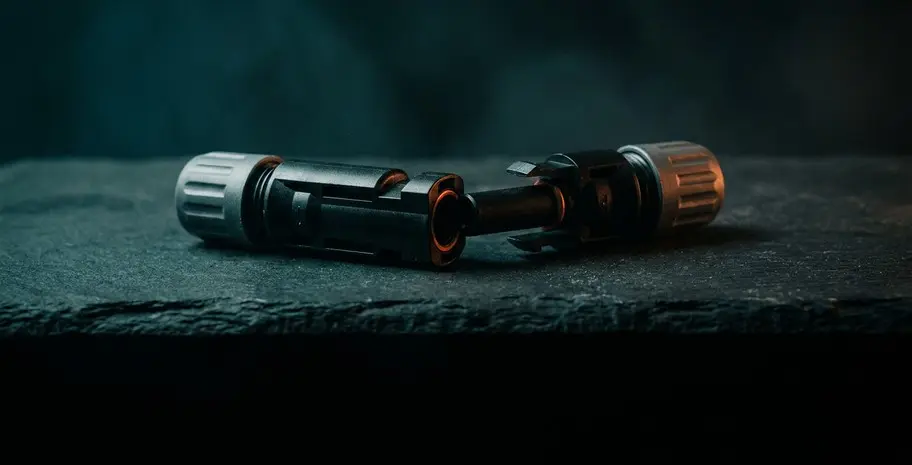
MC4 vs “MC4-Compatible” Connectors: Why Cross-Mating Is a Fire Risk?
Published by Quinn Lai | By InverPower Technical Team
Published · Last updated
DIRECT ANSWER
First, the naming: the generic part is the “DC connector.” MC4 is the brand name of the original DC connector — invented by Multi-Contact (MC = Multi-Contact, 4 = the 4mm contact pin) and now made by Stäubli as “the Original MC4.” The fire risk is not “the MC4” — it is cross-mating: pairing a connector from one brand with a different brand’s “MC4-compatible” copy. No product certification exists for a cross-brand connection; combining two makers’ connectors voids the certification each held on its own. Mismatched contact geometry and materials raise contact resistance, which heats the joint, degrades it further, and can arc — a recognised cause of rooftop fires. A Netherlands (TNO) investigation attributed roughly 70% of the PV fires it examined to faulty connectors, principally cross-mating. The rule for EPCCs is simple: use the same genuine connector brand on both ends of every connection.
What exactly is “cross-mating”?
Cross-mating (or cross-connection) means joining a male connector from one manufacturer to a female connector from another — even when the second brand is sold as “MC4-compatible.” It usually happens innocently on site: a module arrives terminated with one connector type, the crew has a different brand in the toolbox, the two click together, and the string gets built. The parts look identical and lock cleanly, so nothing seems wrong. That is precisely the trap.
Stäubli, the maker of the original MC4, is explicit: it has not recognised any third-party product as compatible with the Original MC4, and it dissociates itself from components advertised as “MC4 compatible.” In its words, “there is no compatibility and no certification for a cross-connection.”
Why is mixing brands unsafe if they fit together?
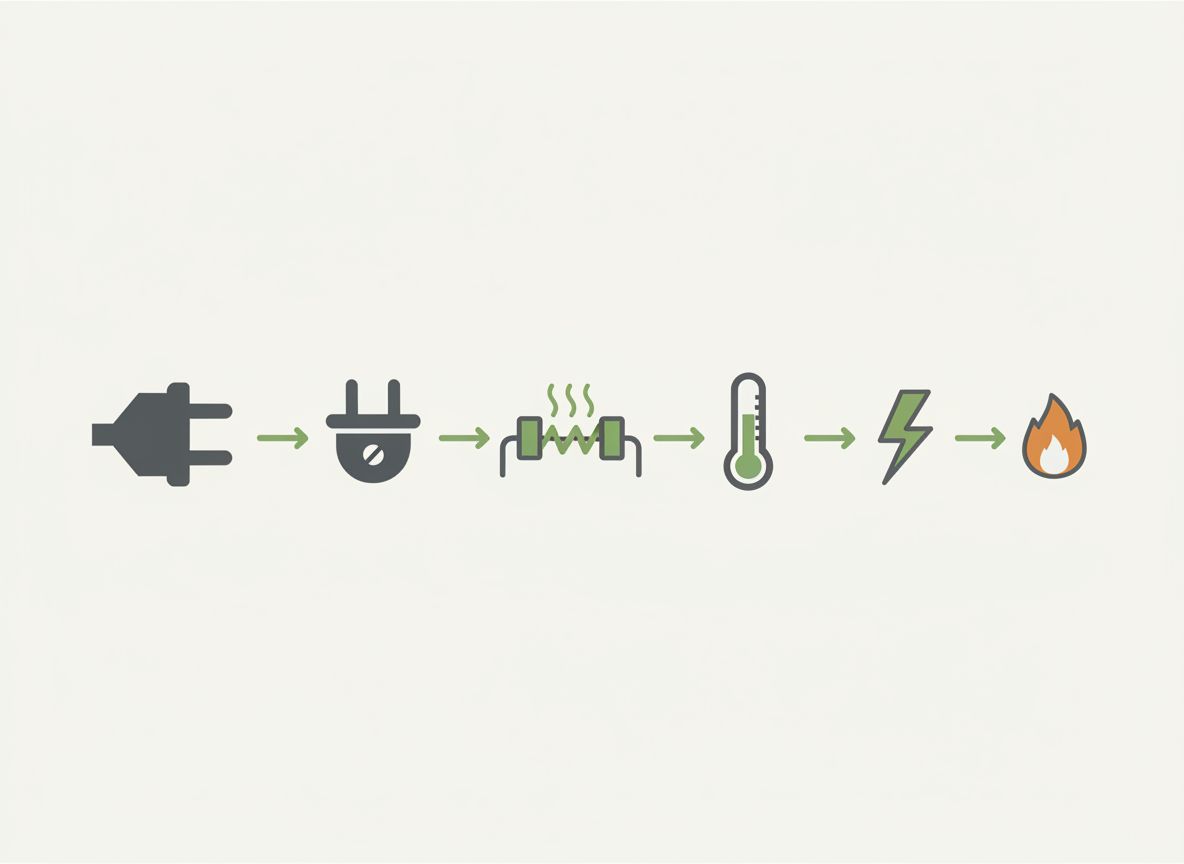
Because the danger is invisible from the outside. Two connectors can share the same overall shape yet differ in the tolerances of their contact zones, the spring force that holds the metal contacts together, and the polymer and metal materials used. When the geometries and forces don’t match, the actual contact area shrinks and the clamping force is wrong. That raises the electrical resistance at the joint — and in a PV string, where current flows all day, higher resistance means heat. The table below traces how a mismatch becomes a fire.
| Stage | What happens | Result |
|---|---|---|
| 1. Mismatch | Different-brand contacts: wrong geometry, contact force, materials | Reduced, uneven contact area |
| 2. Resistance | Smaller contact area raises transition (contact) resistance | Joint runs hotter than designed |
| 3. Degradation | Heat + humidity oxidise and corrode contacts; polymers crack | Resistance climbs further (a runaway loop) |
| 4. Arcing | A loose or degraded contact breaks while current flows | An electric arc — near 1,000 V DC |
| 5. Ignition | Sustained heat / arc reaches ignition temperature | Rooftop fire |
How cross-mated solar DC connectors fail: mismatch to resistance to heat to arc to fire
Doesn’t IEC 62852 certification cover it?
No — and this is the point most “MC4-compatible” sales pitches gloss over. IEC 62852 (“Connectors for DC-application in photovoltaic systems — Safety requirements and tests”) certifies connectors of the same type or type family from one manufacturer. When you combine plugs and sockets from two makers, you create a new connection the standard was never written to assess, and the certification each part carried no longer applies to the pair. A one-off “compatibility” test report from a copy-connector seller is not the same as a design-type certification — Stäubli calls such reports “misleading and dangerous.” In short: there is no certificate for a cross-brand mate, because none can exist.
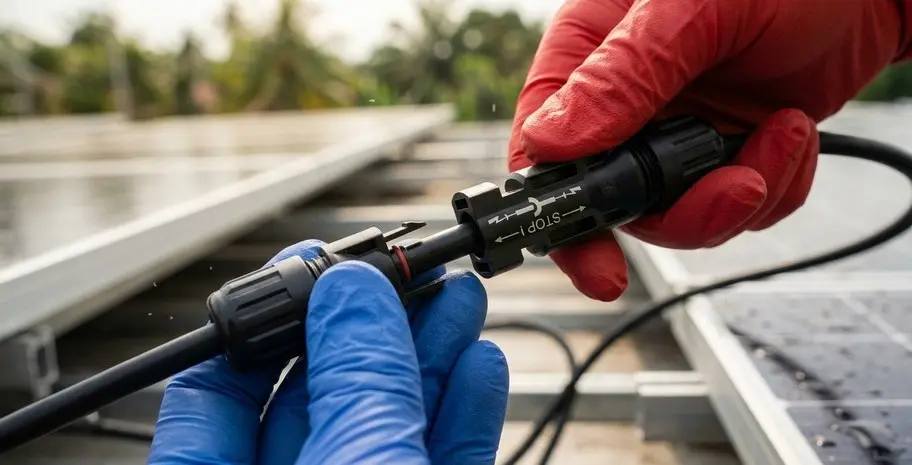
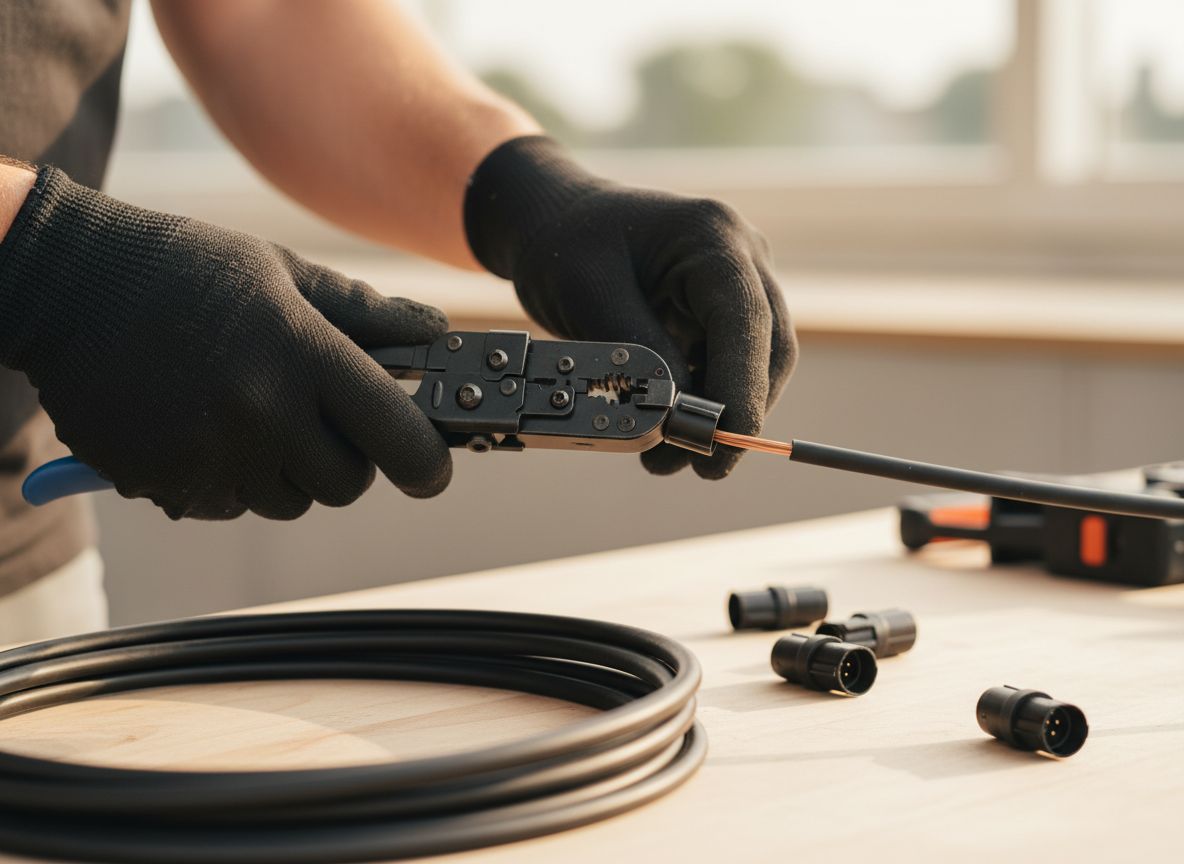
Installer assembling a genuine solar DC connector with the correct crimping tool
Is this a real risk, or just theory?
It is real, and it is measured. The Netherlands organisation TNO investigated a set of PV fires and found that roughly 70% resulted from faulty connectors — specifically the cross-mating of incompatible types. Broader fire studies point the same way: connectors were blamed for about 27% of PV-instigated fires in a UK dataset (2010–2017) and about 24% in a German dataset (1995–2012). Field audits tell the prevention side of the story too — inspectors routinely find cross-mated joints, incomplete insertions, and bad crimps on commercial systems. In a hot, humid Malaysian rooftop environment, where heat and moisture accelerate corrosion, a marginal joint ages faster, not slower.
Commercial rooftop solar array in Malaysia, the asset protected by using matched DC connectors
How should an EPCC protect the project?
- One brand, both ends. Male and female on every connection must be the same type from the same manufacturer — never mate a genuine MC4 with another brand’s copy.
- Stock the matching connectors before install. Cross-mating usually happens when the crew improvises with whatever fits — remove that temptation by supplying the right genuine parts up front.
- Buy genuine. Specify the Original MC4 by Stäubli (or another single certified brand end-to-end); counterfeit and look-alike connectors are a documented field problem.
- Assemble to spec. Use the manufacturer’s crimping tool and torque, and confirm full insertion and the locking click on every connector.
- Remember who carries the liability. Connector makers exclude responsibility for cross-brand combinations — if it burns, the installer is usually held responsible.
InverPower supplies genuine Stäubli connectors and matched solar DC cable, so an EPCC can terminate every string with certified, same-brand parts from one source — no field improvisation, no cross-mating.
Frequently Asked Questions
The supplier says their connector is “MC4-compatible” — isn’t that good enough?
No. Stäubli has not recognised any third-party product as compatible with the Original MC4, and no certification exists for a cross-brand connection. “MC4-compatible” is a marketing claim, not a certification — treat it as a warning, not a reassurance.
They look identical and click together perfectly. How can it be unsafe?
External fit hides mismatched contact tolerances, spring forces and materials. Those raise contact resistance and can crack or corrode invisibly, producing heat and, eventually, an arc. The failure is inside the joint, where you can’t see it.
Doesn’t IEC 62852 certification cover mixed connectors?
IEC 62852 tests connectors of the same type or family from one manufacturer. Combining two brands creates a new, uncertified connection the standard was never written to assess, and voids the certification each part held alone.
Is cross-mating actually causing fires, or is this precautionary?
It causes fires. A Netherlands (TNO) investigation attributed about 70% of the PV fires it studied to faulty connectors, principally cross-mating; UK and German studies attribute roughly 24–27% of PV fires to connectors overall.
Who is liable if a cross-mated connection starts a fire?
Connector manufacturers exclude liability for combinations with third-party products, so responsibility typically falls on the installer or EPC who built the system — a strong commercial reason to standardise on one certified brand.
Sources
- Stäubli — Avoid cross-mating (official position) — https://www.staubli.com/global/en/electrical-connectors/industries/renewable-energy/cross-connection.html
- Stäubli — Cross-connection & product-liability statement (PDF) — https://www.staubli.com/content/dam/ecs/pictures/solar-photovoltaics/RE-Statement-PV-CrossConnection-ProductLiability-EN.pdf
- pv magazine — Cross-mating chief cause of Netherlands PV fires (TNO) — https://www.pv-magazine.com/2019/04/12/cross-mating-of-connectors-was-chief-cause-of-netherlands-pv-fires/
- Kiwa PVEL / HelioVolta — Safety Guide for Solar PV Connectors (PDF) — https://www.pvel.com/wp-content/uploads/PVEL-HelioVolta-Ultimate-Safety-Guide-for-Solar-PV-Connectors-Feb-2022.pdf
- TÜV Rheinland — PV connector check routine, IEC 62852 — https://www.tuv.com/content-media-files/master-content/services/products/0206-tuv-rheinland-photovoltaic-components/tuv-rheinland-check-routine-connectors-for-pv-systems-en.pdf
- IEC 62852 — Connectors for DC-application in PV systems — https://webstore.ansi.org/standards/iec/iec62852ed2014
About InverPower
InverPower is Malaysia's A–Z solar component distributor — Sungrow Preferred Distributor and Sunkean Sole Distributor — supplying EPCCs, installers, and government projects nationwide.
Explore the InverPower resource hub at inverpower.com.my
Related InverPower posts:
- Solar DC Cables in Malaysia: What Specs and Certs Do EPCCs Need?
- Where to Source Solar PV Components in Malaysia: An EPCC's Supply Checklist
- Which Solar Inverters Are SEDA-Registered in Malaysia (2026)?