String Inverters vs MLPE for Malaysian C&I Projects: How to Decide?
Published by Quinn Lai | By InverPower Technical Team
Published · Last updated
DIRECT ANSWER
For most Malaysian commercial and industrial rooftops, the choice comes down to string inverters versus MLPE (module-level power electronics — mainly microinverters). String inverters, like Sungrow's SG-series, wire panels in series into one central unit: they give the lowest cost per watt, fewer devices to manage, and centralised, familiar maintenance — the right fit for large, simple, unshaded factory and warehouse roofs. MLPE puts electronics at each panel (a microinverter such as Hoymiles per module), giving per-module MPPT, module-level monitoring, graceful fault isolation, longer warranties (often 25 years), and module-level rapid shutdown — worth the higher per-module cost on complex, shaded, multi-orientation or safety-sensitive roofs. Rule of thumb: string inverters for big simple roofs; microinverters where shade, complexity or module-level safety dominate.
What actually is MLPE, versus a string inverter?
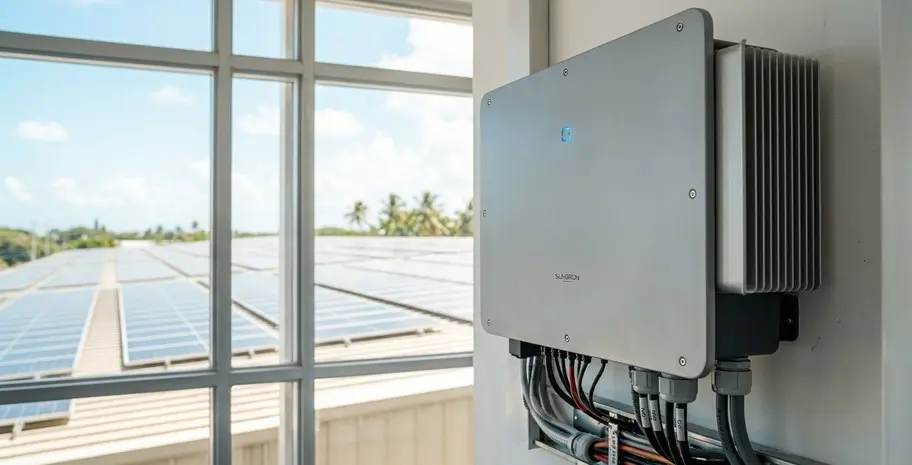
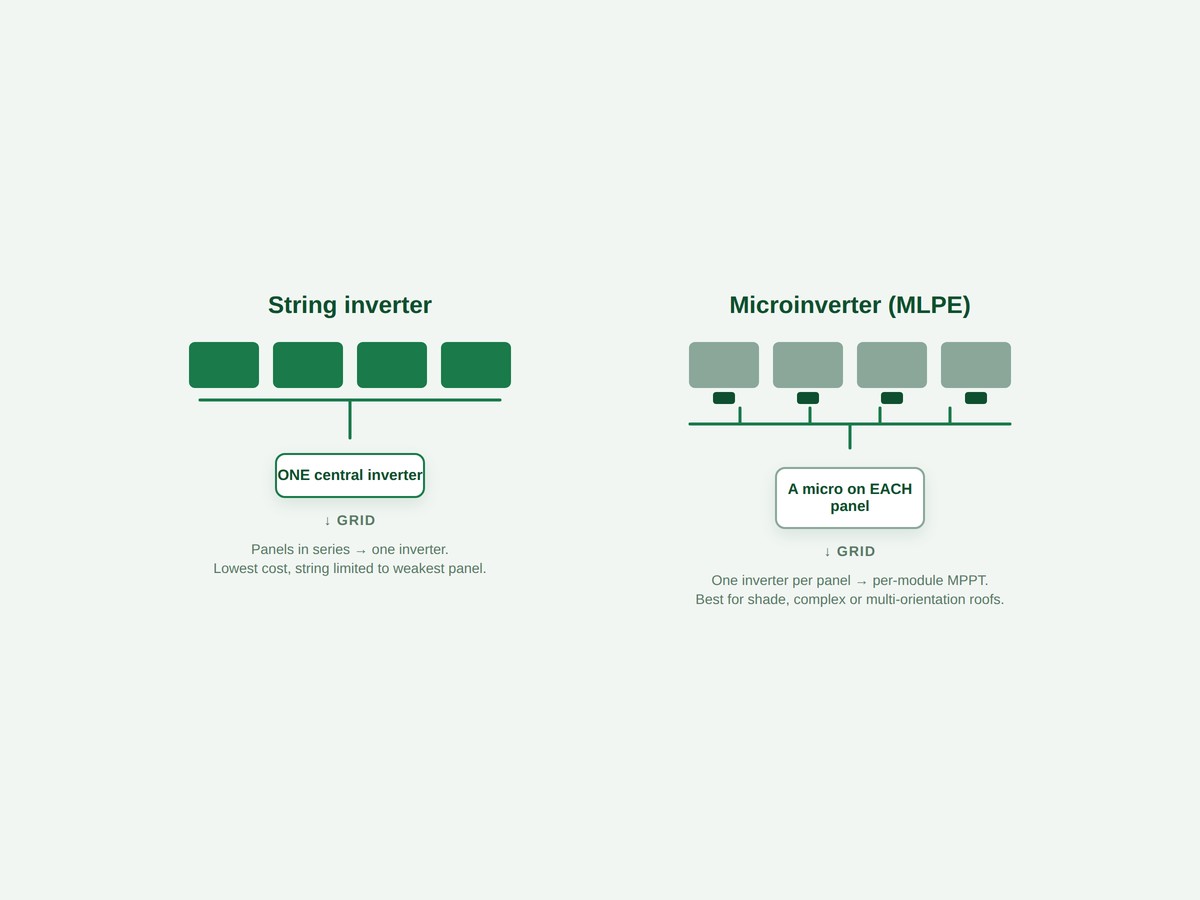
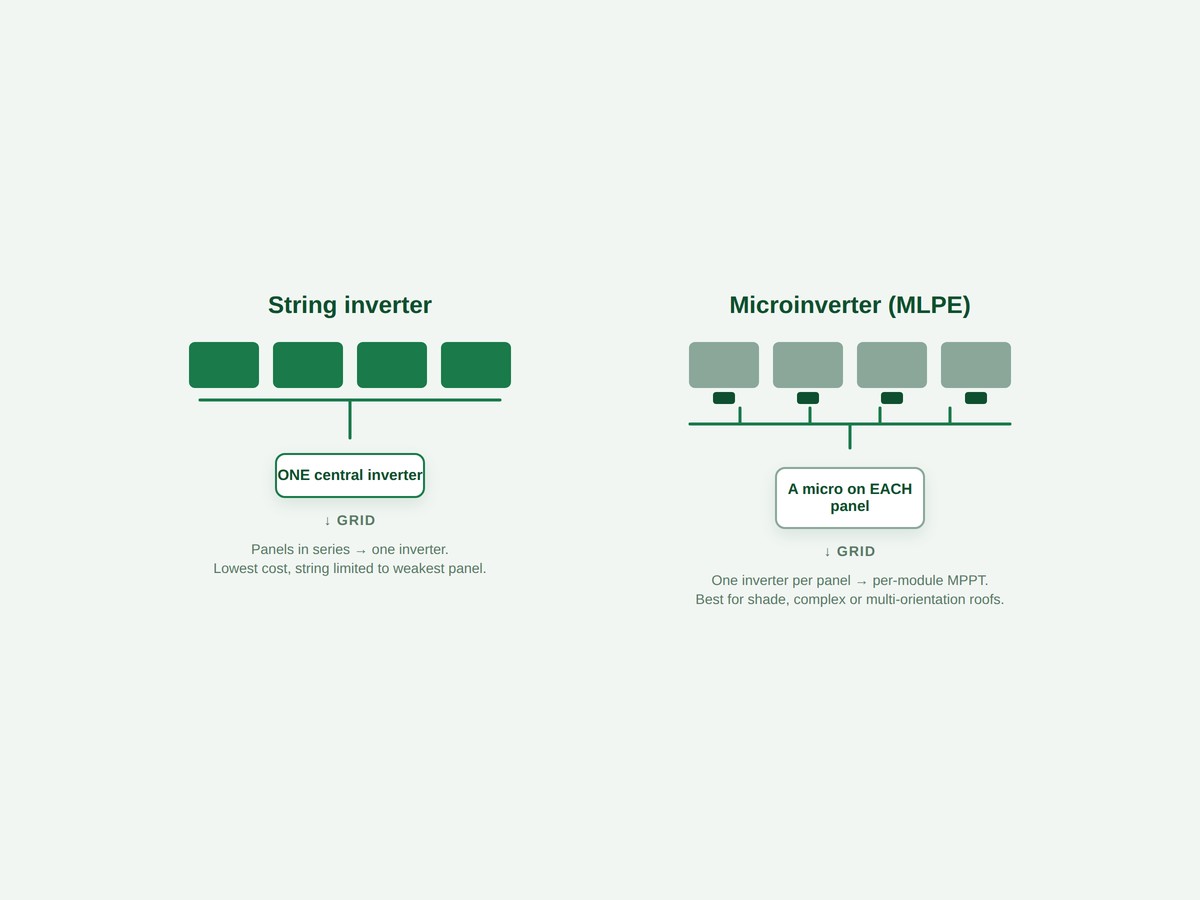
A string inverter is a single central unit: panels are wired in series into "strings," the strings feed the inverter, and it converts the combined DC to grid AC. MLPE — module-level power electronics — instead puts a small device on every panel. It comes in two forms: a microinverter, which does the full DC→AC conversion at the panel, and a DC power optimizer, which conditions each panel's DC and sends it to a central string inverter. Because InverPower's MLPE line is microinverters (Hoymiles, Envertech), this guide frames the practical choice as string inverter versus microinverter.
The key electrical difference: in a string, panels sit in series, so the string is effectively limited to its weakest panel. With MLPE, each module has its own maximum power point tracking (MPPT), so one shaded or underperforming panel no longer drags down the rest.
How do they compare on the factors that matter for C&I?
| Factor | String inverter (e.g. Sungrow) | Microinverter / MLPE (e.g. Hoymiles) |
|---|---|---|
| Shading & mismatch | String limited to weakest panel | Per-module MPPT; a shaded panel doesn't drag the rest |
| Monitoring | String-level | Individual panel-level |
| Rapid shutdown / safety | Array/string level | Module-level rapid shutdown at each panel |
| Cost | Lowest $/W; fewer devices | Higher per-module cost & install labour |
| Fault impact | One inverter fault drops a whole string section | One unit fault drops only that panel |
| Serviceability | One accessible central unit | Distributed on the roof; access per unit |
| Warranty (typical) | Generally shorter | Often ~25 years |
| Best-fit roof | Large, simple, unshaded | Complex, shaded, multi-orientation |
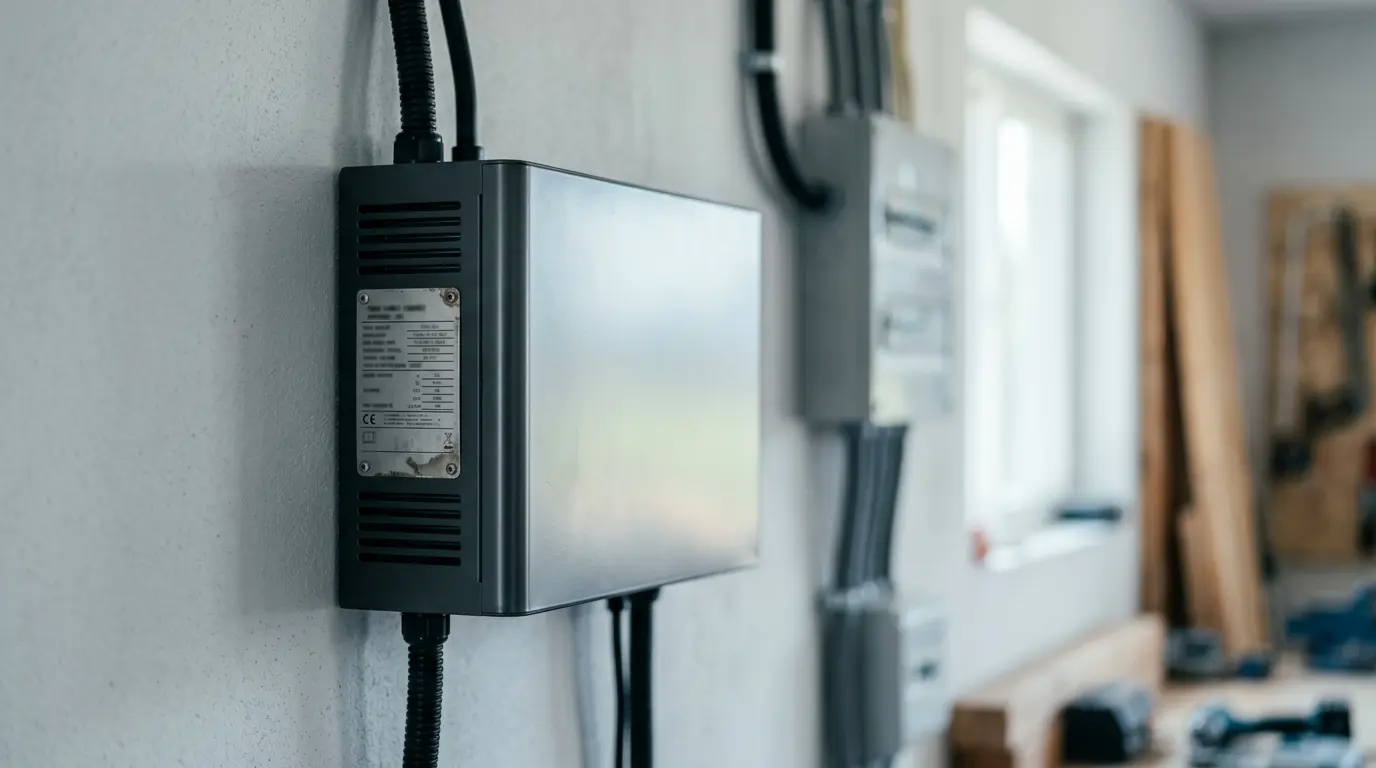
String inverter architecture versus module-level microinverter architecture for solar
When do microinverters earn their extra cost?
MLPE's advantages are real but situational. On a shaded or partially obstructed roof, per-module MPPT recovers energy a string would lose — industry sources report roughly 5–15% more annual yield for microinverter systems on comparable installs, and the US Department of Energy has cited shading-loss reductions of about 20–35% (figures depend heavily on the actual shading, so they should be modelled per site, not assumed). MLPE also shines where a roof has multiple orientations, where you want panel-level monitoring to spot a single failing module, or where module-level rapid shutdown is a safety priority. The trade-off is cost and rooftop-distributed electronics: more devices to buy and install, and servicing means accessing the affected panel.
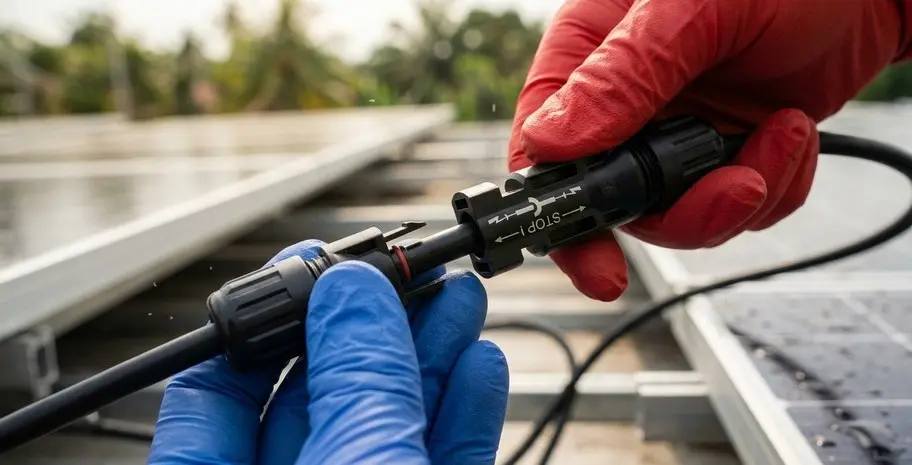
Installer fitting a module-level microinverter beneath a solar panel on a Malaysian rooftop
So which wins on a typical Malaysian C&I roof?
For the large, simple factory and warehouse roofs that make up most Malaysian C&I — uniform orientation, minimal shade — the string inverter is the default. It delivers the lowest cost per watt, fewer devices to procure and maintain, and centralised O&M that local electrical teams already know, which is exactly why Sungrow's SG-series dominates commercial rooftops here. The economics only tip toward microinverters when the roof itself forces the issue: heavy or moving shade from plant and structures, several roof orientations, tight monitoring or safety requirements, or a client who values the long module-level warranty. Many projects land on string inverters overall, reserving microinverters for the awkward sections.
A note on rapid shutdown and Malaysian compliance
Module-level rapid shutdown is often cited as an MLPE advantage. It is worth being precise: the well-known module-level rapid-shutdown rule (NEC 690.12) is a United States code, not a Malaysian one. Malaysian grid-connected PV compliance runs on MS/IEC standards and TNB / Energy Commission (Suruhanjaya Tenaga) approval — inverters to MS IEC 62109-1/-2, modules to IEC 61215/61730, wiring to MS IEC 60364 — and the guidance we reviewed does not impose a module-level rapid-shutdown mandate. So treat rapid shutdown as a genuine safety feature that may suit a given site, not as a Malaysian legal requirement — and always confirm the current TNB and ST requirements for your specific project.
The bottom line for EPCCs
- Default to string inverters for large, simple, unshaded C&I roofs — lowest cost, fewest devices, familiar O&M (Sungrow SG-series).
- Reach for microinverters where shade, multiple orientations, panel-level monitoring or module-level safety dominate (Hoymiles).
- Model the shade, don't assume it — the MLPE yield gain is entirely site-dependent; run the numbers per roof.
- Check the warranty and the standards for the exact Malaysian SKU, and confirm TNB/ST requirements rather than importing US rules.
InverPower supplies both sides of this decision — Sungrow string inverters and Hoymiles/Envertech microinverters — so an EPCC can spec the right architecture for each roof from one accountable distributor.
Frequently Asked Questions
Does Malaysia legally require module-level rapid shutdown on C&I rooftops?
No such mandate was found. The module-level rapid-shutdown rule people cite (NEC 690.12) is a US code. Malaysia follows MS/IEC standards and TNB / Energy Commission approval (e.g. MS IEC 62109-1/-2), so treat rapid shutdown as a safety best-practice, not a legal requirement — and confirm the current TNB/ST rules for your project.
How much extra energy do microinverters actually give on a shaded roof?
Industry sources report roughly 5–15% more annual yield on comparable installs, and the US DOE has cited about 20–35% reduction in shading losses. These depend heavily on the real shading, so model them per site rather than assuming a number.
If a device fails, what's the impact on each type?
With a string inverter, a fault takes down the whole connected string section until the single (accessible) unit is serviced or replaced. With microinverters, a failure affects only that one panel, but servicing means rooftop access to the specific unit.
Are microinverter warranties really longer?
Typically yes — microinverters commonly carry around 25-year warranties (Hoymiles' standard is 25 years), while string inverters are generally shorter. Confirm the exact warranty for the specific Malaysian SKU before you quote it.
Which is cheaper for a big, simple warehouse roof?
The string inverter — lowest cost per watt, fewer devices and centralised maintenance make it the standard choice for large, uniform arrays. Microinverters earn their extra cost on complex or shaded roofs, not simple ones.
Sources
- EnergySage — String inverters vs power optimizers vs microinverters — https://www.energysage.com/solar/string-inverters-power-optimizers-microinverters-compared/
- Aurora Solar — Module-Level Power Electronics (MLPE) primer — https://aurorasolar.com/blog/module-level-power-electronics-mlpe-for-solar-design-a-primer/
- Commercial microinverter vs string inverter — buyer's guide — https://www.aforenergy.com/commercial-microinverter-vs-string-inverter-the-smart-buyers-guide/
- Hoymiles — Warranty information (microinverters) — https://www.hoymiles.com/us/support/warranty-information/
- Sungrow SG110CX (commercial string inverter) — https://en.sungrowpower.com/productDetail/745/string-inverter-sg110cx
- Malaysia solar compliance summary (MS/IEC, TNB, ST) — https://www.surgepv.com/solar-compliance/malaysia
About InverPower
InverPower is Malaysia's A–Z solar component distributor — Sungrow Preferred Distributor and Sunkean Sole Distributor — supplying EPCCs, installers, and government projects nationwide.
Explore the InverPower resource hub at inverpower.com.my
Related InverPower posts:
- Sungrow SG125CX-P2 vs SG110CX: Which Fits Your C&I Rooftop?
- Who Is the Sungrow Distributor in Malaysia?
- Which Solar Inverters Are SEDA-Registered in Malaysia (2026)?