
Published by Quinn Lai | By InverPower Technical Team
Published 8 September 2026 · Last updated 4 November 2026
DIRECT ANSWER
Before buying a BESS for maximum demand shaving, run the proposed battery as a virtual system against the factory's own demand, either replayed from historical load data or tracked live at the meter for a full billing month. The run shows whether the proposed kW and kWh hold your real peaks, where the battery runs short, and what a larger size adds. In Malaysia the service is EWISER Live Shadow Mode, available through InverPower.
Your factory carries a high maximum demand charge, you have looked at storage, and the quotations are arriving. One contractor recommends one battery size and another recommends a different one. Both say it will reduce your MD. For a purchase this size, it is reasonable to want to know which one fits your site before you sign.
InverPower, as EWISER's strategic partner and distributor in Malaysia, supports the use of EWISER Live Shadow Mode to check a proposed BESS against your own load before you commit. The sizing method itself is set out in our post on sizing a BESS for MD shaving.

Why do two proposals for the same factory look so different?
Sizing a battery rests on assumptions about how your load behaves, how the system will be operated, and where the battery's limits sit. None of those appear in a quotation. What you see is a capacity and a price, so the larger system tends to read as the safer one.
The questions to ask are whether the proposed configuration suits your site's actual demand, and whether the extra capacity in the bigger option buys you anything. TNB bills MD on the highest 30-minute average demand in the month, and on the Medium Voltage General tariff that costs RM89.27 per kW in capacity and network charges, so one missed half-hour sets the charge for the whole month.
What can you test before installing anything?
Live Shadow Mode represents the proposed battery virtually and runs it against your site's load. The virtual system carries the proposed power and energy rating, the power-SOC curve, capacity degradation, response time and virtual solar where you have it, and it is dispatched by the same EWISER control logic that would run the physical battery.
You see your own grid demand with and without the proposed system, how much the battery would have discharged into each peak, how its state of charge is used through the day, and how the shaving holds up across your shift patterns.
| What to check | What the run shows | Why it matters to you |
|---|---|---|
| Is it big enough? | Whether the power meets your peaks and the energy sustains shaving across the window | An undersized system misses the MD reduction it was bought for |
| Is it too big? | What the next size up adds, and where it stops adding anything | Capacity you don't need is CAPEX you don't get back |
| How does it behave day to day? | The charge and discharge pattern and how much charge is left in reserve | Shows how the system will run on your site |
| Will the control system make the right calls? | How the dispatch logic responds to your demand profile | The controller decides whether the battery has charge when the peak arrives |
| What could go wrong after installation? | Where the system runs power-limited, energy-limited or short on charge | Found now, before commissioning |
Why does the eight-hour rule of thumb oversize?
A common shortcut divides the usable battery capacity by eight hours, because the TNB time-of-use peak window runs from 2pm to 10pm on weekdays. It gives a number quickly and works as a first pass.
It assumes the battery discharges evenly across the whole window. Factory demand doesn't. The peaks sit in particular hours, driven by whichever machines run together, and a flat discharge spends energy in hours that would never have set the month's maximum. Sizing to that assumption asks for more kWh than the site needs, which raises the price and weakens the payback.
EWISER's Energy Decision Management algorithm starts from your load instead. It derives an optimised MD target from your load profile and the proposed configuration, then discharges to hold that target against real-time demand and available charge.
How long does the check take?
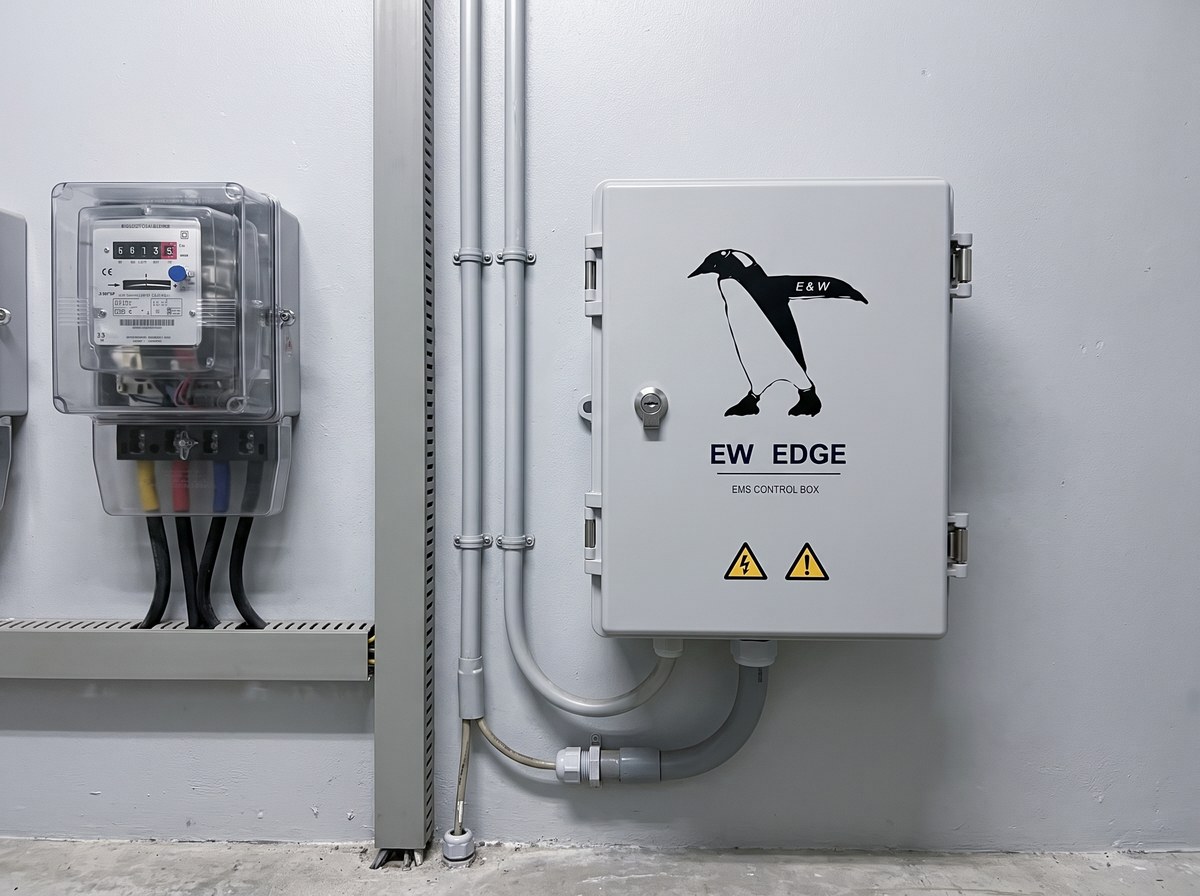
For a live run, an EWISER EW Edge control box goes on your power meter to feed real-time data to the monitoring platform. It reads the meter brands normally found on Malaysian sites over Modbus RTU and TCP. The standard collection period is one month, extendable by a further two weeks, which covers a full billing cycle and the shift patterns inside it. Any historical load data you already have is used first, to pre-train the algorithm on your demand patterns before live collection starts.
Historical replay needs no hardware, only the load data your site already holds.
The one-month period follows the bill. MD is charged on a single half-hour peak in the billing period, so a check shorter than a full cycle can miss the day that sets the charge. A month covers normal production, the quiet weeks and the busy ones, and the occasional day when everything starts at once.
What does the check not tell you?
It doesn't settle your return on investment. That depends on your tariff, the CAPEX, how the purchase is financed and what it costs to run, and the validation touches none of them. It also leaves the engineering with your contractor: site assessment, protection design, equipment selection, the grid connection, and compliance with the Energy Commission's BESS Safety Guidelines (GP/ST/No.62/2026).
What it gives you is evidence on the sizing and the dispatch strategy, measured against your own factory. Ask your contractor how the proposed system responds to your load, and what validation has been done before you sign. The C&I cabinets a proposal is likely to name, such as the Sungrow PowerStack range, are on our Sungrow cabinet battery page.
Live Shadow Mode is available in Malaysia through InverPower, with a working installation at the Puchong headquarters that can be demonstrated on a real load. Batteries for MD shaving are on our battery energy storage page.
Frequently Asked Questions
How does a BESS reduce maximum demand for a factory?
The battery discharges during demand peaks so less power is drawn from the grid in the half-hour the meter records as your highest. MD is billed per kW on that peak, largely independent of total consumption, so cutting it reduces the charge.
How do I know what BESS size my factory needs?
Sizing follows your site's half-hourly demand profile and the operating strategy proposed for it. Running the proposed configuration against your own load data before installation lets you check that calculation.
Can I compare two BESS sizes before buying?
Yes. Different proposed configurations can be dispatched against the same load, which shows what the extra capacity in the larger option delivers and where it stops delivering more.
Can this prove the ROI on a BESS?
No. It gives evidence for the MD-shaving behaviour and how the battery is used, which is one input to the return. Tariff, CAPEX, financing terms and operating costs decide the rest.
Does my factory need hardware installed for this?
For a live run, an EWISER EW Edge control box is fitted at your power meter for the real-time data and monitoring. A historical replay needs no hardware, only the load data your site already has.
Sources
- EWISER, Live Shadow Mode: virtual BESS representation, historical analysis and live shadow operation: https://ewiser.energy/solutions/live-shadow
- EWISER, BESS Sizing Tool (EStack+), pre-investment sizing from historical site load: https://ewiser.energy/solutions/bess-sizing-tool
- EWISER, Malaysia market page: https://ewiser.energy/markets/malaysia
- TNB, Maximum Demand definition (twice the largest kWh in any consecutive 30 minutes): https://www.tnb.com.my/commercial-industrial/maximum-demand
- TNB, myTNB tariff page: ToU peak 2pm to 10pm weekdays, capacity and network charges per kW: https://www.mytnb.com.my/tariff/index.html
- Energy Commission, BESS Safety Guidelines, GP/ST/No.62/2026: https://www.st.gov.my/sites/default/files/2026-05/Guidelines-on-Battery-Energy-Storage-System-(BESS)-Safety_0.pdf
About InverPower
InverPower is Malaysia's A–Z solar component distributor — Sungrow Preferred Authorised Distributor and Sunkean Sole Distributor — supplying EPCCs, installers, and government projects nationwide.
Explore the InverPower resource hub at inverpower.com.my
Related InverPower posts:
- How Do You Size a BESS for MD Shaving on a C&I Site in Malaysia?
- TNB time-of-use tariff: what are the peak hours and rates for solar sites?
- Adding a battery to existing solar: AC-coupled or DC-coupled?