

Structuring a Solar Quotation: How Much Detail Should the Client See?
Published by Quinn Lai | By InverPower Technical Team
Published 22 August 2026 · Last updated 22 August 2026
DIRECT ANSWER
Enough that every category is visible and nothing is hidden inside a single figure. Break the quotation into equipment by type, installation, electrical works, connection and commissioning, then state the assumptions and exclusions in plain language. It builds trust at the sale and it settles arguments about scope later.
A lump sum tells a client one thing: the total. Everything else they might want to know — what equipment they are getting, what happens if the roof turns out to need work, who applies for the connection — is invisible, so they either ask for it line by line or they compare your total against someone else's and pick the smaller one.
A single figure works against you
Two things happen. First, the client cannot see the difference between your proposal and a cheaper one, so the decision defaults to price. A quotation that shows the module, the inverter and the balance of system by name lets a client understand why one number is larger, and that is a conversation you can win.
Second, and more expensive: a lump sum makes every mid-project change a negotiation from zero. If the roof needs a structural repair, or the board turns out to have no spare ways, there is nothing in the document that says whether that was included. An itemised quotation with clear exclusions answers that question in a sentence rather than a meeting.

The categories worth separating
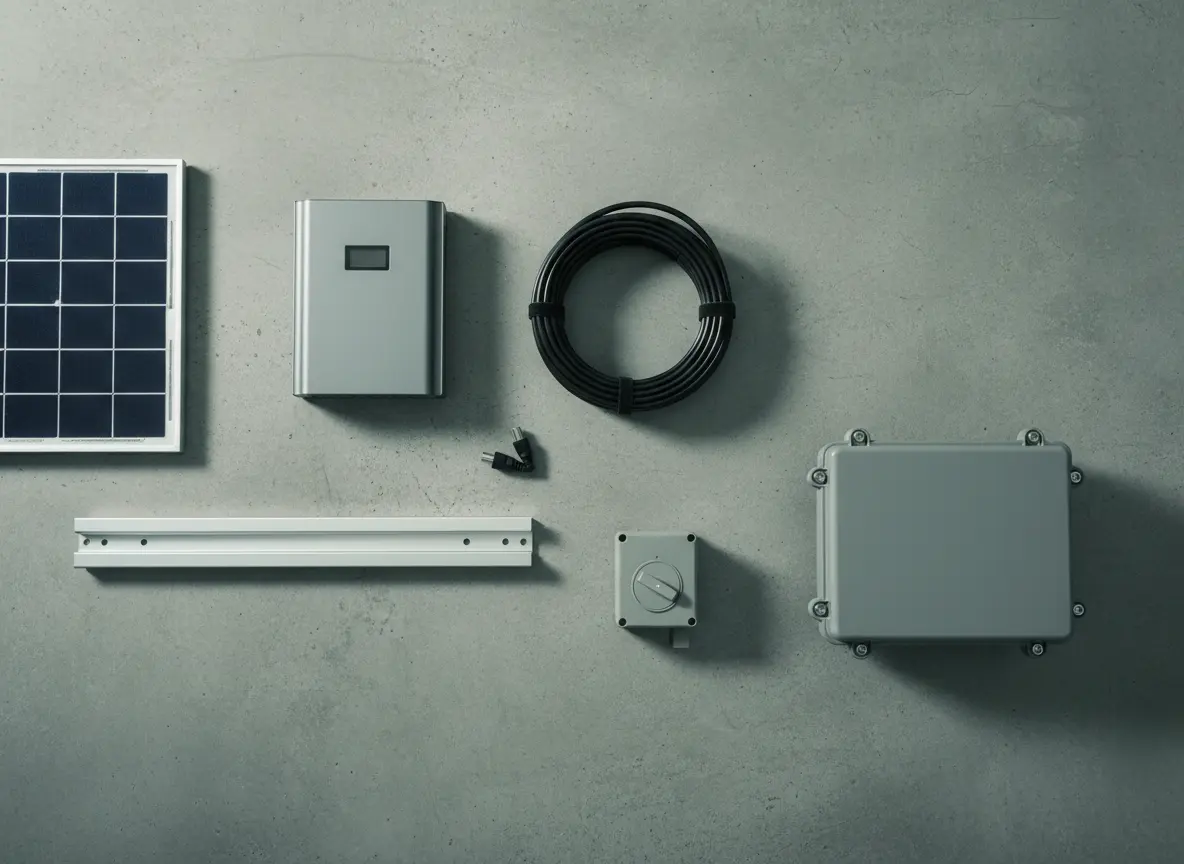
Group by what the client can actually distinguish, not by your internal cost codes. Modules by make, model and quantity. Inverters the same way. Mounting and structure. The electrical balance of system — cable, protection, isolation, containment. Installation labour and access. Electrical works at the connection point. Application, commissioning and handover. Monitoring. Anything optional, priced separately so the client can choose rather than negotiate.
This is also where an EPCC's sourcing shows. Named brands with model numbers and certification references read as a specified system; "solar panels, 400W" reads as whatever was cheapest that week, and invites the client to substitute.
Quantities matter as much as names. A schedule that says how many modules, how many inverters and how many metres of cable lets a client check the design against the capacity they were promised, and it makes a later substitution visible. It also gives you something precise to point at when a competitor's cheaper proposal turns out to be a smaller system described in the same language.
Assumptions and exclusions, in plain language
The most valuable paragraph in a solar quotation is the one that says what it assumes. Roof condition and remaining life as inspected. Structural capacity as assessed, and by whom. Available headroom at the connection point. Who applies for the connection and who pays the fees. Working hours and access arrangements. What happens if asbestos, ponding or a failed membrane is found.
Write them as statements a client can understand rather than as legal boilerplate. "This quotation assumes the existing main board has capacity for the new connection; the survey found X, and if that proves incorrect an upgrade would be a variation" is a sentence any facilities manager can act on. The equivalent buried in terms and conditions is not.

The rest of the document
| Section | What it contains | Why the client needs it |
|---|---|---|
| Scope summary | What is being installed, in one paragraph | Confirms you understood the brief |
| Equipment schedule | Make, model and quantity by category | Lets them compare like with like |
| Works | Installation, electrical, access | Shows what the labour actually covers |
| Connection and approvals | Who applies, who pays fees, expected sequence | The most common source of delay |
| Commissioning and handover | Tests, documentation, training | What they receive at the end |
| Warranty summary | Product and performance terms, and exclusions | Sets expectations before a claim |
| Assumptions and exclusions | What the price depends on | Prevents the mid-project argument |
| Payment terms | Milestones and what triggers each | Cash flow on both sides |
| Validity | How long the price holds | Equipment pricing and lead times move |
The limit on detail
The limit is usefulness. A client wants to see categories, brands, quantities and the boundaries of the scope. They do not want a line for every cable gland, and an over-itemised quotation invites line-by-line haggling over items that cannot be removed. Group the small parts into a balance-of-system line and name what it covers.
Two things are worth resisting. Showing your margin structure, which is what a fully costed breakdown effectively does. And promising energy or savings figures with more precision than the modelling supports — a yield estimate with its assumptions stated is a professional document; a savings figure presented as a fact is a hostage.
Presentation does some of the work too. A quotation that is easy to read — consistent headings, a scope paragraph at the front, the assumptions where they can be found rather than at the back in small type — signals the same care the installation will get. Clients cannot assess your engineering from a document, so they assess the document.
Validity and lead times
Put a validity period on the price and mean it. Module and inverter pricing moves, and so do lead times; a quotation that was honest in March can be unprofitable in June. State what the price is based on being available, and where an item has a long lead time, say so — clients plan around information and resent surprises.
InverPower quotes EPCCs from stock held in Malaysia, with current availability and lead times on the items we do not hold. Send the bill of materials and we will come back with what is on the shelf, so the equipment schedule in your quotation is something you can stand behind.
Frequently Asked Questions
Should warranty terms be spelled out in the quotation?
A summary should be: product and performance terms for the main equipment, and what a claim does not cover — freight, labour and access. It takes three lines and it prevents the most common post-installation misunderstanding, which is a client expecting a free replacement to arrive fitted.
How much detail is too much for a client-facing quote?
When the itemisation starts exposing your cost structure or listing components the client cannot make a decision about, it has gone too far. Categories, brands, models and quantities are useful; individual fixings are not, and they invite haggling over items that are not optional.
Should a quotation include energy yield figures?
Yes, with the assumptions attached — the irradiance data used, the losses assumed and the software used to model it. Presented as an estimate with a basis, it is professional. Presented as a promise, it becomes a performance claim you may be asked to stand behind.
What protects an EPCC when scope changes mid-project?
The assumptions and exclusions paragraph, plus a variation process stated in the quotation. Together they turn a discovery on site into a defined variation rather than a dispute about what the original price was supposed to include.
Sources
- IEC — IEC 62446-1, Photovoltaic (PV) systems: requirements for testing, documentation and maintenance, which defines the handover deliverables a quotation should promise — https://webstore.iec.ch
- Department of Standards Malaysia — MS 1837:2018, Installation of grid-connected photovoltaic (PV) system — https://www.jsm.gov.my
- TNB — connection application process, fees and requirements for distributed generation — https://www.tnb.com.my
- SEDA Malaysia — Solar ATAP programme, application through a registered PV service provider — https://www.seda.gov.my/reportal/atap/
- Electricity Supply Act 1990 (Act 447) and the Electricity Regulations 1994 — competent person and contractor requirements — https://lom.agc.gov.my
About InverPower
InverPower is Malaysia's A–Z solar component distributor — Sungrow Preferred Distributor and Sunkean Sole Distributor — supplying EPCCs, installers, and government projects nationwide.
Explore the InverPower resource hub at inverpower.com.my
Related InverPower posts:
- Site Assessment: What Has to Be Checked Before the Quote Goes Out?
- Handover Documentation: What Does a Complete Solar Package Contain?
- Where Do EPCCs Source Solar PV Components in Malaysia?