
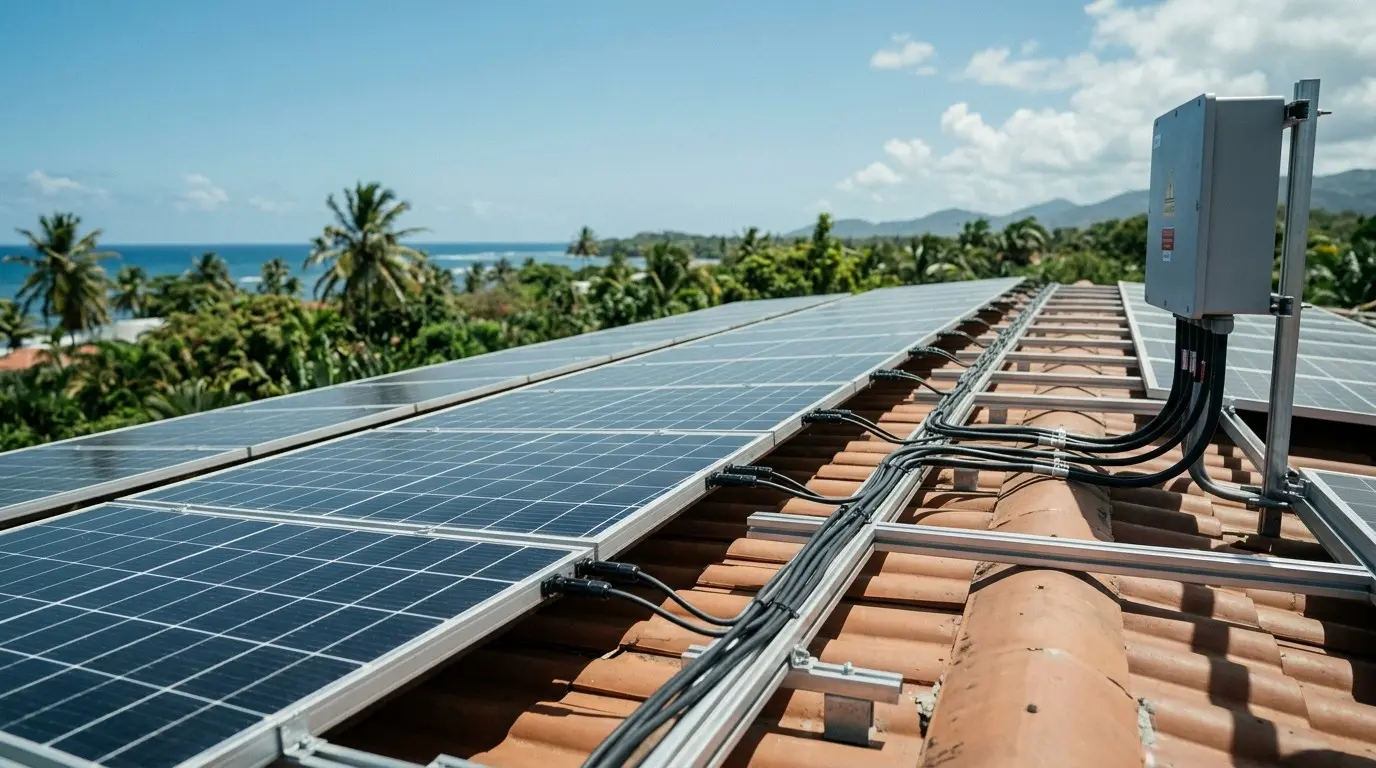
How Do You Size a Solar String for a Malaysian Rooftop?
Published by Quinn Lai | By InverPower Technical Team
Published 14 August 2026 · Last updated 14 August 2026
DIRECT ANSWER
String sizing means choosing how many modules go in series so the string voltage stays inside the inverter's limits in every condition the site will see. In Malaysia the binding constraint is usually the maximum input voltage on a cool morning, not the hot-afternoon minimum — which is the opposite of the temperate-climate assumption most templates are built on.
String sizing is the calculation most often inherited rather than performed. A template comes from a supplier, a previous project or a European design guide, the module count looks reasonable, and nobody re-runs it against the actual pairing on the actual roof. It survives because the failure is quiet: a string slightly outside the window does not announce itself, it just produces less than the model said it would, for twenty-five years.
What are the two limits a string has to respect?
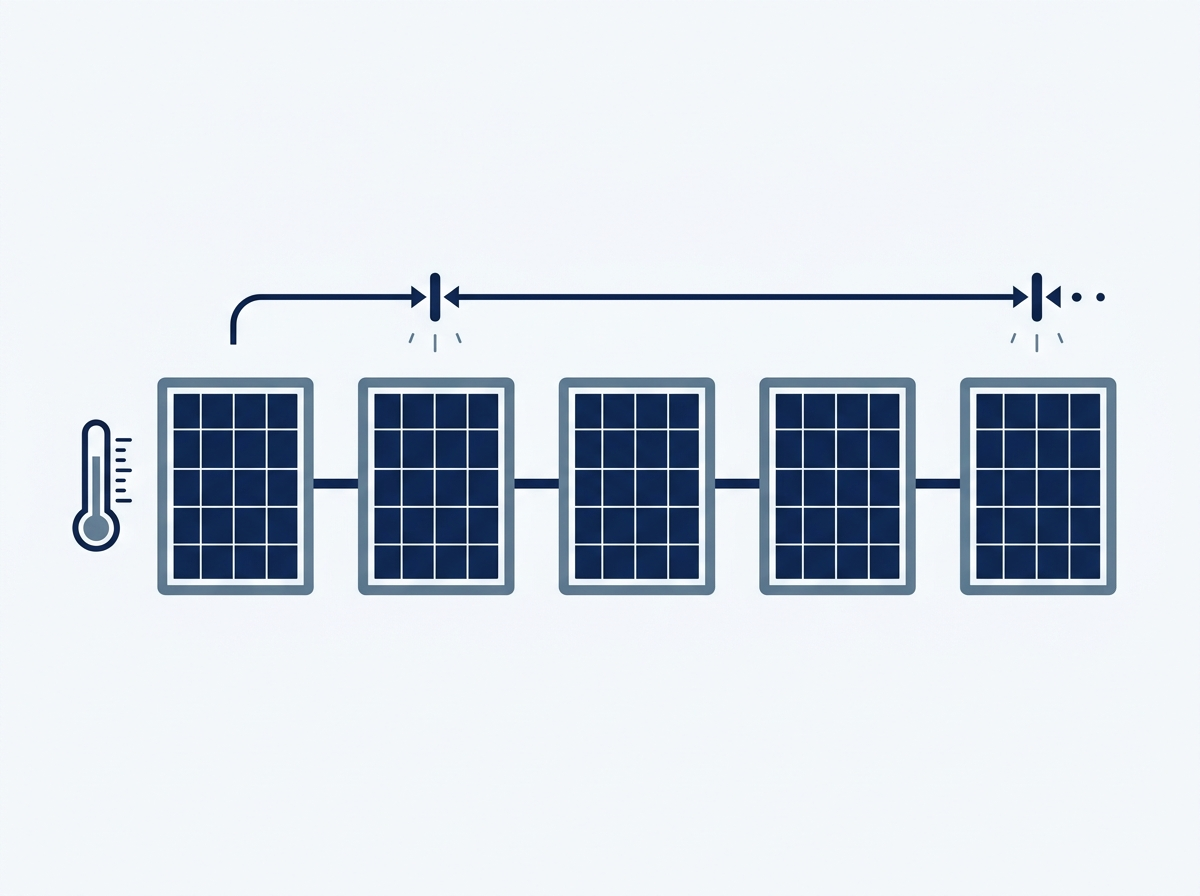
Every inverter datasheet gives two different voltage numbers and they do different jobs. The maximum PV input voltage is a hardware limit — exceed it and you risk damage, and you void the warranty argument before you start. The MPP voltage range is an operating window: inside it the inverter can track the array's maximum power point, and outside it the inverter is either not running or not tracking properly.
A string has to sit under the hardware limit at its highest possible voltage, and inside the tracking window at its lowest. Those two conditions happen at opposite ends of the day, which is why the calculation needs two cases rather than one.
The highest voltage a string will ever produce is its open-circuit voltage at the lowest cell temperature it will ever see — typically first light, before the inverter has begun exporting. The lowest operating voltage is the maximum power point voltage at the hottest cell temperature, which on a Malaysian rooftop is a genuinely extreme number.
Why does Malaysian heat change the answer?
In a temperate market the design driver is cold. A −10 °C winter morning pushes open-circuit voltage well above the datasheet figure, so strings get shortened to stay under the inverter's ceiling. That is the logic baked into most imported templates.
Malaysia has no cold case worth the name. Our coolest cell temperatures sit close to the 25 °C standard test condition, so open-circuit voltage barely rises above the datasheet number. What we have instead is a punishing hot case: cell temperature on a rooftop at midday runs far above the ambient air temperature, dragging the maximum power point voltage down.
The practical consequence catches people out. Because our cold case is mild, Malaysian strings can often be longer than a European template allows — but the ceiling arrives suddenly, and the hot case has to be checked against the bottom of the tracking window rather than assumed safe.

What does a real worked example look like?
Take a Trina Vertex S+ 440 W module and a Sungrow SG125CX-P2, both of which we distribute, using each manufacturer's published figures. The module gives 52.2 V open circuit and 44.0 V at maximum power, with temperature coefficients of −0.24 %/°C on open-circuit voltage and −0.29 %/°C on power. The inverter accepts 1100 V maximum and tracks between 180 V and 1000 V.
| Check | Condition | Result |
|---|---|---|
| Module open circuit | 52.2 V at 25 °C standard test conditions | The datasheet starting point |
| Cool-morning voltage | About 20 °C cell temperature | Roughly 52.8 V per module |
| 20 modules in series | 20 × 52.8 V | About 1,056 V — under the 1,100 V limit |
| 21 modules in series | 21 × 52.8 V | About 1,109 V — over the limit, not allowed |
| Hot-afternoon operating voltage | Around 62 °C cell temperature | Roughly 40 V per module |
| 20 modules, hot | 20 × 40 V | About 800 V — comfortably inside the tracking window |
The answer for this pairing is twenty modules, and the number is set by the cool-morning ceiling rather than by the heat. Twenty-one breaks the hardware limit. It is worth seeing how little margin there is at twenty — about four percent — which is precisely why the calculation should be run rather than inherited.
Note also the bottom end. At twenty modules the hot-case string sits around 800 V, nowhere near the 180 V floor, so the tracking window is not the constraint here at all. On a much shorter string — five or six modules on a small roof section — it becomes the constraint instead, and the check runs the other way.
Where do string calculations usually go wrong?
- Reusing a template built for a cold climate, which shortens strings unnecessarily and leaves inverter capacity unused.
- Using ambient air temperature instead of cell temperature for the hot case. Cell temperature on a rooftop runs well above the air around it.
- Sizing on the maximum power point voltage while forgetting that open-circuit voltage — the higher number — is what the hardware limit applies to.
- Ignoring the module's NOCT figure, which is the datasheet's own statement about how hot that module runs in service.
- Mixing module models or ages within one string, so the string's behaviour no longer matches any single datasheet.
- Treating one calculation as valid for the whole site when different roof sections have different orientations, tilts and airflow.
The last one is the expensive habit. A single string calculation covering an entire multi-orientation roof is not a calculation, it is an assumption applied several times.

How does InverPower support the sizing conversation?
We distribute both sides of this calculation — Trina modules and Sungrow inverters — and we hold the datasheets the numbers come from, at the revision that matches the stock you are quoting. The string design belongs to the EPCC and we do not step into it. What we can do is make sure the figures you are working from are the manufacturer's current ones rather than a value copied from an older version of the same product.
Frequently Asked Questions
Does Malaysia's heat make strings shorter or longer than in temperate climates?
Usually longer. Cold weather is what forces short strings elsewhere, by pushing open-circuit voltage above the inverter's limit. Malaysia has no meaningful cold case, so the ceiling is set closer to the datasheet figure and more modules often fit in series.
What happens if a string exceeds the inverter's MPPT window?
Two different failures. Above the maximum input voltage you risk damaging the inverter and forfeiting warranty cover. Below the tracking window the inverter cannot find the maximum power point and either under-produces or does not start.
Should I size on open-circuit voltage or maximum power point voltage?
Both, for different checks. Open-circuit voltage at the coolest cell temperature is what the maximum input voltage limit applies to. Maximum power point voltage at the hottest cell temperature is what has to stay above the bottom of the tracking window.
Can I use one string calculation for a whole rooftop?
Only if the whole rooftop is one orientation, one tilt and one mounting condition. Different sections run at different cell temperatures and produce different voltages, so each electrically distinct group needs its own check.
Sources
- Trinasolar — Vertex S+ NEG9R.28 datasheet, APAC 2024 (temperature coefficients, NOCT, electrical data) — http://static.trinasolar.com/sites/default/files/Vertex%20S+_NEG9R.28_EN_2024_APAC_A_web.pdf
- Sungrow — SG125CX-P2 inverter datasheet, Version 13 (MPP voltage range, maximum PV input voltage) — https://info-support.sungrowpower.com/application/pdf/2023/02/28/DS_20230227_SG125CX-P2_Datasheet_V13_EN.pdf
- Department of Standards Malaysia — MS 1837:2018, Installation of grid-connected photovoltaic (PV) system — https://www.jsm.gov.my/
About InverPower
InverPower is Malaysia's A–Z solar component distributor — Sungrow Preferred Distributor and Sunkean Sole Distributor — supplying EPCCs, installers, and government projects nationwide.
Explore the InverPower resource hub at inverpower.com.my
Related InverPower posts:
- MPPT Explained: How Do Solar Inverters Track Maximum Power?
- Sungrow SG125CX-P2 vs SG110CX: Which Fits Your C&I Rooftop?
- Which Solar Inverters Are SEDA-Registered in Malaysia (2026)?