Sungrow SG125CX-P2 vs SG110CX: Which Fits Your C&I Rooftop?
Published by Quinn Lai | By InverPower Technical Team
Published · Last updated
DIRECT ANSWER
For a Malaysian commercial and industrial rooftop, both are Sungrow three-phase 400V string inverters — but they suit different projects. The SG125CX-P2 is the newer “-P2” platform: 125kW output, 12 MPPTs, and 30A maximum input current per MPPT, which gives it the headroom for large-format, high-current modules (182mm / 210mm cells, high-Isc bifacials) and larger rooftops that benefit from more independent MPPTs. The SG110CX is the earlier-generation 110kVA unit with 9 MPPTs and 26A per MPPT — a fine fit for mid-size rooftops whose string currents stay within about 26A, with a marginally higher headline efficiency. In short: choose the SG125CX-P2 for high-current modules and bigger arrays; the SG110CX for mid-size systems on lower-current strings. Always confirm the current datasheet at spec time.
What are these two inverters, in one line each?
Both are transformerless, three-phase, 1100V-input Sungrow string inverters built for commercial and industrial rooftops on Malaysia’s 400V network. The SG125CX-P2 is the second-generation (“-P2”) 125kW unit; the SG110CX is the earlier 110kVA unit. They share Sungrow’s C&I DNA — IP66, smart forced-air cooling, integrated surge protection, AFCI and PID recovery — so the decision comes down to MPPT count, input-current headroom, and the modules you’re pairing them with.
How do the specs compare side by side?
| Spec | SG125CX-P2 | SG110CX |
|---|---|---|
| Rated AC output | 125 kW / 125 kVA | 110 kVA (100 kVA @ 50°C) |
| Max AC output current | 181.1 A | 158.8 A |
| Number of MPPTs | 12 | 9 |
| DC inputs (strings) | 24 (2 per MPPT) | 18 (2 per MPPT) |
| Max input current per MPPT | 30 A | 26 A |
| Max PV input voltage | 1100 V | 1100 V |
| MPPT voltage range | 180–1000 V | 200–1000 V |
| Startup voltage | 200 V | 250 V |
| Max efficiency | 98.5% | 98.7% |
| European efficiency | 98.3% | 98.5% |
| Protection / cooling | IP66 / smart forced air | IP66 / smart forced air |
| Weight | ~87–93 kg (per datasheet rev.) | 89 kg |
| Notable | AFCI 2.0, string monitoring, PID recovery | AFCI, string monitoring, PID recovery |
Figures are from Sungrow / distributor datasheets. Datasheet revisions vary slightly (e.g. the SG125CX-P2 weight) — always confirm against the exact datasheet revision you’re quoting.
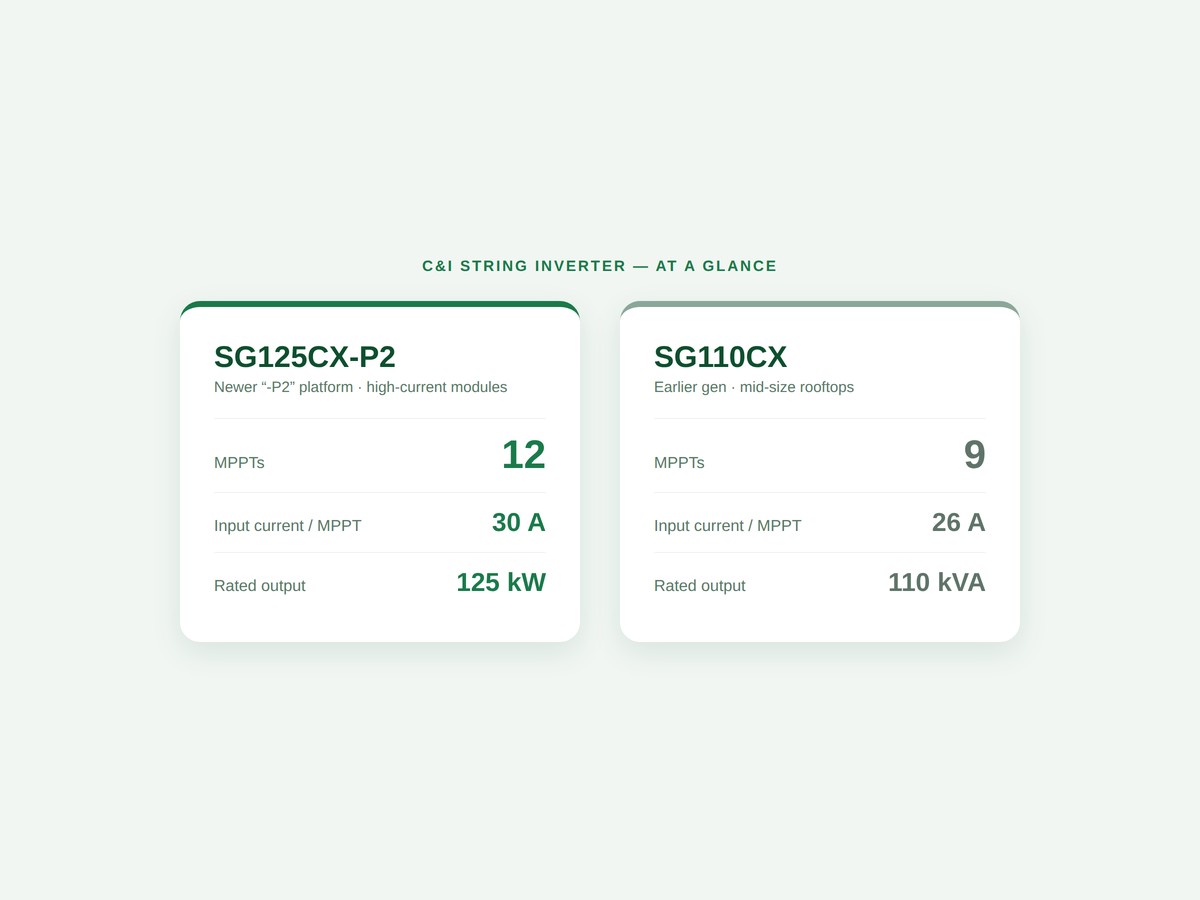
Comparison of MPPT count and input current between two Sungrow C&I string inverters
Why does input current (30A vs 26A) matter so much now?
Because modules have changed. Today’s large-format cells (182mm and 210mm) and high-power bifacials push higher short-circuit currents (Isc) per string than the panels of a few years ago. If a string’s operating current approaches or exceeds an inverter’s per-MPPT input rating, you either lose energy to clipping or can’t wire the string the way you’d like. The SG125CX-P2’s 30A per-MPPT input gives more margin for these high-current modules; the SG110CX’s 26A is comfortable for lower-current strings but is the tighter constraint if you’re speccing the newest high-Isc panels. This single number is often the deciding factor between the two.
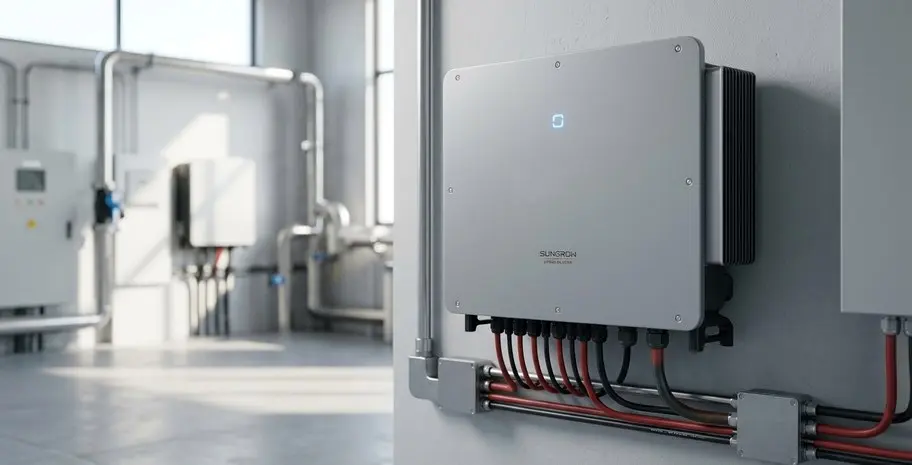
Commercial and industrial rooftop solar installation in Malaysia served by Sungrow string inverters
How much can I oversize the DC array on each?
More MPPTs and higher input current also give the SG125CX-P2 more flexibility to oversize (a higher DC:AC ratio), which can lift yield in tropical conditions where panels rarely hit their nameplate rating. It also means more independent MPPTs to handle multiple roof orientations or partial shading without dragging a whole array down to the weakest string. The SG110CX still supports sensible oversizing for mid-size systems — just confirm the current recommended maximum PV input power on the official datasheet before you finalise the DC:AC ratio, as that figure varies by revision.
Are both fine for Malaysian C&I and NEM?
Yes. Both are three-phase 400V transformerless inverters carrying the IEC 62109 safety and IEC 61727 / 62116 grid-interconnection and anti-islanding certifications that Malaysian grid-tied C&I and NEM projects require, and both integrate the protection features TNB looks for. As always — and as covered in our SEDA and TNB compliance guides — confirm the exact model is accepted for your specific TNB connection at the time of quotation rather than assuming it from the brand.
So which one should you spec?
- Choose the SG125CX-P2 when: you’re using large-format / high-Isc modules, want more MPPTs for shading or multi-orientation roofs, or plan a higher DC:AC oversize on a larger array.
- Choose the SG110CX when: it’s a mid-size rooftop, your module string currents sit comfortably within ~26A, and you want a proven, slightly higher-efficiency unit.
- Either way: match the inverter to the module’s string current first — that’s the number that most often makes the decision.
InverPower is a Sungrow Preferred Distributor — both models are supplied genuine and locally, with the current datasheet and firmware, so you spec the right unit and get it on time.
Frequently Asked Questions
Which inverter suits high-current 210mm or bifacial modules?
The SG125CX-P2. Its 30A per-MPPT input current gives more margin for high-Isc modules than the SG110CX’s 26A, so you avoid clipping and keep string-design flexibility.
How many MPPTs does each have, and why does it matter?
The SG125CX-P2 has 12 MPPTs; the SG110CX has 9. More MPPTs means more independent control for multiple roof orientations or partial shading, so one weak string doesn’t pull down the rest.
Do both run on Malaysian 400V three-phase C&I supply?
Yes — both are 3/N/PE 400V transformerless string inverters with a single three-phase AC output, suited to Malaysian C&I connections.
Which is more efficient?
On paper the SG110CX edges it (98.7% max / 98.5% EU vs 98.5% / 98.3% for the SG125CX-P2), but the difference is marginal and usually outweighed by the SG125CX-P2’s current headroom and MPPT count on modern arrays.
Are both certified for NEM and TNB grid connection?
Both carry IEC 62109 safety and IEC 61727 / 62116 grid and anti-islanding certifications and the protection features TNB requires. Confirm the specific model is accepted for your TNB connection at quotation time.
Sources
- Sungrow SG125CX-P2 datasheet (V6) — https://solsol.eu/file/view/2115/ds_20240709_sg125cx-p2_datasheet_v6_en.pdf
- Sungrow SG125CX-P2 — ENF Solar listing — https://www.enfsolar.com/pv/inverter-datasheet/15134
- Sungrow SG110CX datasheet (vpsolar) — https://www.vpsolar.com/download/catalog/Inverter/sungrow/SG110CX/Datasheet/Datasheet-Sungrow-SG110CX_EN.pdf
- Sungrow SG110CX product page — https://en.sungrowpower.com/productDetail/745/string-inverter-sg110cx
- Sungrow SG125CX-P2 datasheet (Krannich) — https://krannich-solar.com/fileadmin/user_upload/global/datasheets/Sungrow/sungrow-inverter-sg125cx-p2-datasheet.pdf
About InverPower
InverPower is Malaysia's A–Z solar component distributor — Sungrow Preferred Distributor and Sunkean Sole Distributor — supplying EPCCs, installers, and government projects nationwide.
Explore the InverPower resource hub at inverpower.com.my
Related InverPower posts:
- Who Is the Sungrow Distributor in Malaysia?
- Which Solar Inverters Are SEDA-Registered in Malaysia (2026)?
- String Inverters vs MLPE for Malaysian C&I Projects: How to Decide?