
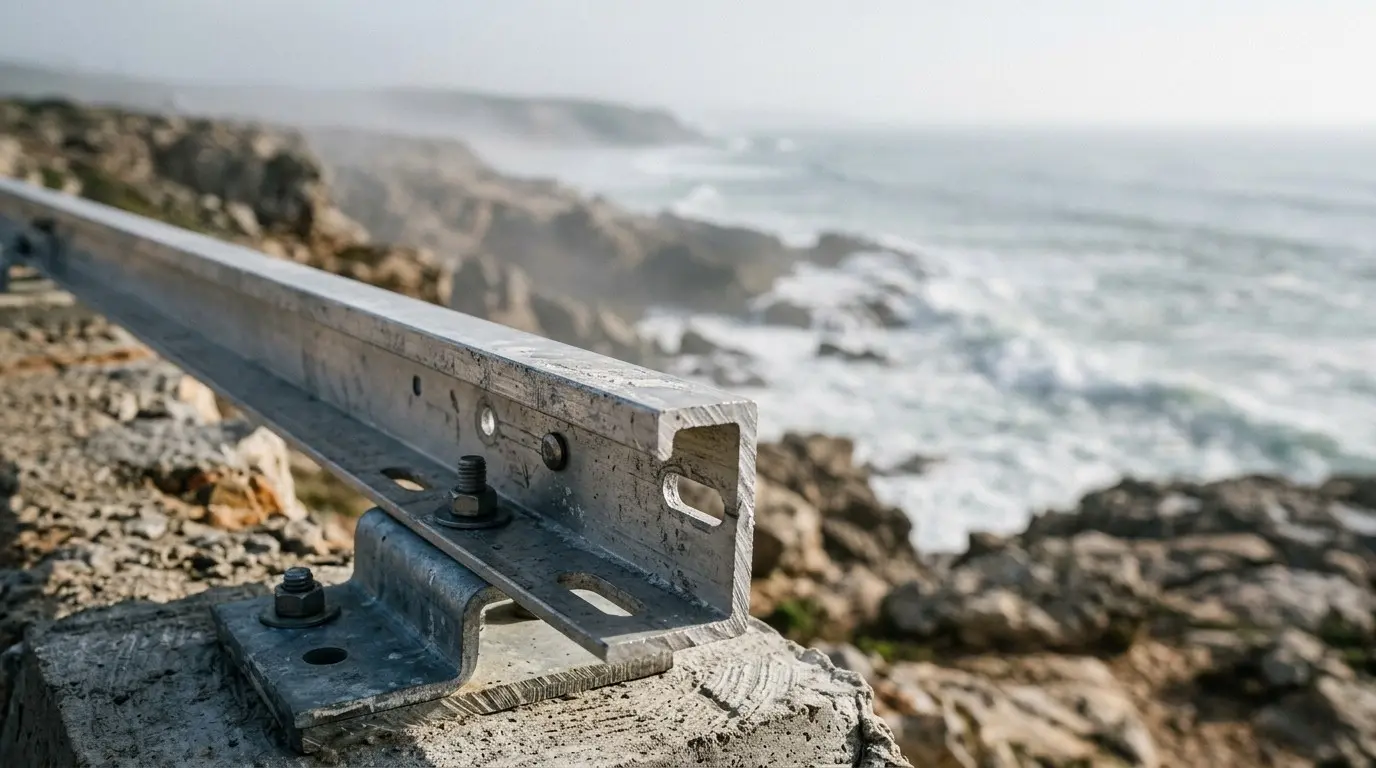
Racking Corrosion: Aluminium or Galvanised Steel for a Coastal Site?
Published by Quinn Lai | By InverPower Technical Team
Published 22 August 2026 · Last updated 22 August 2026
DIRECT ANSWER
Aluminium protects itself with an oxide layer and is the safer default in salt air; galvanised steel relies on a sacrificial zinc coating that is consumed faster the more aggressive the atmosphere. Neither is automatically right — the specification has to state the alloy or coating thickness, the fastener grade, and the corrosivity category the site actually sits in.
Malaysia has a long coastline and a lot of industry on it. A racking system specified for an inland site and installed within sight of the sea is not slightly worse; it is on a different clock. The specification that separates the two is short, and most of it is missing from the quotations that get compared.
Two metals, two failure mechanisms
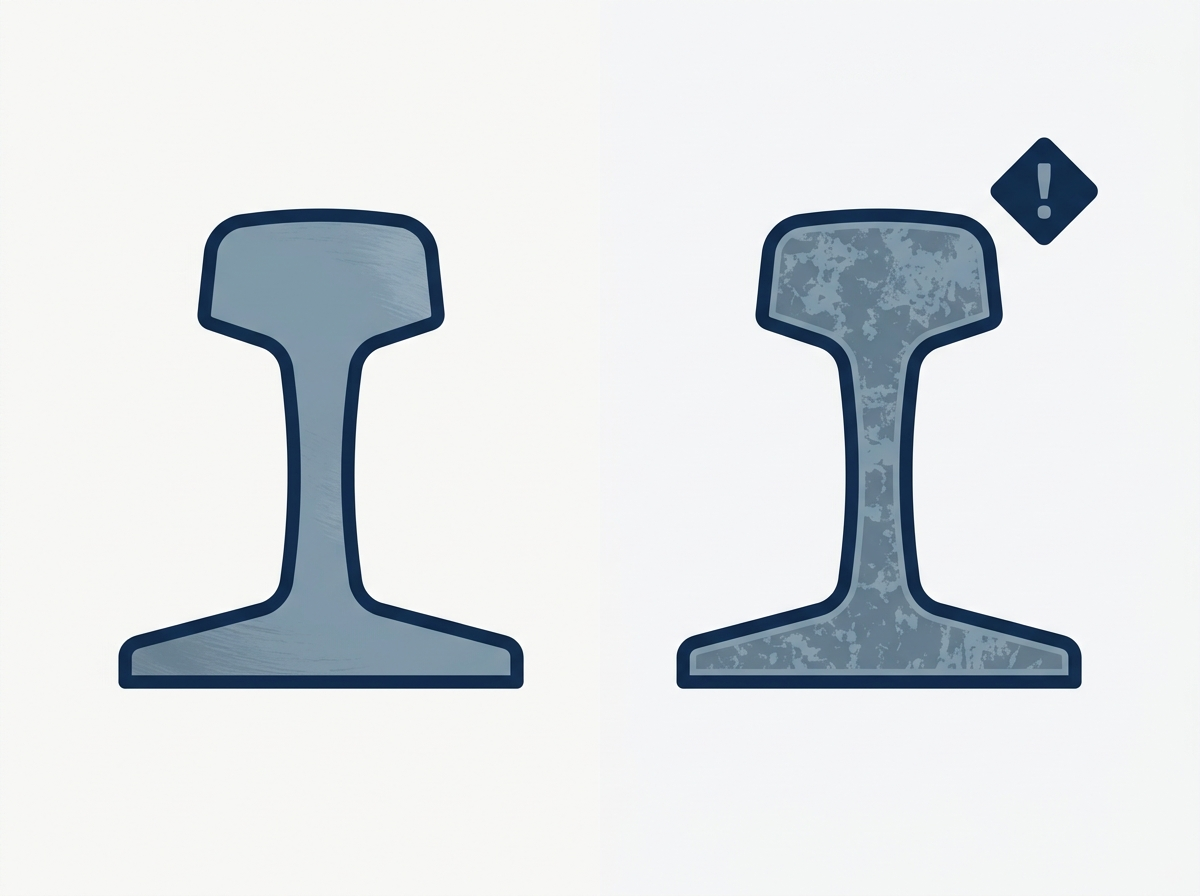
Aluminium forms a thin oxide layer as soon as it meets air, and that layer is what protects it. The layer re-forms when it is scratched, which is why aluminium survives outdoors without a coating. Its weakness is chloride: salt drives localised pitting through the oxide, and pitting is a depth problem rather than a surface one, so it shows up as perforation at a fixing hole rather than as an even loss of thickness.
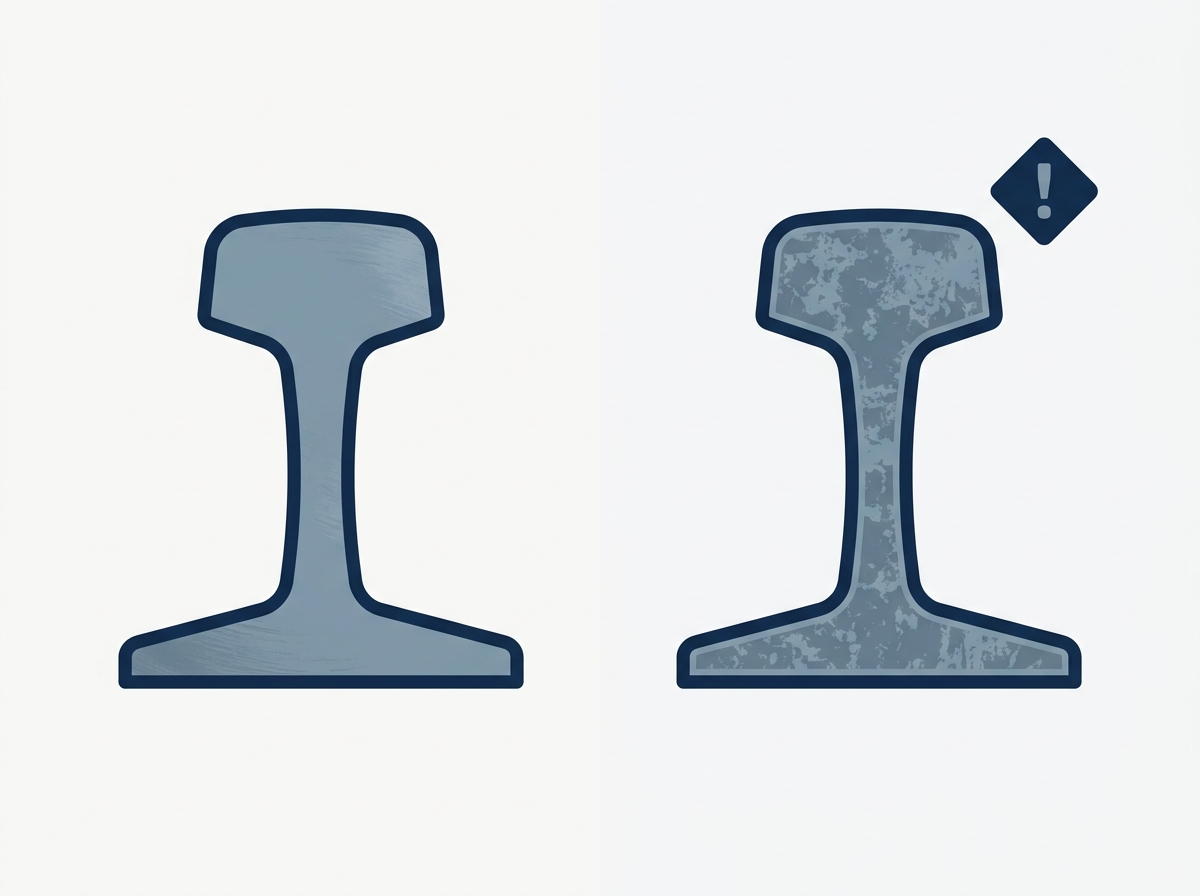
Galvanised steel works the opposite way. Zinc is applied over the steel and corrodes preferentially, protecting the steel underneath until the zinc is consumed. That gives a service life you can estimate: the more aggressive the atmosphere, the faster the zinc goes. In marine air it goes several times faster than inland, and once it is gone the steel underneath has nothing.
Classifying the site before specifying the metal
The vocabulary for this is the ISO 9223 corrosivity category, and it is the number a racking supplier should be asked for rather than a promise of durability. A rural inland site sits low on the scale. Urban and industrial areas sit higher. Coastal exposure sits higher again, and a site that is both coastal and industrial — which describes a good deal of Malaysian port and estate land — sits at the top of the practical range.
Distance from the shoreline matters, but so does what lies between. Prevailing wind carrying salt spray across open ground puts a building two kilometres inland in a harsher class than a sheltered site half that distance away. Where the classification is marginal, the cheap answer is to specify for the harsher one; the expensive answer is to find out in year six.
Industrial air deserves the same treatment. Sulphur dioxide from combustion and chlorides from process plant do to a coating what sea spray does, and a site inside a petrochemical or palm oil complex can be as demanding as a beachfront one. Classify the atmosphere the structure will stand in, not the postcode.
The lines a specification should carry
| Item | For aluminium | For galvanised steel |
|---|---|---|
| Material grade | Alloy and temper stated | Steel grade and coating standard |
| Surface treatment | Anodising thickness in microns | Zinc coating mass or thickness |
| Coating method | n/a | Pre-galvanised or hot-dip after fabrication |
| Cut and drilled edges | Not an issue | Exposed steel — needs treatment |
| Fasteners | Stainless grade suited to chloride exposure | Same |
| Dissimilar metal contact | Isolators where it meets steel | Isolators where it meets aluminium |
| Test evidence | Salt spray test result and duration | Salt spray test result and duration |
| Warranty | Coastal exclusions and distance limits | Coastal exclusions and distance limits |
The details that fail before the metal does
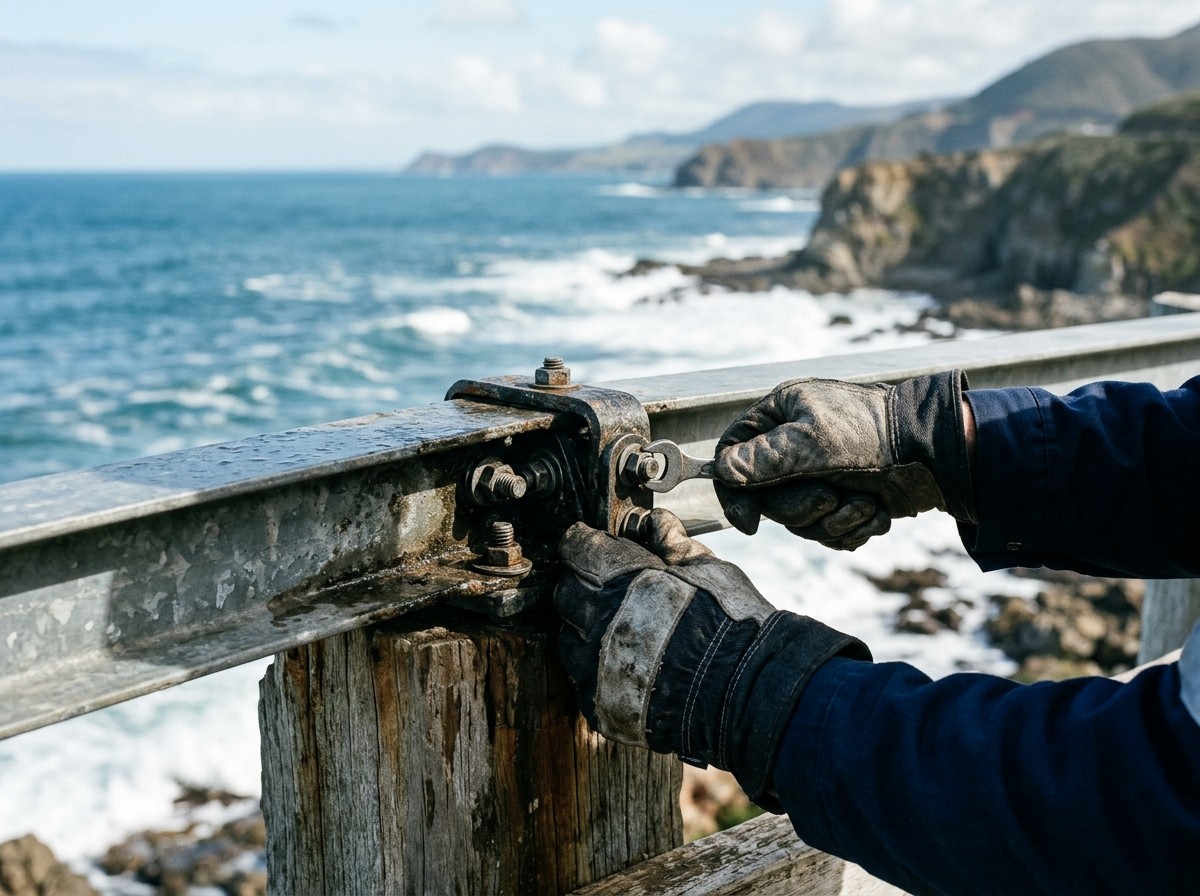
In practice, structures rarely fail because someone chose the wrong metal. They fail at the joints. Stainless fixings in an aluminium rail are a dissimilar-metal pair, and in salt air with a film of moisture between them that pair becomes a small battery which eats the aluminium around the fixing. Isolating washers and the correct fastener grade cost almost nothing and remove the mechanism.
The second is drilled and cut edges on galvanised steel. Galvanising applied before fabrication leaves every subsequent cut and hole with bare steel at its edge, which is exactly where water sits. Either the components are hot-dip galvanised after fabrication, or every cut and drilled edge is treated on site — and the second option depends on a crew doing it in the afternoon heat, so the first is the one to specify.
The third is water traps. Sections that hold standing water, feet sitting in a ponding area, and channels that fill with leaf litter all keep the surface wet for far longer than the weather does. Drainage is a corrosion decision as much as a structural one, and it is decided by how the frame is oriented and fixed rather than by what it is made of.
Reading the warranty
Racking warranties routinely carry a coastal exclusion — a stated distance from the shoreline, or a corrosivity category, beyond which the standard warranty does not apply unless an upgraded specification is supplied. That clause is the manufacturer telling you exactly what they think their product will survive, and it is worth more than the marketing copy above it. Read it before quoting, because a customer who discovers it during a claim will regard it as your omission.
InverPower distributes Enertrack mounting systems in Malaysia and holds them locally. Tell us where the site is and how exposed it is, and we will tell you which specification suits it, what the warranty says about that location, and what is in stock.
Frequently Asked Questions
Is galvanised steel unusable near the coast?
No, but it has to be specified for the environment — a heavier zinc coating, hot-dip galvanising after fabrication rather than pre-galvanised sheet, and treatment of any cut or drilled edges. Specified for an inland site and installed on the coast, it will not reach its intended life.
Does the racking material affect the system warranty?
It affects the racking warranty directly, since most carry coastal exclusions by distance or corrosivity category. It affects the rest of the system indirectly: a structure that loosens or perforates puts loads and movement into modules and cabling that were never designed for it.
Do stainless fixings solve corrosion on aluminium racking?
They solve the fixing's own corrosion and introduce a dissimilar-metal pair. In salt air that pair corrodes the aluminium around the fixing unless the joint is isolated. Use the fastener grade the manufacturer specifies, with the isolating hardware they specify with it.
How far inland does salt air matter?
Further than most people assume, and it depends on prevailing wind and what lies between the site and the shore. Open ground carries salt spray a long way; hills and dense development shorten it. Where the classification is borderline, specify for the harsher category.
Sources
- ISO — ISO 9223, Corrosion of metals and alloys: corrosivity of atmospheres, classification, determination and estimation — https://www.iso.org
- ISO — ISO 9227, Corrosion tests in artificial atmospheres: salt spray tests — https://www.iso.org
- ISO — ISO 1461, Hot dip galvanized coatings on fabricated iron and steel articles: specifications and test methods — https://www.iso.org
- Department of Standards Malaysia — MS 1553, Code of practice on wind loading for building structure — https://www.jsm.gov.my
- Enertrack — mounting system datasheets, material specifications and warranty terms — https://www.enertrack.com
About InverPower
InverPower is Malaysia's A–Z solar component distributor — Sungrow Preferred Distributor and Sunkean Sole Distributor — supplying EPCCs, installers, and government projects nationwide.
Explore the InverPower resource hub at inverpower.com.my
Related InverPower posts:
- Enertrack Mounting Systems: Which One Suits the Roof You Are Surveying?
- Grounding and Bonding for Solar Arrays: How Do You Prove Continuity?
- Where Do EPCCs Source Solar PV Components in Malaysia?