
Solar Monitoring: What Should an EPCC Actually Hand the Client?
Published by Quinn Lai | By InverPower Technical Team
Published 22 August 2026 · Last updated 22 August 2026
DIRECT ANSWER
Generation data alone tells a client the system ran; it does not tell them whether it ran well. Useful monitoring reports production against what the weather made available — the performance ratio — at string level where the inverter supports it, with alerts that fire on a deviation rather than on a total failure.
Every inverter sold today comes with an app. That is not the same as monitoring, and the difference shows up the first time a client asks whether last month was a bad month or a bad system. Answering that requires a reference, and the app on its own does not have one.
The data a platform pulls
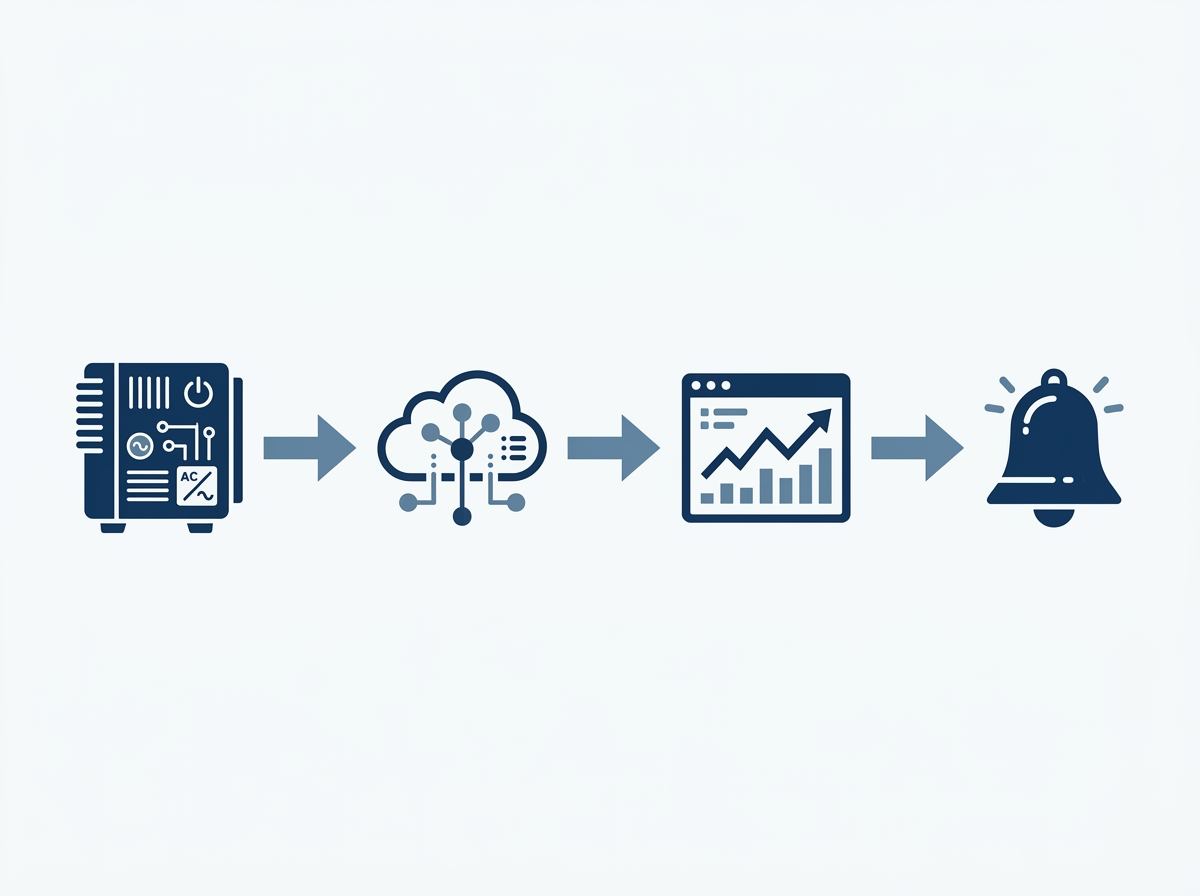
At minimum, energy and instantaneous power from the inverter, and its fault and status codes. Above that, per-string current and voltage where the inverter reports them, which is what turns a low reading into a location. Above that again, module-level data where the architecture provides it. And alongside all of it, whatever the site can supply about conditions — irradiance and temperature from a sensor or a weather station, or nothing at all.
That last input is what decides whether monitoring answers the client's real question. Without it, a dashboard can show that output fell; with it, it can show whether output fell more than the weather explains.
Performance ratio, not kilowatt-hours
Performance ratio compares what the system produced against what it should have produced given the irradiance that actually fell on it. It is dimensionless, it is comparable month to month regardless of weather, and it is the number a technical adviser or a lender will ask for. A ratio that drifts down over a year is telling you about soiling, degradation or a fault. A raw energy total that drifts down might just be a cloudier year.
For it to mean anything, the reference has to be measured rather than modelled. That is the argument for an irradiance sensor or a small weather station on any site large enough for the answer to matter — and it is why those sensors belong in the bill of materials on an O&M-contracted site rather than being sold later.

Alerts that are worth having
The alert everybody configures is zero output, and it is the least useful one, because a dead system is obvious within a day. The valuable alerts are the quiet ones: one string reading consistently below its neighbours, a performance ratio that has fallen by a few points and stayed there, a communications dropout that means nobody is watching, or an inverter derating repeatedly at the same time each day.
Set thresholds that reflect the site rather than the defaults. On a Malaysian roof a single cloudy afternoon should not trigger anything, while a string sitting five per cent below its identical neighbour for a fortnight should. Alerts that fire constantly get muted, and a muted alert is the same as no alert at all.
Decide who receives them, too. An alert routed to a project engineer who has moved on is the most common reason a fault sits unaddressed for months. Name a role rather than a person on the handover sheet, and check the address still works at the first annual service.
Standard package or optional extra
| Item | Include as standard | Reasonable as an option |
|---|---|---|
| Inverter-level monitoring | Yes — it comes with the equipment | — |
| Data logger and connectivity | Yes, with a stated connection method | Redundant connection on critical sites |
| String-level reporting | Yes on C&I where the inverter supports it | — |
| Irradiance or weather sensing | On any site with an O&M contract | Small residential |
| Performance ratio reporting | Yes, monthly | Weekly on large sites |
| Configured alerts and recipients | Yes, at handover | Escalation to a service desk |
| Consumption metering | Where self-consumption is the business case | — |
| Portal handover and training | Yes, with logins in the client's name | — |
The handover details that get missed
Three of them, and all three cause avoidable arguments. Accounts registered in the installer's name rather than the client's, which becomes a problem the day the client changes contractor. Connectivity that depends on the customer's guest wi-fi, which changes password and takes the system offline for a month before anyone notices. And a string map that exists only in the commissioning engineer's head, so string-level data cannot be tied back to physical modules.
Fix all three at handover: accounts in the client's name with the EPCC granted access, a connection method that is either wired or on a dedicated connection, and the string map on the as-built drawing.
A short monthly report closes the loop. One page — energy, performance ratio, any alerts raised and what was done about them — turns monitoring from a portal the client never opens into a service they can see the value of, and it makes the case for the O&M renewal without a separate conversation.
Specifying the hardware
Monitoring capability is an inverter selection criterion, not an accessory decision: string-level reporting, the logger it needs, the communication options it supports and what its platform exposes. InverPower stocks Sungrow inverters with their monitoring hardware, along with Seven and RainWise weather stations for sites that need a measured reference. Send the site details and we will tell you what the monitoring package should contain and what is in stock.
Frequently Asked Questions
Is monitoring included by default with most inverter brands?
Basic monitoring is, in the sense that the inverter reports to the manufacturer's platform. What is not automatic is a logger and connection that suit the site, string-level reporting configured and mapped, alerts set to sensible thresholds, and a measured irradiance reference — those are specification decisions.
How is underperformance actually flagged?
By comparison. A string against its identical neighbours, a month's performance ratio against previous months, or measured output against measured irradiance. Any of those turns a number into a judgement. A raw energy total, on its own, cannot separate a bad month from a bad system.
Does a small residential system need a weather station?
Usually not. The value of a measured reference scales with the cost of underperformance, so it belongs on O&M-contracted and revenue-metered sites. On a small residential system, string or module-level data and a sensible alert threshold are enough.
Who should own the monitoring account?
The client, with the EPCC given access. Accounts registered to the installer become an obstruction the moment the client changes contractor or sells the building, and transferring them later is harder than setting them up correctly at handover.
Sources
- IEC — IEC 61724-1, Photovoltaic system performance: monitoring, including performance ratio definitions and sensor requirements — https://webstore.iec.ch
- IEC — IEC 61724-2 and 61724-3, capacity and energy evaluation methods for PV systems — https://webstore.iec.ch
- Sungrow — inverter monitoring documentation, logger options and communication interfaces — https://www.sungrowpower.com
- Department of Standards Malaysia — MS 1837:2018, Installation of grid-connected photovoltaic (PV) system — https://www.jsm.gov.my
- Malaysian Meteorological Department — irradiance and weather data for Malaysia — https://www.met.gov.my
About InverPower
InverPower is Malaysia's A–Z solar component distributor — Sungrow Preferred Distributor and Sunkean Sole Distributor — supplying EPCCs, installers, and government projects nationwide.
Explore the InverPower resource hub at inverpower.com.my
Related InverPower posts:
- MPPT Explained: How Do Solar Inverters Track Maximum Power?
- String Inverters vs MLPE: How to Decide for Malaysian C&I?
- Who Is the Sungrow Distributor in Malaysia?