

Anti-PID Explained: Why Do Modules Quietly Lose Output in Malaysian Humidity?
Published by Quinn Lai | By InverPower Technical Team
Published 22 August 2026 · Last updated 22 August 2026
DIRECT ANSWER
Potential induced degradation is driven by the voltage difference between a module's cells and its earthed frame. That field moves ions through the laminate and shunts the cells, and heat and surface moisture accelerate it — which is why Malaysian conditions are among the harsher places to install a module that has not been tested for it.
PID does not announce itself. There is no fault code, no tripped device and nothing to see on the glass. What there is, three or four years in, is a string producing less than its neighbours and a customer asking why. By then the cause is inside a sealed laminate and the argument is a warranty conversation.

What is happening inside the laminate?
Cells sit at the string's operating voltage, and the frame is earthed. Toward one end of a string that difference is a few volts; toward the other it can be most of the array's voltage. That potential acts across the encapsulant and the glass, and it drives ions — sodium is the usual culprit, and glass is full of it — toward or away from the cell surface. Where they accumulate, they shunt the cell: current that should leave through the busbars leaks internally instead.
The result is a loss of output that grows over years, worst on the modules at the extreme end of the string and mild or absent at the other. That gradient along a string is the diagnostic signature, and it is why a whole array rarely degrades uniformly.
Heat and humidity accelerate it
Two accelerants, and Malaysia supplies both. Temperature increases ion mobility, so the same voltage moves more charge in a hot laminate than a cool one. Humidity provides the conductive path across the module's surface — a film of moisture on the glass, or water tracking along the frame, connects the cell's environment to the earthed frame far more effectively than dry air does.
That is why laboratory PID testing is done hot and wet, and why results from temperate markets travel badly. A module that behaves for a decade in a dry continental climate is not evidence of anything for a coastal roof in Penang, where the glass is wet at dawn most days of the year and the laminate runs well above ambient by mid-morning.
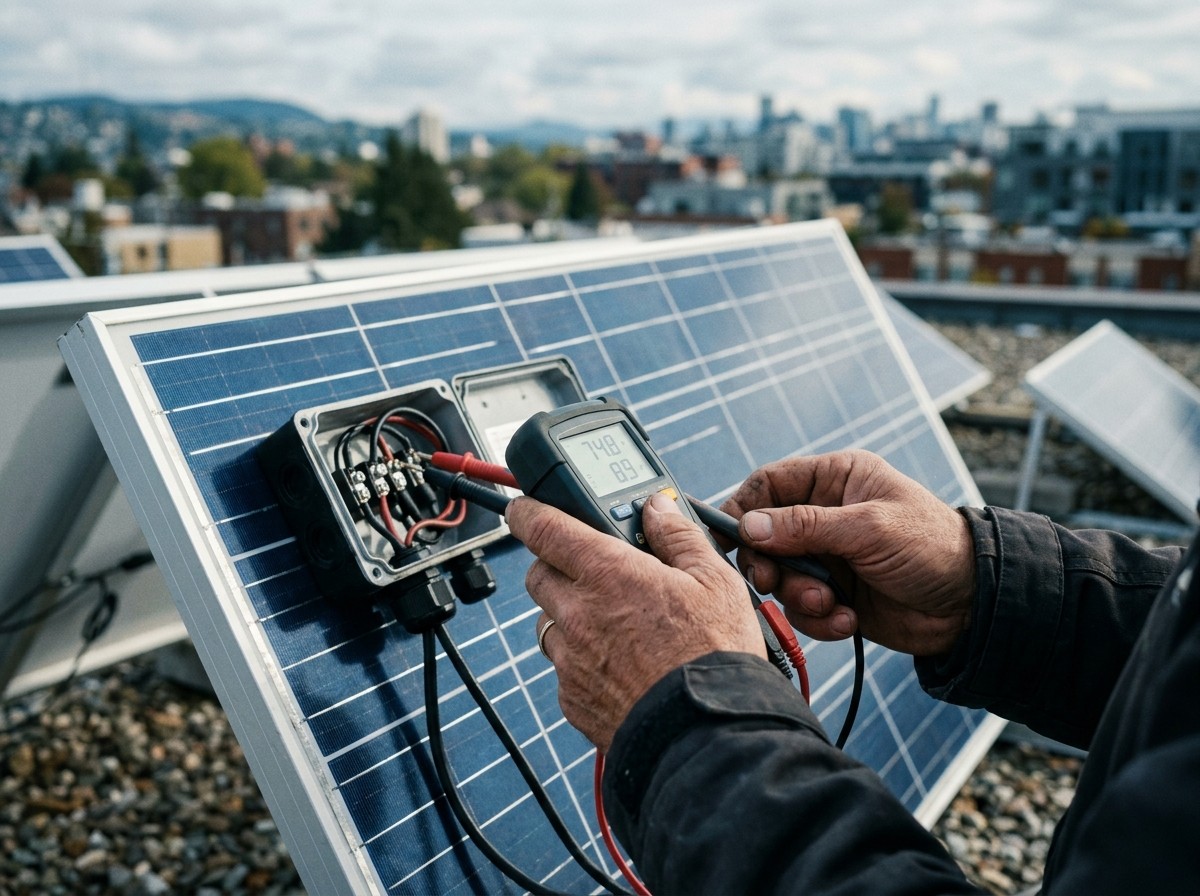
Designing modules against PID
Manufacturers address PID at several levels, and the differences are real rather than marketing. Cell design and the anti-reflective coating on the cell surface influence how easily charge accumulates. Encapsulant chemistry matters: polyolefin encapsulants have far lower ionic conductivity than the older ethylene vinyl acetate, which is one reason they have spread through the industry. Glass composition affects how much sodium is available in the first place. And cell architecture matters — n-type designs are structurally less susceptible to the shunting mechanism that affects conventional p-type cells.
None of that is visible on a module. What is visible is a test result, and this is the reason to read the datasheet's certification block rather than its headline efficiency.
The datasheet lines that matter
| Line | What to look for | Why it matters |
|---|---|---|
| PID test | Tested to IEC TS 62804-1 | The standard method; a claim without it is a claim |
| Test conditions | Temperature, humidity and duration stated | Severity varies; the conditions are the substance |
| Encapsulant | Polyolefin or equivalent low-conductivity material | Lower ionic conductivity through the laminate |
| Cell type | n-type or p-type architecture | n-type designs are less susceptible |
| Maximum system voltage | 1000 V or 1500 V rating | Sets the worst-case potential to frame |
| Warranty terms | Degradation curve and exclusions | What is actually recoverable if it happens |
| Inverter compatibility | Whether the module tolerates the inverter's earthing scheme | Some combinations raise the risk |
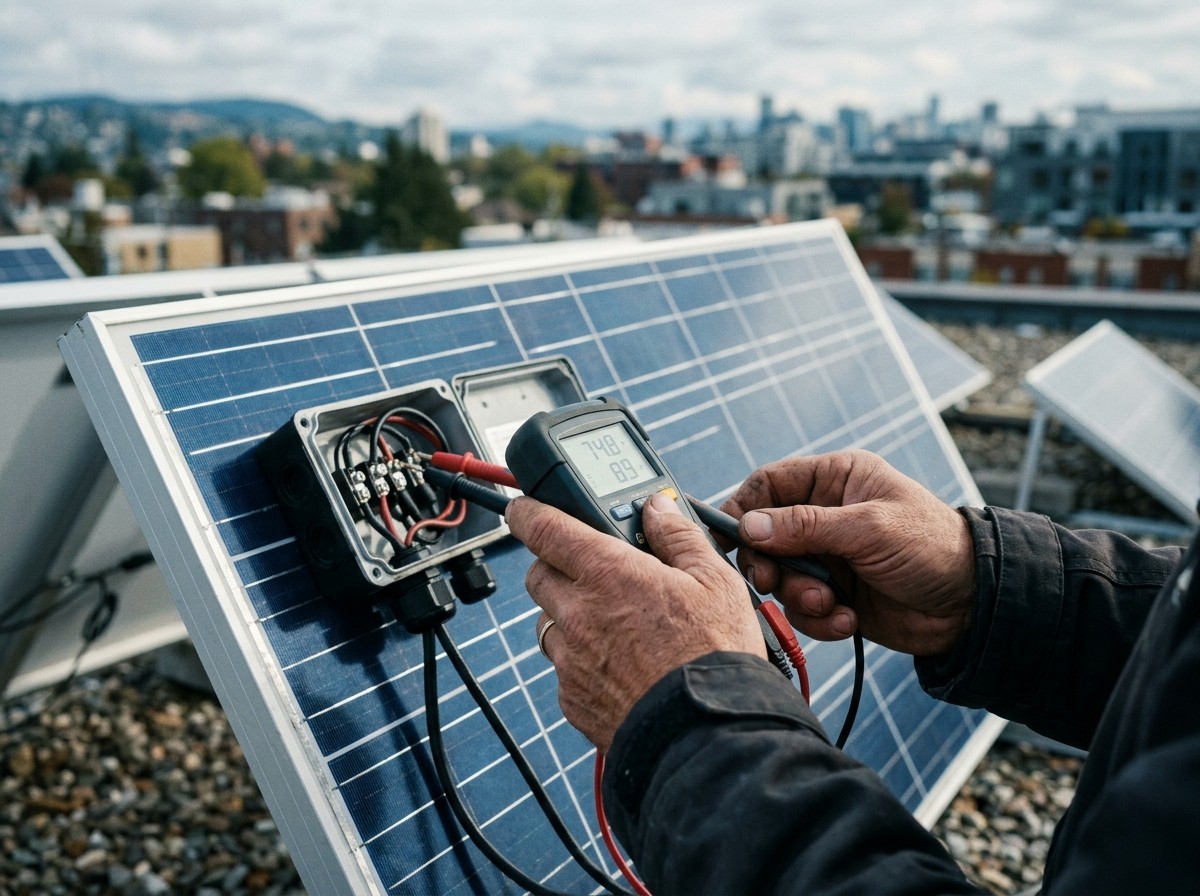
Design decisions that change the risk
String length is the obvious one. The modules that suffer are those at the end of the string furthest from earth potential, and a longer string means a larger potential difference at that end. A 1500 V system is more exposed than a 1000 V one, all else equal, and that is a live consideration on large Malaysian ground mounts.
The inverter's earthing arrangement is the other. Older designs allowed one pole of the array to be earthed, which removes the negative-to-earth potential entirely; most modern transformerless inverters leave the array floating instead. Some manufacturers offer anti-PID functionality that applies a corrective bias to the array overnight, and where that is available it is a genuine mitigation on a site with a known risk. Whether it is needed is a design question, and it belongs in the specification rather than in a retrofit.
If it has already happened
Partial recovery is possible on the classic shunting mechanism: applying a reverse bias overnight, whether through an inverter function or a dedicated recovery unit, can drive some of the accumulated charge back. Recovery is rarely complete, it takes weeks, and it does nothing about any physical corrosion that has started. Treat it as a way of arresting a loss rather than undoing one.
The evidence for a claim is the same evidence you would collect anyway: module-level measurements across the string showing the gradient, the string layout, and the site conditions. InverPower is a Trinasolar distributor holding modules in Malaysia, and can supply the datasheets and test documentation that let you check this before it becomes an argument. Send the array design and we will tell you what is in stock.
Frequently Asked Questions
Is PID reversible?
Partially, for the common shunting mechanism, by applying a reverse bias to the array overnight through an inverter function or a dedicated recovery device. Recovery takes weeks and is seldom complete, and it does not reverse physical corrosion, so prevention through module selection is worth more than recovery.
Does string length affect PID risk?
Yes. The stress is the potential difference between the cells and the earthed frame, and that is largest at the end of the string furthest from earth potential. Longer strings and higher system voltages put more modules under more stress.
How do you identify PID on an existing array?
Look for a gradient. Measure module or string output along the string: PID typically shows as a progressive loss worst at one end and mild at the other. Uniform loss across an array usually points at soiling, degradation or measurement error instead.
Are n-type modules immune to PID?
Not immune, but structurally less susceptible to the shunting mechanism that affects conventional p-type cells. The right check is still the test result on the datasheet, done to the standard method under stated conditions, rather than the cell architecture alone.
Sources
- IEC — IEC TS 62804-1, Photovoltaic (PV) modules: test methods for the detection of potential-induced degradation, crystalline silicon — https://webstore.iec.ch
- IEC — IEC 61215 series, Terrestrial photovoltaic modules: design qualification and type approval — https://webstore.iec.ch
- IEC — IEC 61730-1 and IEC 61730-2, Photovoltaic module safety qualification, including maximum system voltage — https://webstore.iec.ch
- Trinasolar — module datasheets and technical bulletins (PID test results, encapsulant and cell architecture) — https://www.trinasolar.com
- Sungrow — inverter manuals covering array earthing arrangements and anti-PID functionality — https://www.sungrowpower.com
About InverPower
InverPower is Malaysia's A–Z solar component distributor — Sungrow Preferred Distributor and Sunkean Sole Distributor — supplying EPCCs, installers, and government projects nationwide.
Explore the InverPower resource hub at inverpower.com.my
Related InverPower posts:
- Why Do Solar Panels Lose Power in Malaysia's Heat?
- How Do You Size a Solar String for a Malaysian Rooftop?
- Which Solar Inverters Are SEDA-Registered in Malaysia (2026)?