
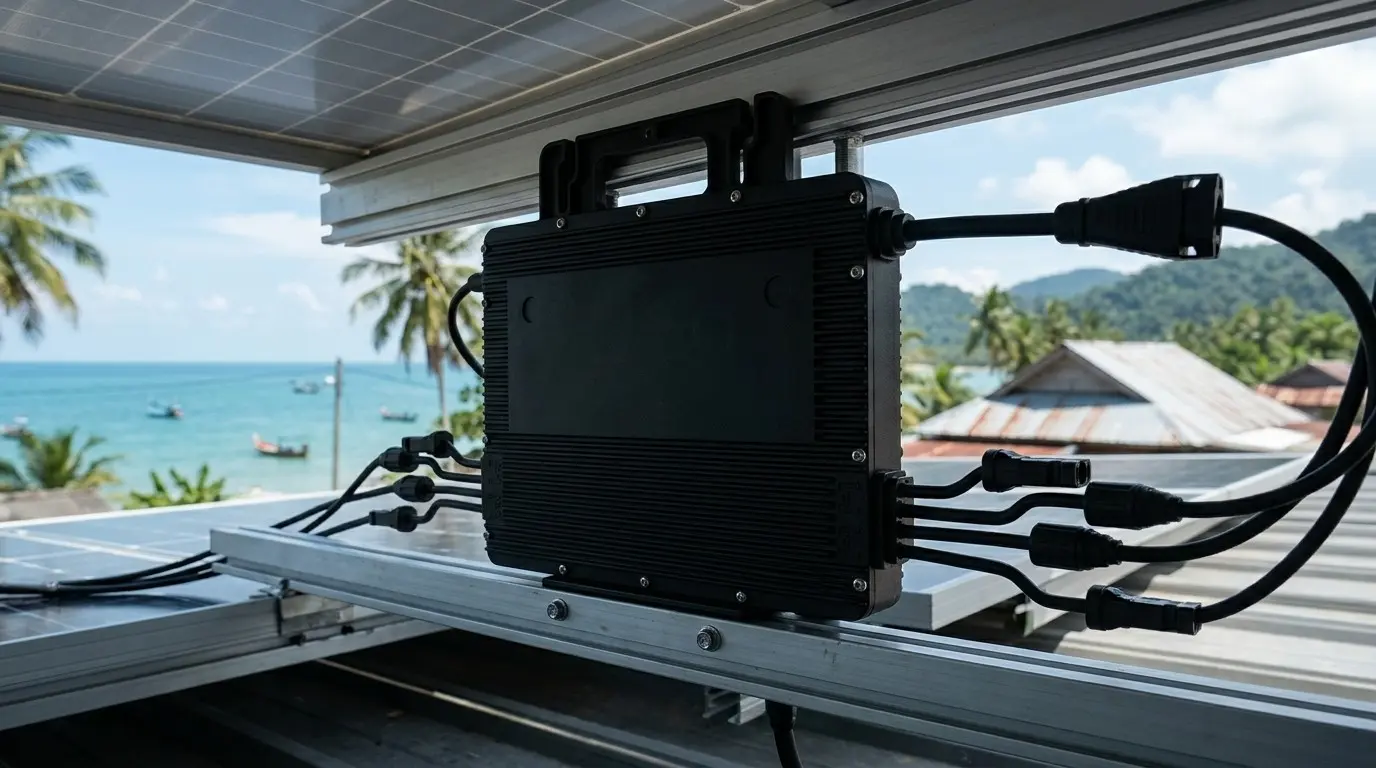
Microinverters in Malaysia: When Do Hoymiles and Envertech Earn Their Premium?
Published by Quinn Lai | By InverPower Technical Team
Published 22 August 2026 · Last updated 22 August 2026
DIRECT ANSWER
A microinverter converts at the module, so each panel runs at its own optimum and there is no high-voltage DC string on the roof. That premium is worth paying where shading, mixed orientations or module-level monitoring matter. On a clean, uniform roof, a string inverter does the same job for less.
Microinverters get sold on a feature list and bought on a roof. The feature list is the same everywhere; the roof is what decides whether any of it is worth money. InverPower supplies Hoymiles and Envertech units in Malaysia, and the conversation that leads to the right answer is about the building rather than the brand.
Converting at the module
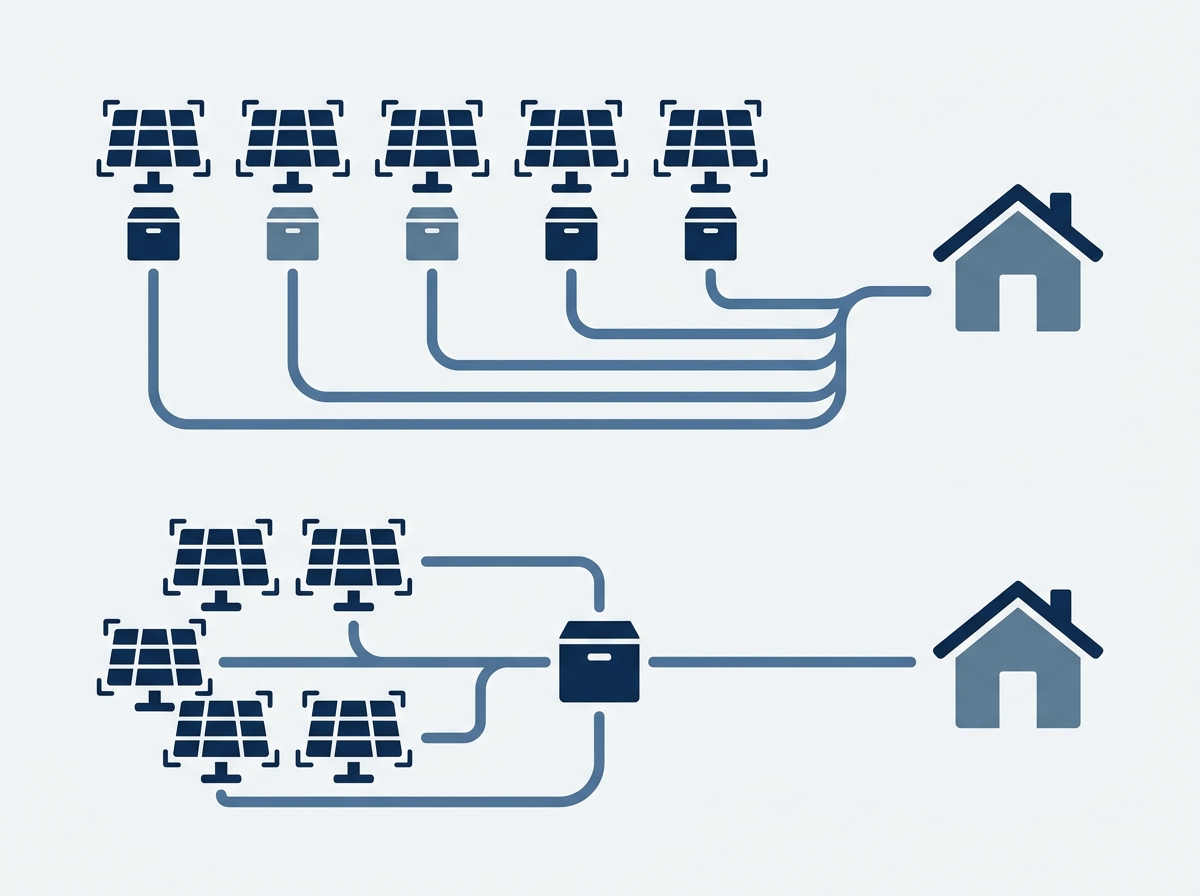
In a string system, modules are wired in series and the whole string is converted at one inverter, which tracks a single operating point for all of them. In a microinverter system each module has its own converter, so each is operated at its own maximum power point and its output leaves as alternating current.
Two consequences follow. Mismatch stops propagating: a shaded, soiled or degraded module costs its own output and nothing else. And the roof carries AC rather than a high-voltage DC string, which removes a category of risk from the array and simplifies what happens during maintenance.
The roofs where this pays
Shading is the first and clearest case. A Malaysian terrace or bungalow roof with a neighbouring building, a water tank, a tree, or its own gable casting shade for part of the day loses far more from a string system than the shaded area suggests. Per-module conversion contains that loss.
Mixed orientation is the second. Roofs here are rarely one clean plane, and a system that puts east-facing and west-facing modules on the same string operates both badly. Microinverters make orientation a non-issue, which also means small awkward faces become usable rather than being left off the design.
The third is monitoring. Per-module data turns a service call into a diagnosis before anyone leaves the office, which matters most where the customer is a homeowner rather than a facilities team, and where the roof is not easy to walk.
Hoymiles and Envertech, and what differs
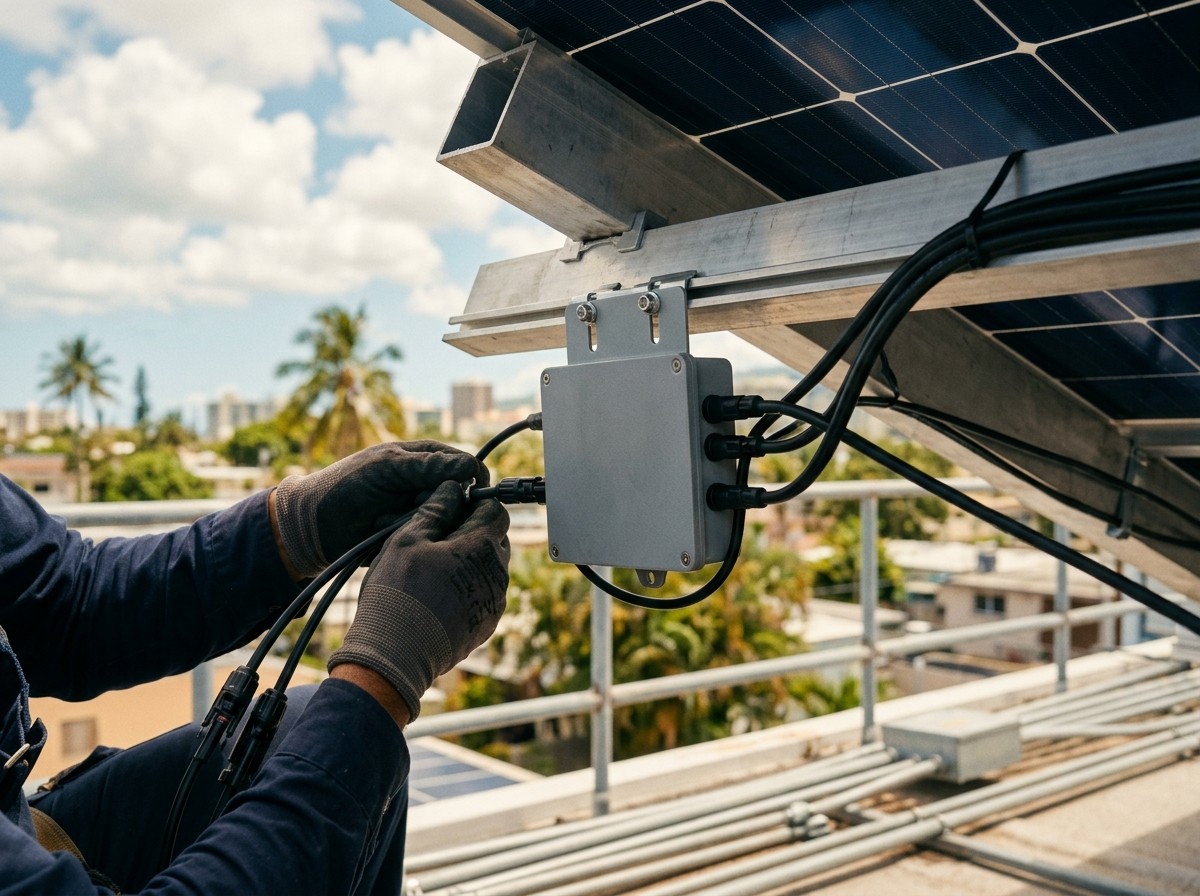
Both are established microinverter manufacturers with product ranges spanning single-module and multi-module units — one converter serving two or four modules is common, and it changes the arithmetic on cost per watt without giving up per-module tracking. Both provide a gateway or data unit that collects from the microinverters and reports to a monitoring platform.
The practical differences to check for a given project are the module compatibility window, the number of modules per unit in the range you are specifying, how the units communicate with their gateway, and what the monitoring platform gives the customer and the installer. Take those from the current datasheets for the specific models rather than from the brand, because both ranges move.
Two things are worth confirming for any model before it goes on a quotation. The unit's input window has to suit the module actually being supplied, since module currents have climbed steadily and an older microinverter can be clipped by a current-generation panel. And the model has to be on the SEDA register, which is what makes the installation eligible rather than merely functional.
The installation, side by side
| String system | Microinverter system | |
|---|---|---|
| On the roof | DC strings at high voltage | AC trunk cable |
| DC isolation | Isolators at array and inverter | DC confined to module leads |
| Units to mount | One or a few | One per module or per pair |
| AC side | One connection per inverter | Trunk cable to a distribution point |
| Monitoring | String level | Module level |
| A single failure | Part of the array offline | One module offline |
| Servicing | Reach the inverter | Lift the module to reach the unit |
The roofs that do not need them
A large, uniform, unshaded C&I roof does not need per-module conversion, and paying for it there is paying to solve a problem the roof does not have. String inverters cost less per watt, there are fewer devices to commission and warrant, and the monitoring granularity is sufficient when every string behaves the same way.
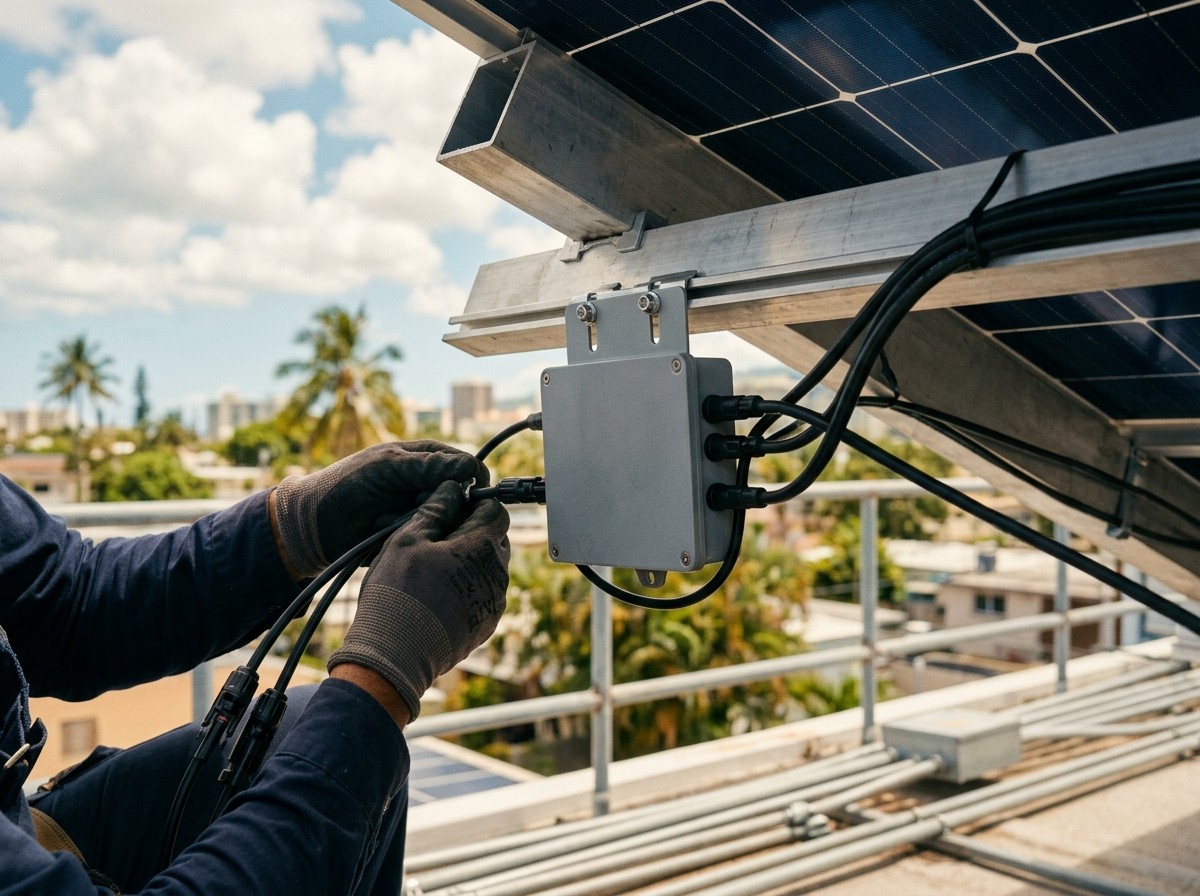
Accessibility is the other consideration. Microinverters are reliable, but reaching one means lifting a module, so a roof that is difficult or expensive to access changes the arithmetic on any future service visit. That is an argument for accurate monitoring and good records, not against the technology, but it belongs in the decision.
Unit count also lands on the paperwork. Every microinverter is a device with a serial number, a warranty and a place on the as-built drawing, and a fifty-module roof means fifty of them. That is manageable when the records are produced as the job goes in, and unpleasant when someone tries to reconstruct them afterwards from a monitoring screen.
Specifying and ordering
Check three things before ordering: the module's electrical characteristics against the microinverter's input window, the number of units and the AC trunk arrangement against the distribution board they will land on, and that the model is on the SEDA register for the installation to be eligible. InverPower holds Hoymiles and Envertech units in Malaysia alongside modules, mounting and cable — send the roof layout and the module datasheet and we will tell you what pairs and what is in stock.
Frequently Asked Questions
Are microinverters worth the extra cost?
On a shaded roof, a roof with several orientations, or where module-level monitoring genuinely matters, yes — the recovered output and the diagnostic value pay for the premium. On a large uniform unshaded roof they usually are not, and a string inverter gives the same energy for less.
Do microinverters need special monitoring hardware?
They need a gateway or data unit that collects from the microinverters and passes the data to the manufacturer's platform. It is a small, specified part of the bill of materials rather than an optional accessory, and it should be included in the quotation from the start.
Can microinverters be mixed with a string system on one building?
Yes — string inverters on the clean part of a roof and microinverters on the shaded or awkward section is a reasonable design. It means two monitoring platforms and two sets of spares, so it should be a deliberate choice rather than an accident.
Is there still DC on the roof with microinverters?
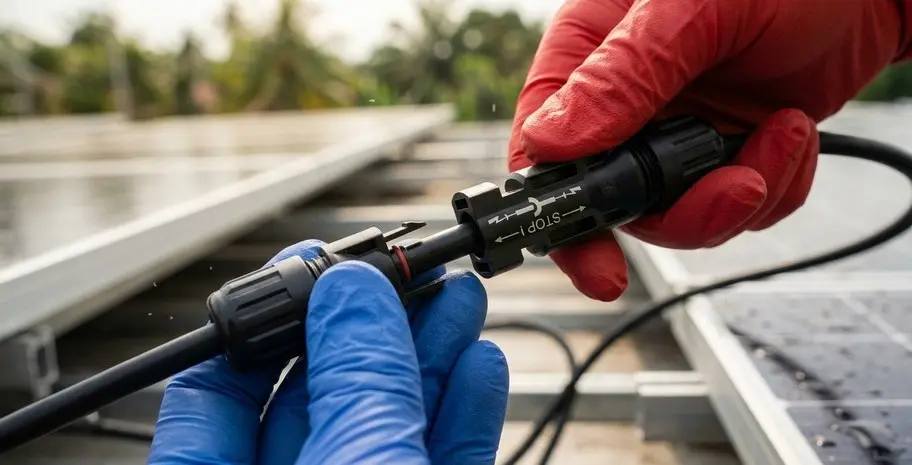
Only between the module and its microinverter, a lead or two long, at module voltage rather than string voltage. There is no high-voltage DC string running across the roof, which is one of the main safety arguments for the architecture.
Sources
- Hoymiles — microinverter datasheets, gateway documentation and monitoring platform information — https://www.hoymiles.com
- Envertech — microinverter datasheets and monitoring documentation — https://www.envertec.com
- IEC — IEC 62109-1 and IEC 62109-2, Safety of power converters for use in photovoltaic power systems — https://webstore.iec.ch
- IEC — IEC 62116, Utility-interconnected photovoltaic inverters: test procedure of islanding prevention measures — https://webstore.iec.ch
- SEDA Malaysia — register of approved solar PV inverters — https://www.seda.gov.my
About InverPower
InverPower is Malaysia's A–Z solar component distributor — Sungrow Preferred Distributor and Sunkean Sole Distributor — supplying EPCCs, installers, and government projects nationwide.
Explore the InverPower resource hub at inverpower.com.my
Related InverPower posts:
- String Inverters vs MLPE: How to Decide for Malaysian C&I?
- Which Solar Inverters Are SEDA-Registered in Malaysia (2026)?
- Where Do EPCCs Source Solar PV Components in Malaysia?