
Solar for Data Centres: What Can a Rooftop Actually Contribute?
Published by Quinn Lai | By InverPower Technical Team
Published 22 August 2026 · Last updated 22 August 2026
DIRECT ANSWER
A small share of the load, and that is still worth doing. A data centre draws its full demand around the clock at a density no roof can match, so on-site solar is a partial daytime offset. The volume comes from grid-level green procurement — CRESS and, for those who secured it, CGPP — with the rooftop as the visible, on-site part of the mix.
Data centres are the largest new source of electricity demand in Malaysia, and the ones being built now arrive with corporate renewable commitments attached. That combination puts EPCCs in front of clients who want solar quoted, understand that it will not cover the load, and want it anyway — which is a different conversation from a factory looking to cut its bill.
The load is the whole problem
A data centre's demand is flat and continuous. Servers draw what they draw at three in the morning as much as at noon, and the cooling that keeps them running scales with the heat they produce rather than with the working day. There is no evening drop-off and no weekend, so the load profile is a horizontal line across a chart where most C&I sites show a hump.
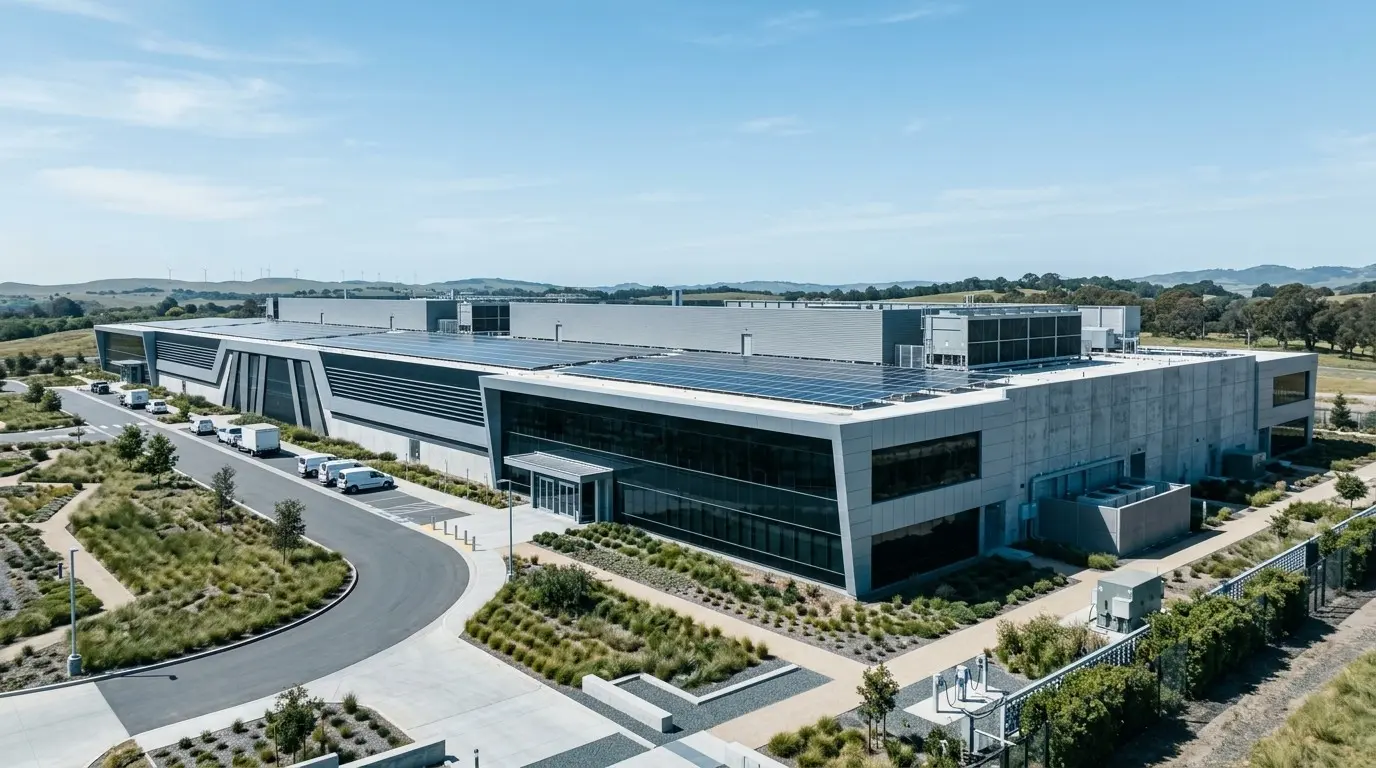
Then there is density. The power drawn per square metre of a data hall is far beyond anything a roof of the same footprint can generate, and much of the roof is taken by cooling plant in any case. Even a fully covered roof on a large facility offsets a modest fraction of the site's consumption, and it does so only in daylight.

Where does the volume actually come from?
Malaysia has built the mechanisms for this, and they operate at grid scale rather than on a roof. The Corporate Renewable Energy Supply Scheme, launched in September 2024, lets a corporate contract directly with a renewable developer and take delivery over the grid, paying a system access charge to the network operator. Eleven developers were registered under it as of May 2026, and it is the route the large data-centre supply agreements have used.
Before it, the Corporate Green Power Programme offered a virtual power purchase arrangement: the developer builds and exports to the grid, the corporate takes the attributes rather than the electrons. Its 800 MW quota was fully subscribed in November 2023, so it is a scheme being delivered rather than one still open — but projects under it are still being built, and clients who hold an allocation still refer to it.
Alongside those sit the large-scale solar tenders, most recently LSS6 with 2,500 MW brought to market in July 2026, which is where much of the generation those contracts rely on will physically come from.
So why quote the roof at all?
Four reasons that hold up in front of a technical buyer. It is generation the operator owns and controls rather than contracts for. It is visible — to customers touring the facility, to auditors, and in reporting that distinguishes on-site generation from purchased attributes. It shaves the daytime peak that the demand charge is set on, which under RP4 is a substantial line on a medium voltage bill. And it is the part of the commitment that can be delivered on the operator's own timeline rather than a developer's.
None of that requires overstating the contribution. Quote the offset honestly as a percentage of annual consumption, and the client will respect the number more than a rounded-up one.
Quoting one, against a normal C&I roof
| Aspect | Typical C&I roof | Data centre |
|---|---|---|
| Load shape | Daytime-weighted | Flat, around the clock |
| Realistic offset | A meaningful share of consumption | A small share of consumption |
| Roof availability | Mostly clear | Heavily occupied by cooling plant |
| Connection voltage | Low voltage, often | Medium or high voltage |
| Access and security | Straightforward | Vetting, escorts, restricted areas |
| Work near live plant | Manageable | No interruption is acceptable |
| Documentation demanded | Standard handover pack | Fuller, with traceability and certification |
| Decision driver | Bill reduction | Reporting, resilience and commitment |
Practicalities on site
Assume the roof is busier than the drawing suggests. Chillers, dry coolers, generator exhausts and cable routes all occupy space and cast shade, and the shading study matters more here than on a bare warehouse roof. Structural capacity is often good, because the buildings are new and engineered — but the plant loading is already committed, so the assessment is a real one rather than a formality.
Then the operational constraints, which drive programme and price more than the technical design does. Access control and vetting for every person on site. Escorted work near live infrastructure. Interruption windows measured in minutes and agreed weeks ahead, or not available at all. And a client whose engineering team will review the specification properly, which is an argument for quoting equipment that stands up to that review.
Storage sits alongside it
Data centre operators already own uninterruptible supply and standby generation, so they understand storage better than most clients. Where storage is being considered for grid services or peak management rather than backup, it is a separate design with its own interconnection requirements — and it is a conversation worth having at the same time, because both use the same connection point and the same headroom.
InverPower supplies Sungrow C&I inverters and storage, Trinasolar modules, and the mounting, protection and cable that go with them, held in Malaysia with the certification and documentation a client of this kind will ask for. Send the roof plan and the connection details and we will tell you what fits and what is in stock.
Frequently Asked Questions
Can rooftop solar meaningfully offset a data centre's load?
Not in the sense of covering it. The demand is continuous and far denser than a roof can generate against, so an array offsets a small share of annual consumption. It is still worth doing for the demand-charge reduction, the owned generation and the reporting — but the number should be quoted honestly.
Do data centre operators prefer grid-level procurement to on-site solar?
They use both, for different purposes. Grid-level schemes like CRESS deliver the volume; on-site solar delivers generation the operator owns and can point at. The two are complementary rather than alternatives, and most large operators are pursuing both.
Is CGPP still open?
The 800 MW quota was fully subscribed in November 2023, so it is not a route for a new allocation. Projects under it are still being delivered, and clients holding an allocation still work within it. New corporate procurement is going through CRESS.
What makes a data centre installation harder than a factory roof?
Access, not engineering. Vetting, escorts, restricted areas, and interruption windows that are short or unavailable all shape the programme. Add plant congestion on the roof and a client engineering team that will scrutinise the specification, and the same array takes longer and costs more to install.
Sources
- Suruhanjaya Tenaga — Corporate Renewable Energy Supply Scheme (CRESS) guidelines and registered developers — https://www.st.gov.my
- Suruhanjaya Tenaga — Corporate Green Power Programme, including the 800 MW quota and programme guide — https://www.st.gov.my/sustainability/energy-transition-programmes/corporate-green-power-programme
- PETRA — Large Scale Solar (LSS6) tender, 2,500 MW, announced July 2026 — https://www.petra.gov.my
- TNB — Maximum Demand definition and measurement, and RP4 tariff structure — https://www.tnb.com.my/commercial-industrial/maximum-demand
- Department of Standards Malaysia — MS 1837:2018, Installation of grid-connected photovoltaic (PV) system — https://www.jsm.gov.my
About InverPower
InverPower is Malaysia's A–Z solar component distributor — Sungrow Preferred Distributor and Sunkean Sole Distributor — supplying EPCCs, installers, and government projects nationwide.
Explore the InverPower resource hub at inverpower.com.my
Related InverPower posts:
- TNB Grid Code for Solar: What Must EPCCs Do Before Energization?
- Busbar and Switchgear Sizing: Will the Existing Board Take the Solar?
- Sungrow SG125CX-P2 vs SG110CX: Which Fits Your C&I Rooftop?