
Bifacial or Monofacial: Where Does the Rear-Side Gain Actually Show Up?
Published by Quinn Lai | By InverPower Technical Team
Published 22 August 2026 · Last updated 22 August 2026
DIRECT ANSWER
A bifacial module generates from light reaching its rear face, so the gain depends entirely on what is under the array and how far above it the modules sit. On an elevated ground mount over pale ground the gain is real and worth designing for. On a rooftop retrofit sitting close to a dark surface it is close to nothing.
Bifacial has stopped being a premium option and become what most n-type modules are. That makes the question less about whether to buy one and more about whether the site will ever pay you back for the rear face — because the module will happily be installed somewhere it cannot use it.
Where does the extra energy come from?
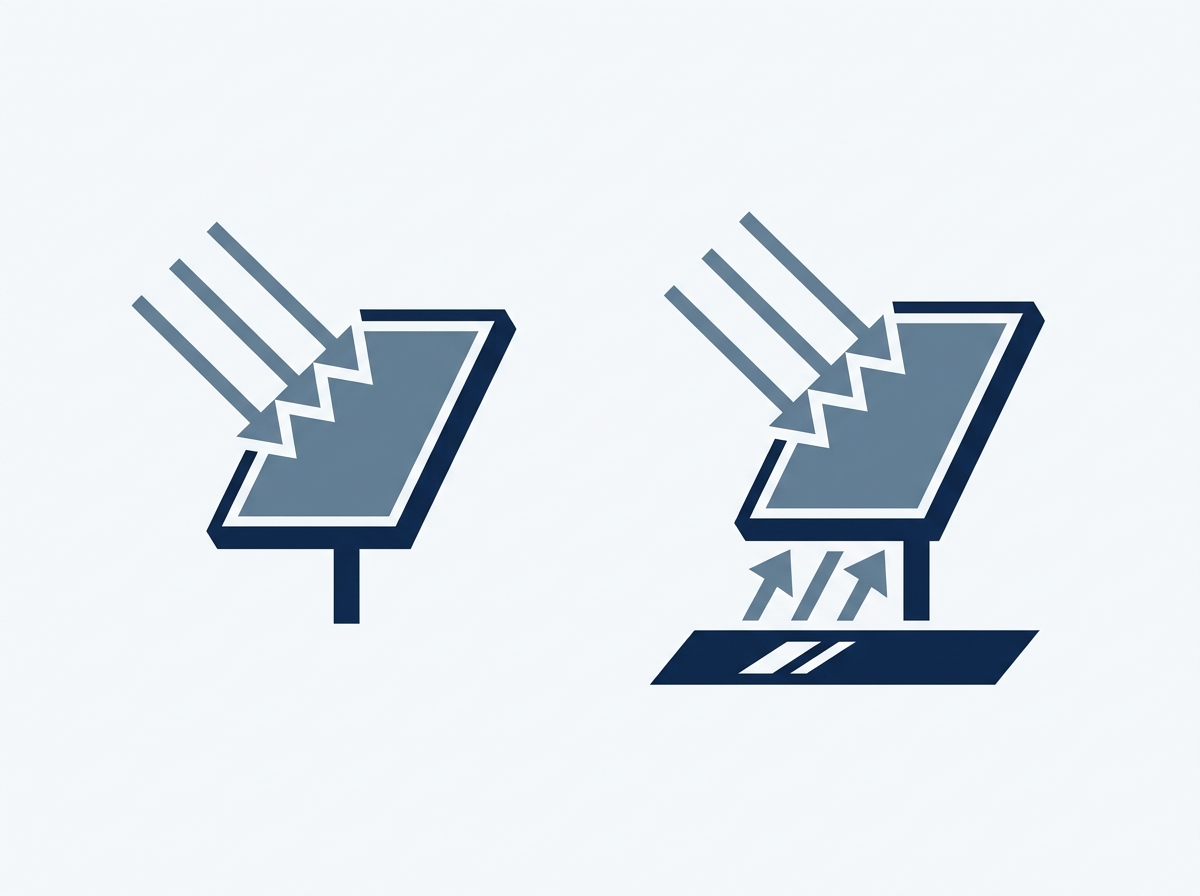
A bifacial cell is built to collect from both surfaces, and the module is made with a transparent rear — glass or a clear backsheet — so light can reach it. That light is whatever bounces off the ground, plus a share of the diffuse sky the rear face can see. Two datasheet numbers describe the capability: the bifaciality factor, which is how efficient the rear face is relative to the front, and the rated output under a stated rear irradiance.
Neither of those numbers is a yield. They describe what the module can do given rear light. Whether it gets any is a question about the installation, not the module.
It is worth being precise about the rating too. A bifacial module carries a front-side rating measured the conventional way and a second figure measured with a stated rear irradiance, and the two are not interchangeable in a yield model or on a string sizing calculation. String voltage and current are set by what the module actually produces on the site, which is why the front-side numbers still drive the electrical design.
Albedo, clearance and structure
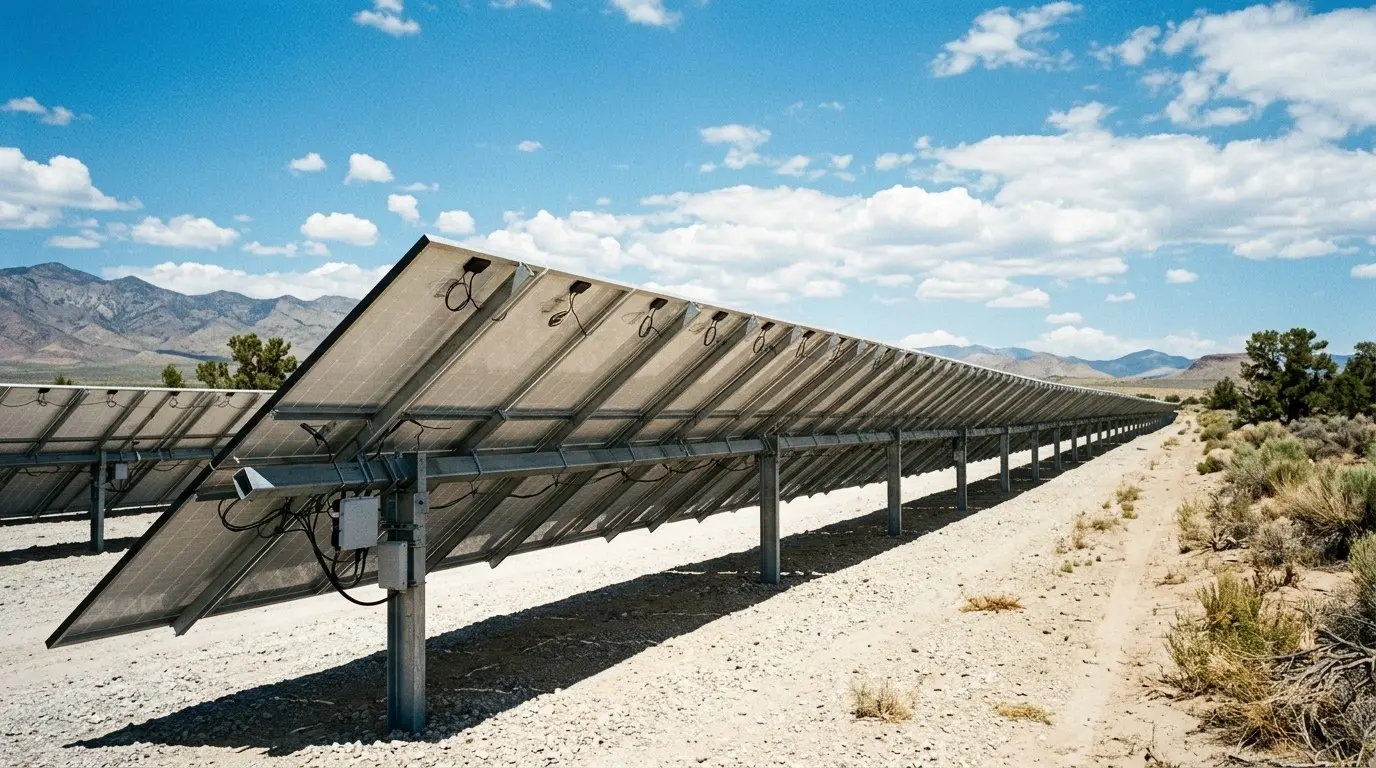
Albedo first. A pale gravel or light aggregate surface reflects several times what dark asphalt or wet soil does, and the difference goes straight through to the rear face. Grass sits somewhere in between, and in Malaysia grass does not stay short by itself — an albedo assumption made at design and never maintained is an assumption that decays through the wet season.
Then clearance and geometry. The higher the module sits above the ground, the more reflected light reaches its rear and the less the structure shades it. Row spacing matters for the same reason. And the mounting itself is part of the problem: torque tubes, wide rails, cable trays and combiner boxes mounted behind the modules all block rear light and create non-uniform illumination, which costs more than the shaded area alone.

The sites that pay it back
| Site type | Realistic rear-side gain | Why |
|---|---|---|
| Elevated ground mount, pale ground | Best case | High clearance, high albedo, open rear |
| Ground mount over grass | Moderate, and it varies | Albedo falls as vegetation grows |
| Tracker installation | Good | Height and movement both help rear illumination |
| Flat roof, ballasted, low clearance | Small | Little space between module and roof surface |
| Flat roof, white membrane, raised frame | Modest but real | High-albedo surface, if clearance allows |
| Pitched roof, flush mounted | Effectively none | Rear face sees the roof covering |
| Floating solar | Small | Water is a poor reflector at most angles |

The Malaysian complications
Two of them, pulling in opposite directions. A large share of Malaysian irradiance is diffuse rather than direct, because of cloud and humidity, and diffuse light is less directional — some of it reaches the rear face regardless of ground reflectance, which flattens the difference between a good and a poor albedo. And vegetation grows fast, so a site designed around a specific ground surface needs that surface maintained if the yield model is going to hold.
There is a second, quieter benefit that has nothing to do with the rear face. Most bifacial modules are glass-glass, and glass is a far better moisture barrier than a polymer backsheet. In a climate that spends its life above eighty per cent relative humidity, that construction is worth something on its own, and it is part of why the market moved.
Soiling cuts both ways as well. A rear face collects dust from below, and on a ground mount that dust arrives from the access tracks every time a vehicle passes. Cleaning schedules written for the front glass alone will not hold the modelled gain on a site where the rear is doing real work.
Putting it in a proposal
Model the rear-side gain rather than quoting it. Yield software handles bifacial with an albedo input, a clearance and a structural shading factor, and the honest version of the exercise is to run the model with the ground surface the site will actually have — not the one in the manufacturer's brochure photograph. Then state the assumption in the proposal, because it is the customer's grounds maintenance that keeps it true.
Where the gain is negligible — a flush pitched roof, a low ballasted array on a dark membrane — a bifacial module is not wrong, it is simply being bought for its front face and its construction. That is a defensible reason to buy one. Presenting the rear-side rating as though it were yield on that roof is not.
Sourcing
InverPower distributes Trinasolar modules in Malaysia, bifacial and monofacial, and holds stock locally with the datasheets and certification behind them. Send the site type, the ground surface and the mounting arrangement, and we will tell you which construction fits and what is on the shelf.
Frequently Asked Questions
Does bifacial make sense on a rooftop retrofit?
For rear-side gain, rarely. A flush-mounted array on a pitched roof sees the roof covering, and a low ballasted array on a dark membrane sees very little reflected light. Bifacial modules may still be the right buy for their glass-glass construction and durability, but the yield case should not rest on the rear face.
What ground surface maximises bifacial gain?
Pale, dry and uniform. Light gravel and pale aggregate reflect well; dark asphalt, wet soil and dense vegetation do not. On a roof, a white membrane is the equivalent. Whatever the surface, it has to stay that way — albedo assumptions fail through maintenance, not through physics.
How high do the modules need to be?
Higher is better, because clearance controls both how much reflected light reaches the rear and how much of it the structure blocks. There is no single threshold; it is a modelling input alongside row spacing and albedo, and it is the reason ground mounts and trackers gain more than ballasted roof arrays.
Do bifacial modules need different mounting?
Often, yes. Clamps and rails that shade the rear face cost output, and the structure behind the module becomes a design consideration rather than just a support. Mounting systems intended for bifacial use keep the rear as clear as the loads allow.
Sources
- IEC — IEC TS 60904-1-2, Photovoltaic devices: measurement of current-voltage characteristics of bifacial photovoltaic devices — https://webstore.iec.ch
- IEC — IEC 61215 series, Terrestrial photovoltaic modules: design qualification and type approval — https://webstore.iec.ch
- IEC — IEC 61730-1 and IEC 61730-2, Photovoltaic module safety qualification — https://webstore.iec.ch
- Trinasolar — bifacial module datasheets, including bifaciality factor and rear-irradiance ratings — https://www.trinasolar.com
- Department of Standards Malaysia — MS 1837:2018, Installation of grid-connected photovoltaic (PV) system — https://www.jsm.gov.my
About InverPower
InverPower is Malaysia's A–Z solar component distributor — Sungrow Preferred Distributor and Sunkean Sole Distributor — supplying EPCCs, installers, and government projects nationwide.
Explore the InverPower resource hub at inverpower.com.my
Related InverPower posts:
- PERC, TOPCon or HJT: Which Cell Technology Suits Malaysian Heat?
- Why Do Solar Panels Lose Power in Malaysia's Heat?
- Where Do EPCCs Source Solar PV Components in Malaysia?